

On this page
By the time a child turns 10, the mechanics of reading are usually firmly in place, but their motivation often drops. The Scholastic Kids & Family Reading Report calls this the "Decline by Nine". According to their data, the number of children who read for fun five to seven days a week falls from 46% at ages 6–8 to just 32% at ages 9–11. This drop rarely rebounds during the teenage years, turning many potential lifelong readers into reluctant ones.
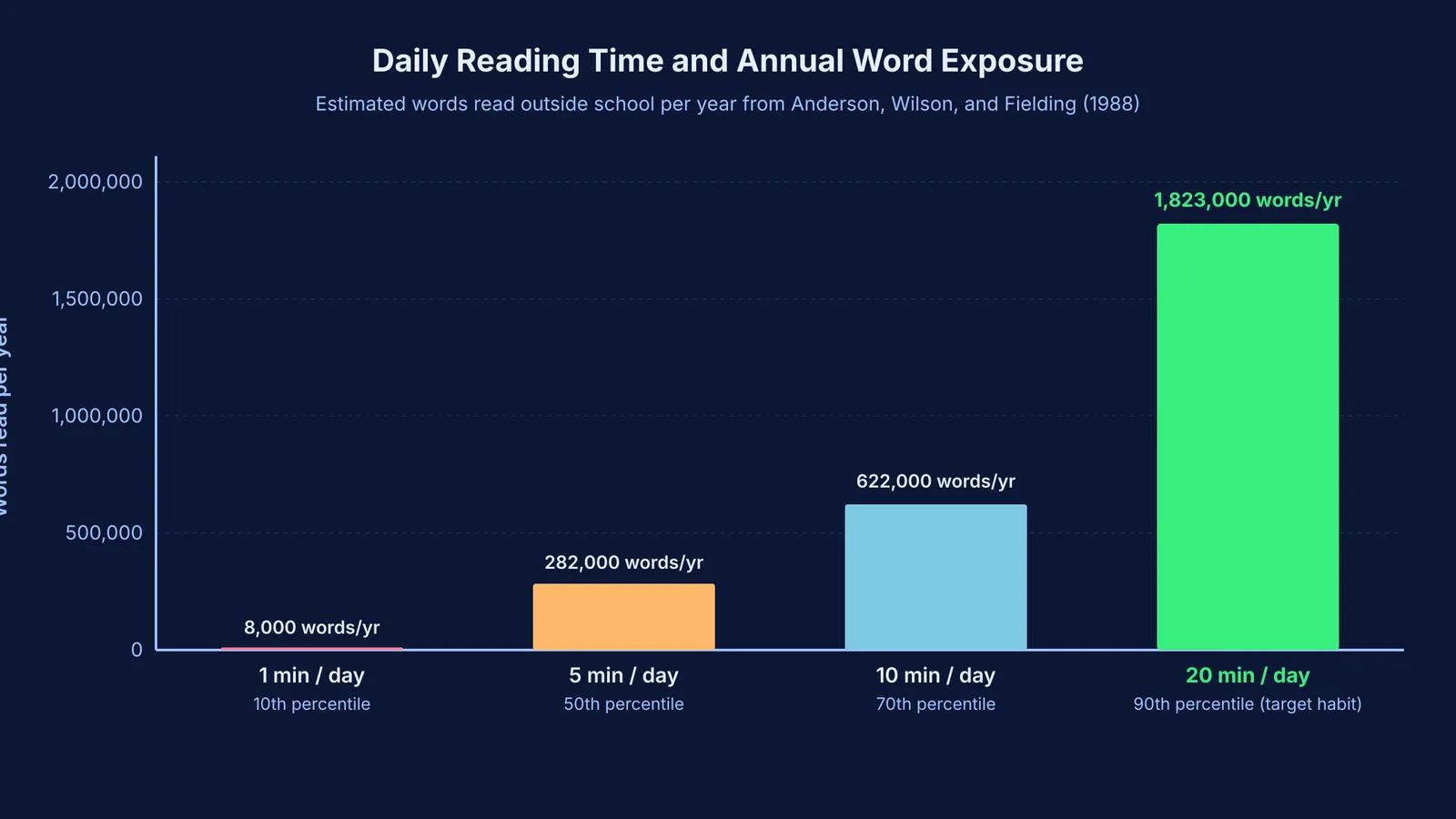
Yet, keeping that daily habit alive is one of the most powerful things a parent can do for their child's academic future. The OECD's PISA Reading for Change report found that reading for pleasure is a stronger predictor of a child's educational success than their family's socio-economic status. Furthermore, foundational research by Richard C. Anderson, Paul T. Wilson, and Linda G. Fielding in Reading Research Quarterly showed that reading for 20 minutes a day exposes a child to roughly 1.8 million words per year, placing them in the 90th percentile of reading achievement.
If you want to build a lasting reading habit in your 10-year-old, you need a routine that makes reading feel like a reward rather than a chore. Here is a practical, three-step plan to help them rediscover the joy of a good book.
What books should a 10-year-old read?
The biggest barrier to reading at age 10 is that school reading becomes increasingly compulsory, analytical, and structured around exams. To build a habit at home, children must have full control over what they read. The Scholastic report notes that 89% of kids say their favourite books are the ones they picked out themselves.
Comics and graphic novels count. Many parents dismiss graphic novels, but the goal is time spent on the page, decoding words, and following a complex narrative. Graphic novels are excellent for building visual literacy and keeping reluctant readers engaged.
Non-fiction is just as valuable. Biographies, encyclopaedias, historical accounts, and science books often appeal to children who simply do not enjoy made-up stories.
Stop books they do not like. If a book is boring after a couple of chapters, encourage them to put it down and try another. Reading for pleasure should never feel like finishing an exam syllabus.
If their reading sparks questions about how the natural world works, the Fermi Concept Library covers concepts across science and mathematics, where Fermi's AI tutor works out what a student already knows and builds a plan for the session.
How long should a 10-year-old read each day?
Consistency matters far more than volume. As documented in Reading Research Quarterly, a reliable, daily 20-minute reading slot exposes a child to over 1.8 million words annually, building the neural pathways and vocabulary necessary for sustained attention in later academic challenges.
Anchor it to an existing habit. Behavioural science shows that habits stick best when attached to something you already do. "Read for 20 minutes right after brushing your teeth" works much better than "make sure you read sometime today."
Make it device-free. Remove phones, tablets, and television screens from the room during this 20-minute window. A book cannot compete with the instant dopamine hits of digital media, so you have to remove the competition.
Read alongside them. Children constantly model adult behaviour. If you spend those 20 minutes reading a book yourself, they will understand that reading is a normal, lifelong habit rather than just homework disguised as fun.
What should you ask a child about their book?
How you discuss a book can either encourage more reading or turn the experience into an interrogation. Avoid asking quiz-like questions that test their memory, such as "What was the main character's name?" or "What year did that happen?" Instead, ask open-ended questions that show genuine interest in their opinion.
Try asking:
"What was the funniest or weirdest part of that chapter?"
"Would you want to be friends with the main character? Why or why not?"
"Did anything in the story surprise you?"
This supportive approach aligns with the research on praising effort over ability. When you focus on their engagement and enjoyment rather than their reading speed or accuracy, you reinforce the habit itself. This insight is essential for parents learning how to help children learn without adding pressure: your role is to be a curious, supportive guide rather than an examiner grading performance. The same principle applies when helping with maths word problems at home.
What should you do when a 10-year-old refuses to read?
Even with a well-structured plan, 10-year-olds will sometimes push back. When this happens, it is important to keep the pressure low but the boundary firm.
The shared reading strategy: "I know you're tired tonight. Let's read the first page together, and then you can read the rest on your own."
The choice strategy: "You don't have to read this novel. You can read your graphic novel, or that magazine about space. Which one do you want?"
The audiobook alternative: "Let's put an audiobook on while you draw." Audiobooks still build vocabulary, listening skills, and narrative comprehension, making them a valid substitute on difficult days.
Building a reading habit at age 10 requires patience, but the long-term rewards—from academic success to emotional well-being—are undeniable. By offering genuine choice, protecting a daily 20-minute time slot, and staying positively engaged with what they read, you can help your child navigate past the "Decline by Nine."


