

On this page
Many Class 6 children, asked to make notes, open the textbook and copy it line by line into a fresh notebook. The page looks neat, but copying is close to rereading with a pen in hand, and the child often cannot tell you what they wrote once the book is shut.
The fix is a different kind of note: short, made with the book closed, and ending with questions your child answers later. Here is how to teach it, with a worked Class 6 example.
Why does copying from the textbook not help much?
A 2013 review of 10 common study techniques by Dunlosky and colleagues in Psychological Science in the Public Interest rated rereading, highlighting and summarising as low utility, and practice testing and spaced practice as high utility. The authors note that most students report rereading and highlighting, yet these do not consistently improve performance.
Testing yourself has stronger evidence. In Roediger and Karpicke's 2006 experiments, students who recalled a passage from memory remembered more of it two days and one week later than students who simply studied it again, even though restudying made students feel more confident.
So a good note page does two jobs: making it forces your child to pick out what matters, and using it later gives them something to test themselves on.
What should a good note page have?
One page per textbook section, with four parts:
Heading: the section's idea in your child's own words, not the book's title copied out.
Key words: three to five terms or short phrases, no full sentences from the book.
One diagram: drawn from memory first, then checked against the book and corrected in a different colour.
Self-quiz box: two or three questions at the bottom, with answers written on the back of the page.
How do I teach my child to make notes, step by step?
Read one section of the chapter together, out loud, book open, pencil down.
Close the book. Ask, "What was that part about?" Their answer becomes the heading.
Ask for the words they would need to explain it to a friend. Write down three to five.
Draw the one picture that explains the section, from memory. Then open the book, compare, and fix it.
Write two or three questions in a box at the bottom. Answers go on the back.
The next day, before any new reading, cover the page and answer the box.
In week one, do every step together. In week two, your child makes the page and you only ask the questions in steps 2 and 3. From week three, your only job is step 6.
What does this look like for a Class 6 chapter?
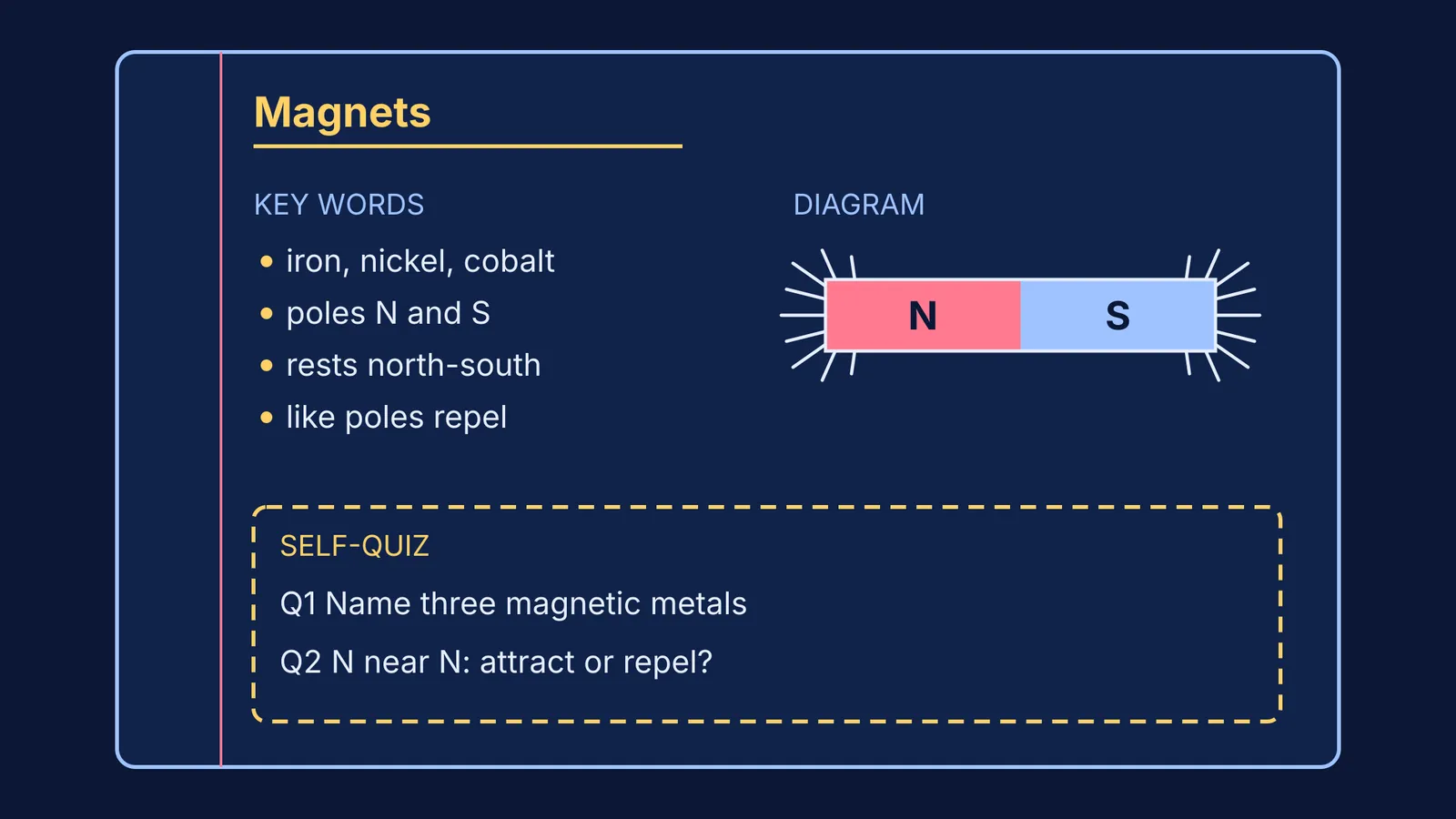
Take Chapter 4, "Exploring Magnets", in the NCERT Class 6 science textbook Curiosity. A copied note for section 4.1 usually reads: "The materials which are attracted towards a magnet are called magnetic materials. The metal iron is a magnetic material. Nickel and cobalt are other metals that are also magnetic." That is the book's wording, moved to a notebook. Here is the chapter as one note page, built from sections 4.1 to 4.4:
Heading: Magnets: what sticks to them and which way they point
Key words: magnetic materials (iron, nickel, cobalt); two poles, N and S, always in pairs; a freely hanging magnet rests north-south, which is how a compass works; unlike poles attract, like poles repel
Diagram: a bar magnet with iron filings bunched at the two ends, labelled N and S, like the chapter's Fig. 4.4
Self-quiz box: Name three magnetic metals. If you break a magnet in two, does each piece still have two poles? How can you tell a magnet from a plain iron bar?
The chapter gives two answers to the last question. Hung freely, a magnet always rests north-south and an iron bar does not; and both ends of an iron bar are attracted to a magnet, but only a magnet can push another magnet away. If your child explains either from memory the next day, the notes worked.
If a question keeps stumping them, the gap is usually the idea, not the notes. The Fermi Concept Library has a lesson on every concept in physics, chemistry, biology, mathematics and computing, so your child can go back to the idea before rewriting the page.
What should parents say, and not say?
Try these lines:
"Tell me this section without looking. I'll write while you talk."
"If you could keep only one word from this page, which one?"
"Cover it up. Quiz yourself from the box, then tick what you got."
Avoid "Your notes are too short" and rewriting their page neatly yourself. Short is the goal.
For the classroom side of this habit, read why your child does not write notes in class. If new subjects feel heavy, see these weekly habits for when Class 6 science and SST feel hard, and use this ten-minute notebook check to look for self-quiz boxes, not neat handwriting. Start this week with one section of one subject.


