

On this page
In Class 5, learning is narrative and familiar. Under India's National Curriculum Framework for School Education (NCF-SE) 2023, primary students study Environmental Studies (EVS), which weaves living creatures, community life, and earth science into a single conversational storyline. In Class 6, schools transition children into the Middle Stage. Overnight, EVS splits into separate subjects with thicker textbooks: *Curiosity* for Science and *Exploring Society: India and Beyond* for Social Science. If your 11-year-old suddenly resists homework or feels lost, they are facing a structural curricular shift, not an academic failure.
Why do Class 6 science and social studies suddenly feel so hard?
The shock of Class 6 stems from a sudden surge in academic vocabulary. In primary school, reading relies on everyday spoken words. In Class 6, expository textbooks introduce specialized terms—such as *sedimentation*, *transpiration*, *latitudes*, and *panchayat*—at a rapid pace.
When too many unfamiliar words appear on one page, reading comprehension breaks down. In a meta-analysis evaluating vocabulary interventions across school-age readers, Elleman et al. (2009) found that direct vocabulary instruction produced large comprehension gains, with struggling readers benefiting more than three times as much (an effect size of d = 1.23) compared to peers without reading difficulties (d = 0.39). In Class 6, children must decode multi-syllable terms while simultaneously grasping abstract concepts, triggering cognitive overload.
Assessments also shift. While primary exams rely on fill-in-the-blanks, middle school tests require multi-point explanations, making rote memorization unsustainable across 12 Science and 14 Social Science chapters.
How can a weekly keyword bank decode dense chapters?
Rather than having your child struggle through a 15-page chapter on a school night, introduce a 10-minute preview habit on Sundays. Before reading the text, have them scan solely for bold subheadings, diagram labels, and key terms.
A physical keyword bank turns abstract jargon into familiar landmarks. A small index card or dedicated notebook entry works best:
Front: The technical term (such as *Decantation* in Science or *Equator* in Social Science).
Back: A one-sentence definition in their own words, paired with a quick sketch or diagram.
Drawing on dual coding notes with words and diagrams strengthens memory traces. Recognizing words in advance lets children read with confidence, while learning how to read a science textbook actively turns headings into questions to investigate rather than text to memorize.
For students encountering unfamiliar terms across biology, physics, and chemistry, the Fermi Concept Library maps every concept with its own lesson and clear definitions, helping learners connect new vocabulary to what they already know.
What does a realistic weekly study routine look like?
When marks dip, parents often add study hours. Yet in a research synthesis on homework, Cooper et al. (2006) found that middle school achievement benefits level off after 60 to 90 minutes daily. Rereading produces diminishing returns.
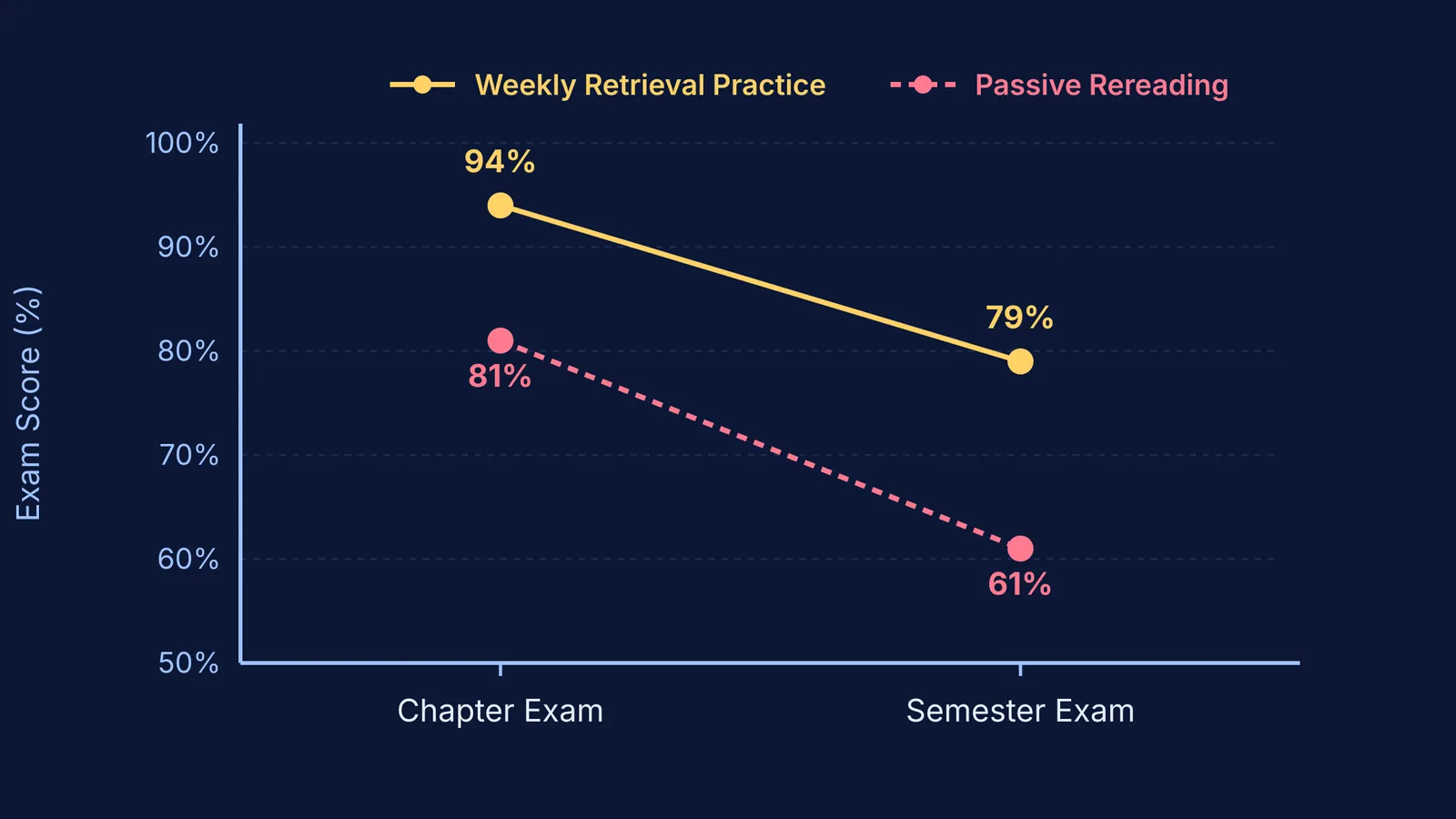
The key is replacing passive rereading with low-stakes retrieval practice. In a classroom trial with 6th-grade students, Roediger et al. (2011) demonstrated that students scored 94% on chapter tests and retained 79% on cumulative semester exams for quizzed content, compared to 81% and 61% for content reviewed only by rereading. In middle school science, McDaniel et al. (2011) found that low-stakes review quizzes raised summative unit exam scores by 13 percentage points, from roughly 79% to 92%.
A sustainable weekly rhythm distributes effort in short blocks:
Sunday Preview (15 minutes): Look through upcoming chapter titles, inspect illustrations, and note 5 new vocabulary words.
Tuesday Recall (20 minutes): Close the book and write down three facts from memory, or answer two end-of-chapter questions before checking notes.
Thursday Card Check (15 minutes): Shuffle keyword cards and practice rapid retrieval, explaining each term aloud.
Saturday Review (20 minutes): Sketch one central process—like the water cycle—without looking at notes.
When abstract processes remain hard to visualize from flat textbook diagrams, the Fermi Simulation Lab offers interactive simulations for ideas that are easier to see than to read, such as magnetic forces and the states of water.
How can parents support without taking over homework?
When a child sits stuck before an open textbook, parents often step in to read for them or supply answers. While well-meaning, this can reinforce the belief that middle school subjects require constant adult rescue.
Instead, act as a coach by asking observational questions. If your child says, 'I do not understand anything in this chapter,' ground their attention in a concrete feature on the page:
'Look at the diagram on page 42. What do you notice about where the water is flowing?'
'Can you find two bold words on this page that you have not seen before?'
'Let us read just this one subheading and guess what the next sentence will explain.'
Narrowing their focus to a single detail breaks task paralysis. Guiding them in teaching your child to plan their time builds independent study habits. When an evening session begins with uncertainty, Fermi's AI tutor works out what the student already knows and builds a plan for the session, turning a daunting chapter into a clear set of steps.


