

On this page
A stick in the ground works as a science instrument on a terrace in Pune or a school ground in Patna. Over one week, your child marks its shadow, finds when it is shortest, and turns the marks into a sundial. Along the way you get to ask: is the Sun moving, or are we?
What do you need for a shadow stick activity?
A straight stick about 1 metre long, checked for vertical with a string and a small weight
A flat spot that gets sun from about 9 am to 3 pm
Chalk, or small stones if the ground is soil
A clock, a notebook and a measuring tape
One rule first: nobody looks at the Sun. NASA's safety guidance says it is not safe to look directly at the Sun without specialised solar viewing protection; regular sunglasses are not enough. Here you only look at the ground.
How do you run a week-long shadow-tracking plan?
Day 1: Every hour from 9 am to 3 pm, mark the tip of the shadow and write the time beside it.
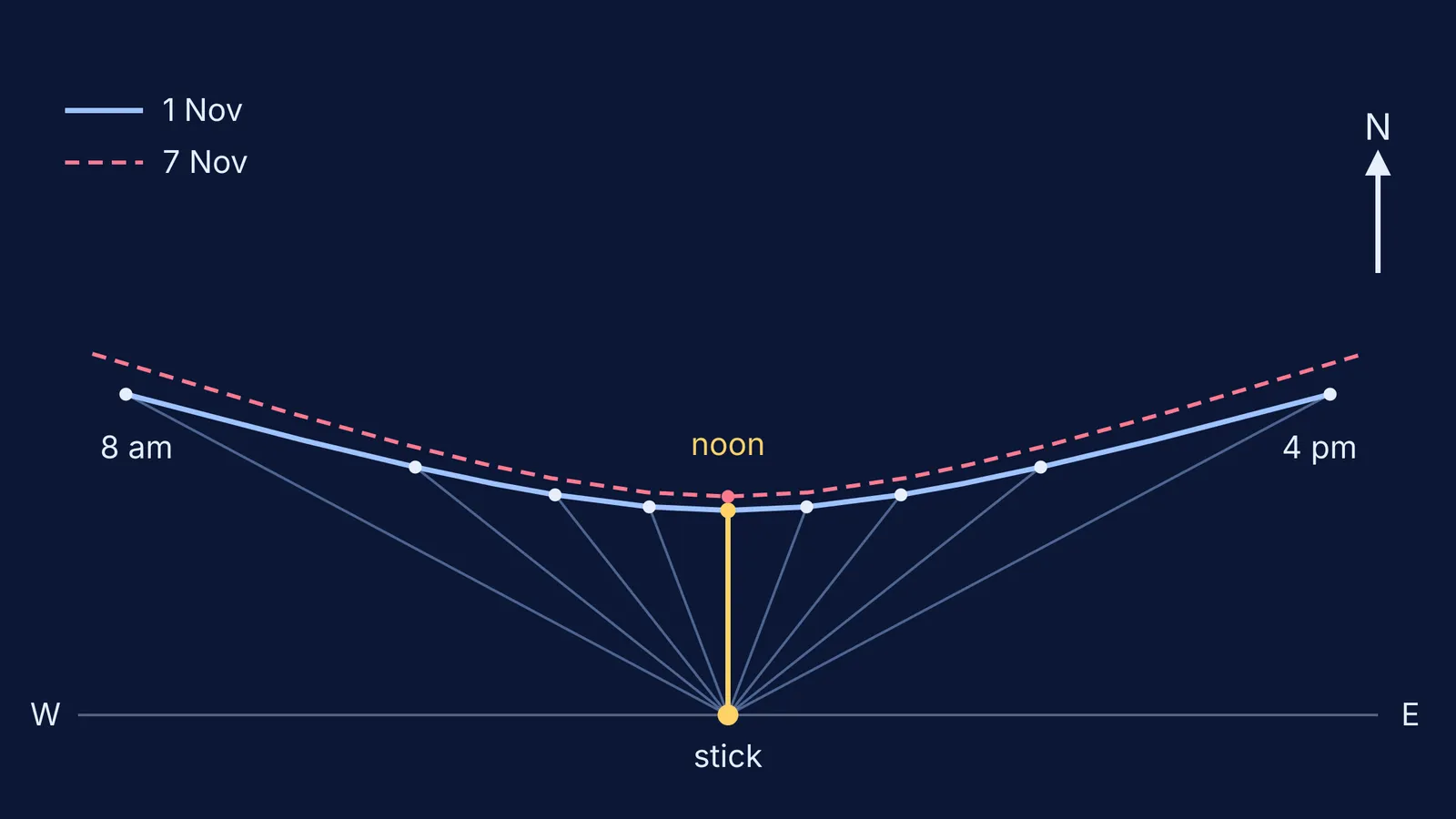
Day 2: Mark the tip every 10 minutes from 11 am to 1 pm. The shortest shadow marks local solar noon. Note its time.
Day 3: Draw a line from the stick's base through the shortest-shadow mark. In India in November, it points due north. A compass app should roughly agree.
Day 4: Before each mark, your child puts a stone where they think the tip will land. Predicting first turns watching into testing.
Day 5: Measure the noon shadow and divide it by the stick's height.
Day 6: Label the Day 1 marks with their hours. You now have a sundial. Does the shadow sit on the 10 o'clock mark at 10 by the clock?
Day 7: Measure the noon shadow again and compare it with Day 5.
What does a shadow tell you about Earth's rotation?
The Sun appears to go round the sky at about 15° per hour, a full 360° in 24 hours, because Earth spins on its axis (Wikipedia: Sundial). The shadow mirrors that motion: Sun in the east, shadow to the west.
To give you something to compare against, we worked through the numbers with the NOAA solar position equations. For a 1-metre stick:
In Delhi, the noon shadow is about 93 cm long on 1 November 2026 and about 99 cm on 7 November, because the noon Sun sits a little lower each day as winter approaches.
In Mumbai, it is about 66 cm on 1 November and about 70 cm on 7 November.
On flat ground the shadow does not turn by 15° every hour. In Delhi it swings about 21° in the first hour after noon, but only about 10° between 3 pm and 4 pm, solar time, because the ground is not lined up with Earth's axis.
Your Day 2 time probably won't be 12:00. Indian Standard Time is set by the 82.5° E meridian near Mirzapur (Wikipedia: Indian Standard Time), and the NOAA formula shifts solar noon by 4 minutes for every degree of longitude. It also adds the equation of time, worth about 16 minutes in early November. By our calculation, solar noon in early November 2026 falls at about 11:20 am in Kolkata, 12:05 pm in Delhi and 12:22 pm in Mumbai.
What questions should you ask at the stick?
"Did the shadow move, or did we?"
"Where was the Sun when the shadow pointed west?"
"Why is noon by the shadow not noon by the clock?"
"Will the noon shadow be longer or shorter next month?"
Let your child guess before you explain. For the last question, our guide on explaining seasons with a globe and a lamp picks up where the stick leaves off.
How do you make a simple sundial that keeps time?
Your Day 6 sundial drifts out of step within weeks, because the Sun's path shifts with the seasons. The fix is to tilt the pointer. A sundial's pointer, the gnomon, must be parallel to Earth's axis, so its angle from the horizontal equals your latitude (Wikipedia: Sundial). Look up your city's latitude in a maps app, cut a cardboard triangle with that angle, stand it on a board with its sloping edge rising towards the north, and mark the hours again.
For older children, the Astronomical Society of India explains that between 23.5° north and south, the noon Sun is directly overhead on two days a year.
If Earth's tilt is still hard to picture, the Fermi Simulation Lab has interactive simulations for the ideas that are easier to see than to read.
When the week ends, try explaining why the sky is blue next, or start astronomy at home together.


