

On this page
Most people find it hard to explain exactly why the days get longer in summer and shorter in winter. If you ask a child—or even most adults—they will likely tell you that the Earth is closer to the sun in the summer and farther away in the winter.
This is a deeply rooted, but entirely incorrect, mental model. A landmark 1987 documentary study by the Harvard-Smithsonian Center for Astrophysics, titled *A Private Universe*, asked randomly selected university graduates to explain the seasons. The researchers found that the vast majority of the graduates failed to correctly explain the seasons, with nearly all of them confidently relying on the distance myth.
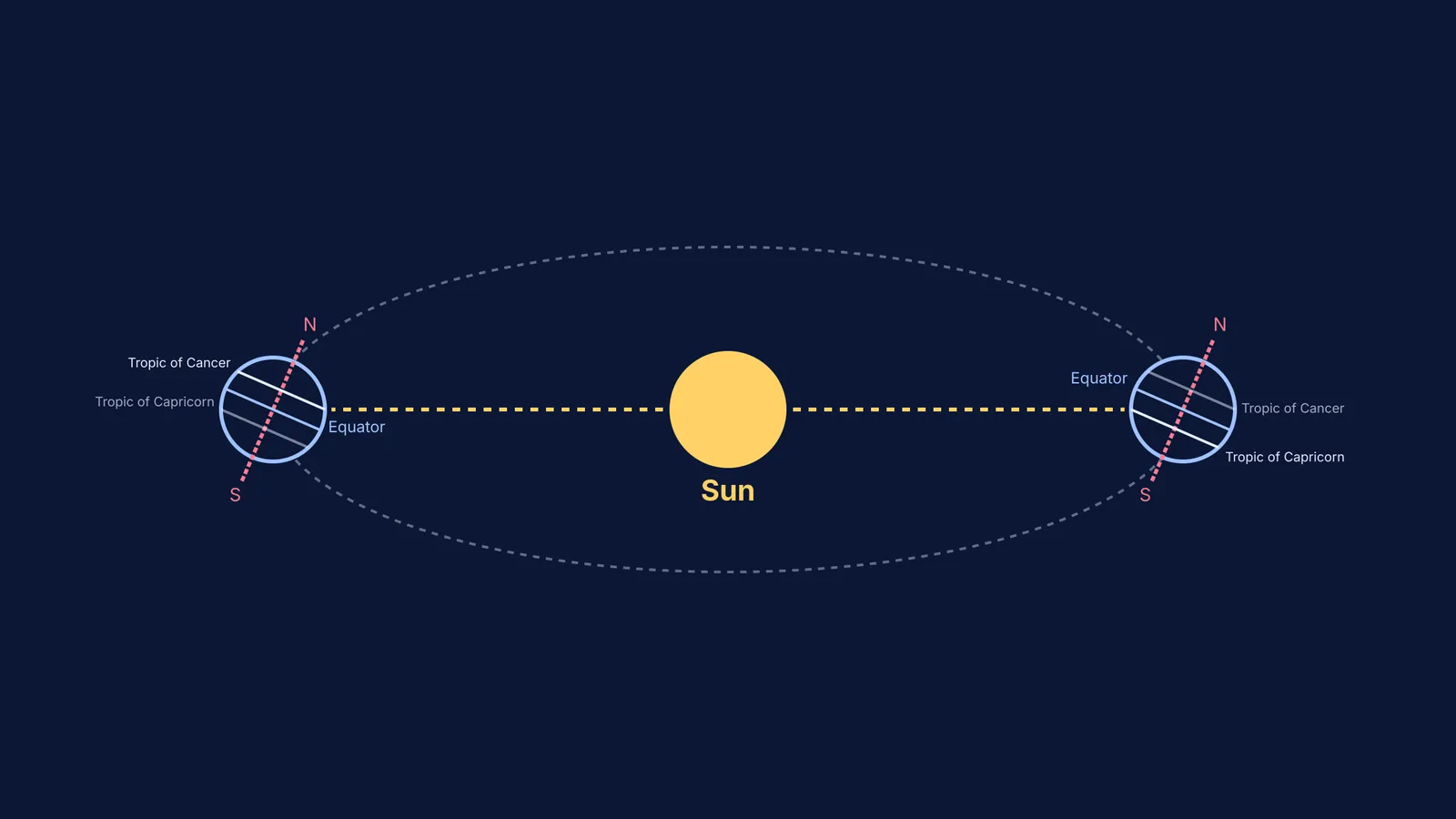
In reality, the Earth's orbit is nearly circular, and the distance to the sun changes by only about 3% throughout the year (Source). In fact, Earth is closest to the sun in early January, right when the Northern Hemisphere is experiencing its coldest winter days. The real reason we have changing seasons is the 23.5° tilt of the Earth's axis.
Why do children misunderstand the seasons?
Children naturally rely on spatial reasoning that mimics their everyday experience: if you stand closer to a campfire, you feel much hotter. When textbooks try to draw the solar system in three dimensions, they often squash the Earth's circular orbit into a highly exaggerated, flattened oval to fit it on the page. Students interpret this two-dimensional drawing literally, creating a powerful visual misconception.
Rather than just telling a child the correct facts, educational researchers suggest using active learning with physical models to break these old habits of thought. Recreating the solar system in your living room allows them to see the physics happening in real time.
How do you explain seasons with a globe and lamp?
To correct the distance myth, you can demonstrate the changing seasons in a dark room using a bright lamp without a shade (the sun) and a globe (the Earth). Most standard educational globes are already mounted on a stand at the correct 23.5° tilt.
The fixed axis rule: Place the lamp in the centre of the room. Pick a specific spot on the wall to represent the North Star. As you walk the globe in a wide circle around the lamp, the North Pole must always point towards that exact spot on the wall. It must never swivel to face the lamp.
Summer Solstice (June): Stop when the Northern Hemisphere is leaning towards the lamp. Ask your child to look at where the light hits the globe most directly. If you slowly spin the globe on its axis to simulate a day, they will see that the North Pole stays in the light for the entire rotation. This explains why summer days are longer and hotter.
Winter Solstice (December): Move the globe to the exact opposite side of the lamp, keeping the tilt pointed at the same spot on the wall. Now, the Northern Hemisphere is leaning away from the lamp. The light has to spread out over a much larger area to reach the north, making the energy weaker and the temperatures colder.
If your child struggles to picture the geometry of the orbit from a static model, letting them explore it virtually can bridge the gap. The Fermi Simulation Lab features interactive simulations that allow students to manipulate the Earth's tilt and orbit, making the direct connection between the angle of sunlight and temperature immediate and obvious.
How does the tilt cause India's summer, monsoon and winter?
You can also use this globe setup to explain local weather patterns. The India Meteorological Department (IMD) officially classifies the Indian climate into four distinct seasons, all fundamentally driven by this same 23.5° tilt: Winter, Pre-Monsoon (Summer), Southwest Monsoon, and Post-Monsoon (Source).
As the Earth moves into May, the Northern Hemisphere leans heavily towards the sun. Point out India on the globe; it sits right on the Tropic of Cancer. During this pre-monsoon summer, the direct rays of the sun hit this line, heating the landmass rapidly. This intense, direct sunlight creates a massive low-pressure zone over the hot northern plains and the Thar Desert.
By June, this low-pressure system becomes so strong that it acts like a vacuum, pulling in moisture-heavy winds from across the Equator. These winds travel over the warm Indian Ocean and burst over the coast as the Southwest Monsoon. This single seasonal shift delivers roughly 75% of India's total annual rainfall.
When the Earth continues its orbit and leans away by December, the sun's direct rays shift south of the equator. The high-pressure systems building over the cold landmass of Central Asia send dry, cool winds down across the Indian subcontinent. This brings clear skies, lower humidity, and the traditional Indian winter.
Building these accurate physical and mental models early helps children immensely when they later encounter complex topics in physics and geography. As they learn, encouraging them to ask their own questions and helping them learn without pressure keeps their curiosity alive. Understanding the grand cycles of our own planet, just like Milutin Milankovic's work on ice age cycles, begins with simply looking at how the Earth leans.


