

On this page
According to the Pew Research Center, 16% of U.S. children live in a blended family, meaning they share a home with a stepparent, stepsibling, or half-sibling. For these children, moving between households and adjusting to new family dynamics can cause "transition fatigue."
Establishing a predictable environment is one of the most effective ways to help them settle in. A consistent study routine moves authority away from the stepparent and onto a shared schedule, reducing friction and giving the child a clear expectation of what happens next. This shared understanding prevents everyday tasks from feeling like personal demands, allowing the family to focus on connection rather than constant negotiation.
Where should step-siblings study?
When families blend, space often becomes a premium. Children may feel territorial, especially if they are suddenly sharing a bedroom with a new stepsibling or dividing their week between two houses. The transition can make them feel as though they have lost control over their environment.
A dedicated study space acts as a psychological cue, helping the brain associate that specific environment with focus and learning. To give each child their own space without requiring an expansion to your home:
Create a static workspace: Instead of the dining table where meals and conversations happen, set up a specific desk or corner that is solely for homework. If you need ideas on what to include, read our parent's checklist for setting up a home study space.
Provide personal storage: If children must share a desk or move between homes, give them a "portable study kit" like a rolling cart or a dedicated bin. This ensures they always have their own pencils, paper, and calculators without having to hunt for them.
Separate by age or need: Some children focus best in isolation, while others need a parent nearby. Consider letting older children study in their rooms while younger ones work in a common area where they can get immediate help.
How to agree on a study routine across households?
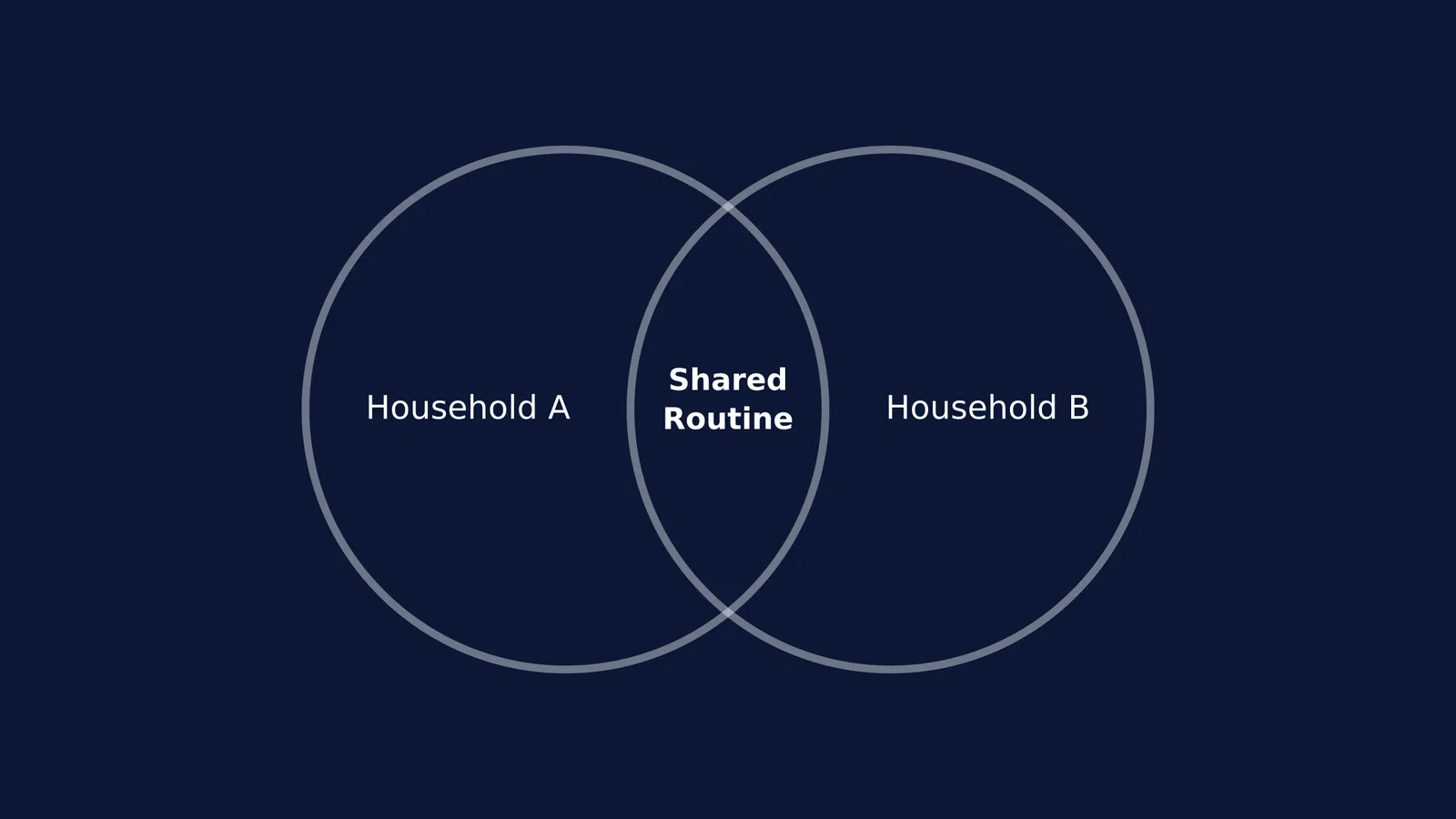
It is rarely possible to make two households identical, but parents and stepparents can minimize the switching cost by keeping core expectations similar. When a child knows what is expected regardless of whose roof they are under, they are less likely to test boundaries or feel overwhelmed.
The National PTA and National Education Association endorse the "10-minute rule" as a baseline for academic workload: approximately 10 minutes of homework per night per grade level (for example, 30 minutes for a third grader and 60 minutes for a sixth grader). Using this guideline helps families set realistic boundaries for study time.
To build a routine that works in a blended family:
Set a regular time block: Establish a fixed hour for homework, such as right after an afternoon snack or at 4:30 PM. Treat this time block as non-negotiable.
Present a united front: Parents and stepparents must agree on the household rules privately before enforcing them with the children.
Respect the other household's limits: Accept that the other parent's home will have its own rules. Focus your energy on maintaining consistency in your own home rather than attempting to control the other.
Be mindful of how you discuss academic progress during these routines. It can be tempting to point out how well one child is doing, but it is important to understand why comparing siblings backfires, and what to say instead.
When to step in if the rules are broken?
Homework can quickly become a source of tension, particularly when a child gets stuck and frustration builds. Knowing when to help with homework and when to step back is crucial. In a blended family, experts often suggest that the biological parent should take the lead on discipline and academic pressure during the early years of the transition. The stepparent is most effective when acting as a supportive guide—someone who enforces the existing routine without inventing new consequences.
When a child hits a wall—say, staring at a blank page or repeatedly using the wrong mathematical formula—it is often better to offer a clear next step rather than taking over the assignment. If they are struggling with a specific concept and the biological parent is unavailable to help, turning to an objective tool can preserve the peace. Fermi's AI tutor can work out what the student already knows and build a plan for the session.
If the child is stuck on a numerical calculation, the Fermi Problem Library provides a step-by-step solver that explains the reasoning rather than just printing an answer. For visual learners trying to grasp difficult ideas, the Fermi Simulation Lab offers interactive simulations for ideas easier to see than read.
By shifting the role of the "homework enforcer" to the routine itself and using neutral tools for academic hurdles, you remove the stepparent from the role of a taskmaster. This gives step-siblings the structure they need to succeed academically while preserving a peaceful family dynamic.


