On this page
Moving to a new school board in middle school is a common step for many families, but the transition can surprise students who were previously doing well. Class 6 marks the beginning of secondary education in the Central Board of Secondary Education (CBSE), introducing subjects with deeper conceptual demands.
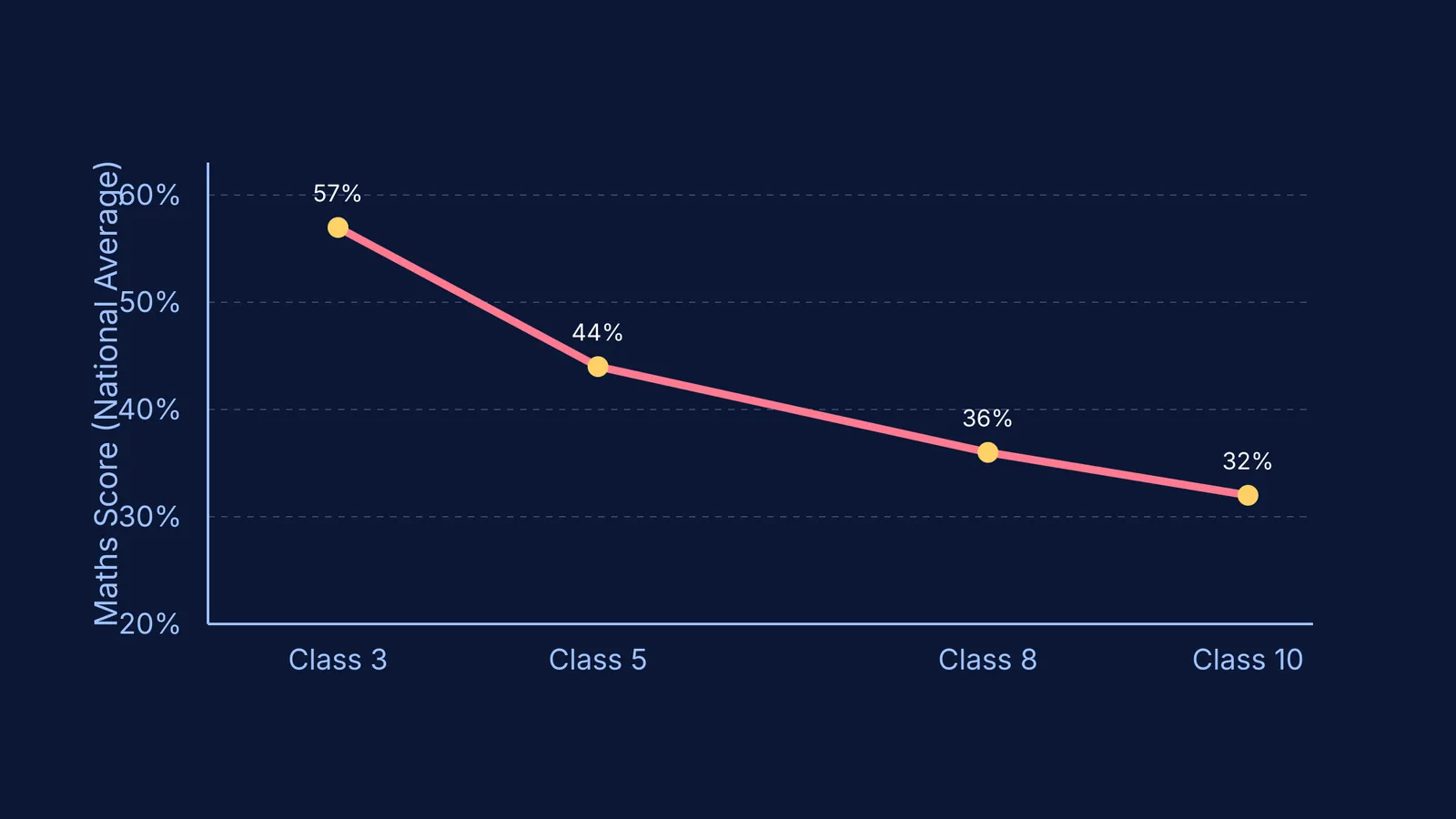
This shift often reveals foundational gaps. The Ministry of Education's National Achievement Survey 2021 found that the national average score in mathematics drops from 44% in Class 5 to 36% in Class 8. This eight-point drop illustrates how students across the country struggle when the curriculum moves from basic calculation to abstract logic.
Why is Class 6 the turning point?
Middle school is universally recognised as a challenging transition in any educational system. The number of independent subjects increases, the textbooks become denser, and students are expected to take more responsibility for their own daily study routines.
For students switching boards, this normal developmental hurdle is compounded by a sudden change in testing styles. State boards often construct exam papers to ensure most students can pass by recalling facts directly from their textbooks. In contrast, CBSE assessments are designed to test application. A student who previously scored top marks by memorising definitions may feel completely lost when a CBSE paper asks them to apply that definition to a scenario they have never seen before.
What changes in the mathematics syllabus?
In many state boards, primary school mathematics focuses heavily on calculation speed and applying direct formulas. When a student enters CBSE Class 6, they encounter the National Council of Educational Research and Training (NCERT) syllabus, which changes the goalpost from "how to calculate" to "why this method works".
The start of algebra: Class 6 introduces variables and algebraic expressions. Students must now solve problems using letters to represent unknown numbers, a major conceptual leap from arithmetic.
Structured geometry: Instead of merely identifying 2D shapes, students learn practical geometry, lines of symmetry, and the reasoning behind geometric constructions.
Complex word problems: CBSE questions often require students to translate real-life paragraphs into mathematical equations. A student used to direct instructions ("Add these two numbers") may struggle with a problem that implies addition without explicitly stating the word.
If your child is stuck on these new topics, Fermi's AI tutor can help. It works out what they already know, builds a plan for the session, and teaches through it—writing on a board and checking understanding as it goes.
Why does the English curriculum feel different?
The leap in English is less about new grammar rules and more about how the language is used under pressure. State board exams in primary classes often rely on questions taken directly from the stories and poems in the textbook. In CBSE, English becomes a test of independent language proficiency.
Unseen passages: Exams rely heavily on reading comprehension passages that the student has never encountered before. This tests their ability to read quickly, infer meaning, and extract information without prior preparation.
Creative and functional writing: Rote-learning standard essays no longer works. Students are asked to write formal letters, notices, and descriptive paragraphs using their own structure and vocabulary.
Grammar in context: Instead of asking for the definition of a noun or a verb, students face "gap filling" or "editing" exercises where they must spot and correct errors in a continuous paragraph.
How can you close the learning gaps at home?
Bridging the gap between the two boards takes time, but a structured approach can make the first few months much easier. Families comparing CBSE, ICSE or state boards often find that preparation is the key to a smooth transition.
Audit their Class 5 math basics: Before tackling algebra, ensure your child is completely comfortable with fractions, decimals, and basic operations. Missing links here will inevitably cascade into failures in Class 6.
Shift to reading for pleasure: To handle unseen passages, a student needs a broader vocabulary than a textbook provides. Encourage them to read age-appropriate fiction or the newspaper every day.
Ask them to explain their working: When they do maths homework, ask them to say out loud why they chose a specific step. If they cannot explain the logic, they have memorised a method without understanding the underlying concept.
Resist the urge to just give answers: When they are stuck, give them hints rather than the final solution. Research on hints vs answers in tutoring shows that guiding a student to the answer builds independent problem-solving skills much faster than simply telling them what to write.
It is completely normal for marks to dip slightly in the first term of Class 6. If you notice your child losing interest in studies because the work feels too hard, remind them that they are learning a new way to think, not just a new set of facts.