

On this page
A sink or float activity needs a tub of water, ten things from around the house and about twenty minutes. Your preschooler guesses, tests and sorts. Along the way they meet one of the first real ideas in physics: whether something floats depends on how heavy it is for its size, not just on how heavy it is.
What do you need for a sink or float activity?
A wide plastic tub or bucket, filled about two-thirds with water, on a towel
Two trays or plates, one marked with a drawn boat (floats) and one with a drawn stone (sinks)
A sheet of paper for tick marks
Ten objects (see the list below)
The WHO drowning fact sheet lists drowning as the fourth leading cause of death for children aged 1 to 4. Among the ways to prevent it, it lists barriers such as doorway barriers and playpens, controlling access to water, and supervised childcare for pre-school children.
Which household objects sink or float?
Here are ten objects found in most Indian homes, with what usually happens. Yours may differ, which is part of the fun.
Steel spoon: sinks
Wooden ice-cream stick or pencil: floats
One-rupee coin: sinks
Plastic bottle cap: floats
Lemon: usually floats
Potato: usually sinks
Dry leaf: floats
House key: sinks
Empty steel katori, placed upright: usually floats, then sinks once you tip water into it
Ball of play dough: sinks, and the same dough pressed into a flat boat shape may float
The last two surprise children: the katori and the dough keep their weight and change only their shape or what is inside. For older children who want to see why a huge steel ship floats, our explainer on how steel ships float works through the same idea.
How do you run it with a three- or four-year-old?
Predict. Hold up one object. Ask, "Will it float on top or sink to the bottom?" Put it on the tray your child chooses. Don't correct them.
Test. Your child drops it in. Count to three together and look.
Sort. Move it to the right tray. Tick the paper if the guess was right.
Talk. Ask, "Were you surprised?" and "Why do you think it did that?"
This pattern of guess, test, then explain follows the Open University's OpenLearn float or sink activity for parents. It has children sort objects by their predictions, test each one in turn, and explain any surprises.
How you present the objects matters too. In a 2010 study, Kloos, Fisher and Van Orden asked children aged 2 to 9 and adults whether objects would sink or float. Children's answers about exactly the same objects changed depending on whether the setup made density stand out or made weight and size stand out. The study did not test home games, but a simple step follows: test each object alone before setting out contrasting pairs like a big lemon and a small coin.
How do you explain heavy, light and floating to a preschooler?
Children's first explanation is usually "heavy things sink, light things float". The OpenLearn activity describes how children often move from there to "things float if they've got air in", and later to the idea of being "light for size". You don't need to rush them. Just give them words that fit what they see:
Heavy: "This coin feels heavy for something so small. Small and heavy things usually sink."
Light: "This lemon is bigger than the coin and heavier too, but it is light for its size. It floats."
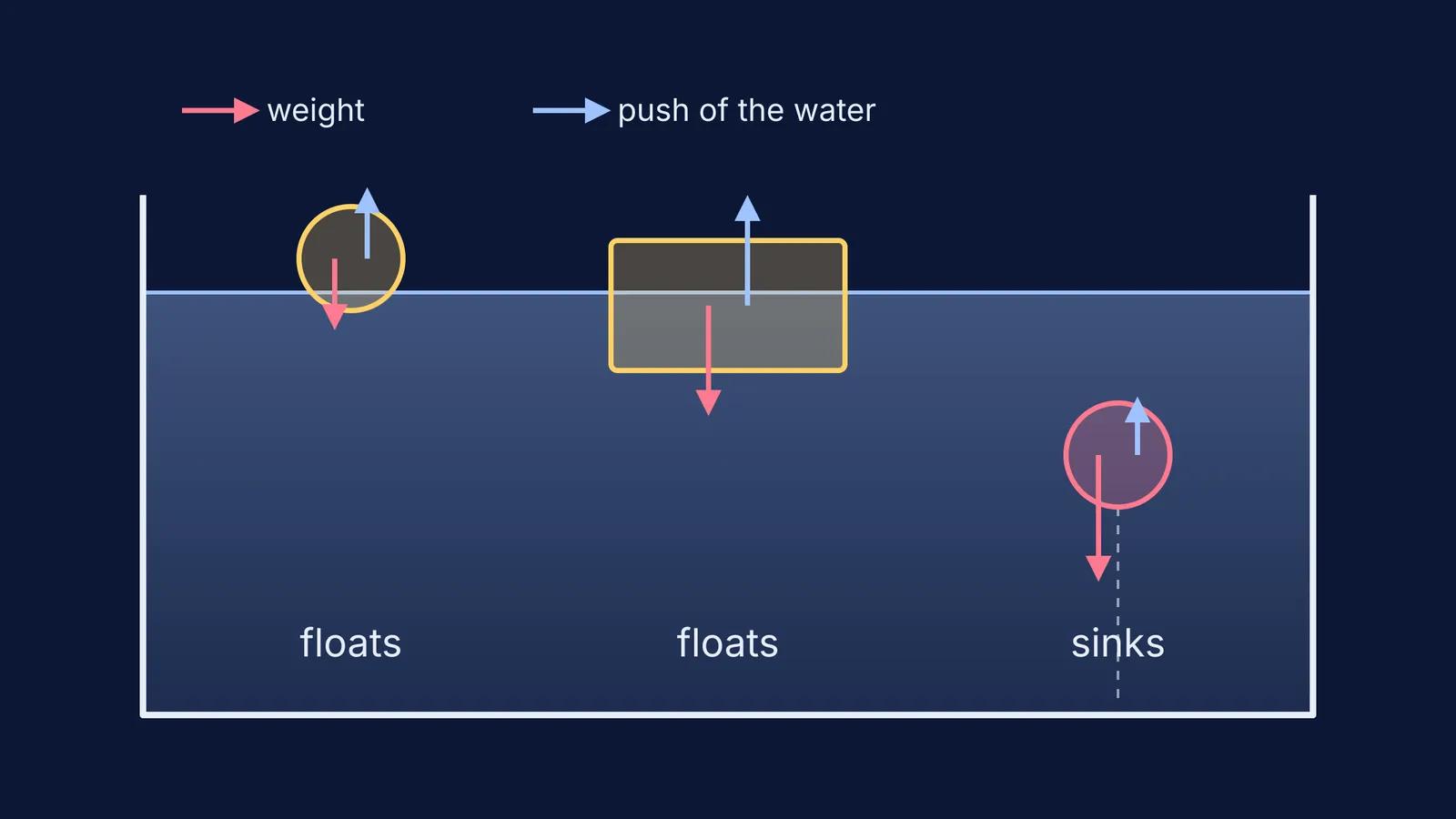
Why: "Water pushes up on everything you put in it. If something is light for its size, the push is enough to hold it up."
Air: "The katori has air inside, so it floats. When water goes in, it sinks."
When your child says "heavy things sink", don't argue. Hand them the lemon and the coin and ask which is heavier. Then test both and let the result do the arguing.
What can you do after the first round?
Re-sort. Ask your child to put the objects in a line from "floats best" to "sinks fastest". Our sorting games plan for young children has more ideas.
Change one thing. Shape the dough into a boat, or fill the bottle cap with sand.
Try other liquids when they are older. The density tower experiment layers honey, water and oil and adds a floating egg.
If an older sibling wants to explore the same idea further, the Fermi Simulation Lab has interactive simulations for ideas that are easier to see than to read.
Tonight, fill the tub, line up ten objects, and let your child make the first guess.


