

On this page
If your child can watch Reels for an hour but struggles to read four pages of a chapter, you are not imagining things. Heavier short-video use does go along with weaker attention, but science cannot yet say how much of that the videos cause. Here is what is known, what is not, and a family plan that does not depend on banning the phone.
Are short videos affecting my child's attention span?
A large 2025 meta-analysis in Psychological Bulletin by Lan Nguyen and colleagues pooled data from 98,299 participants across 71 studies on short-form video apps such as TikTok, Instagram Reels and YouTube Shorts.
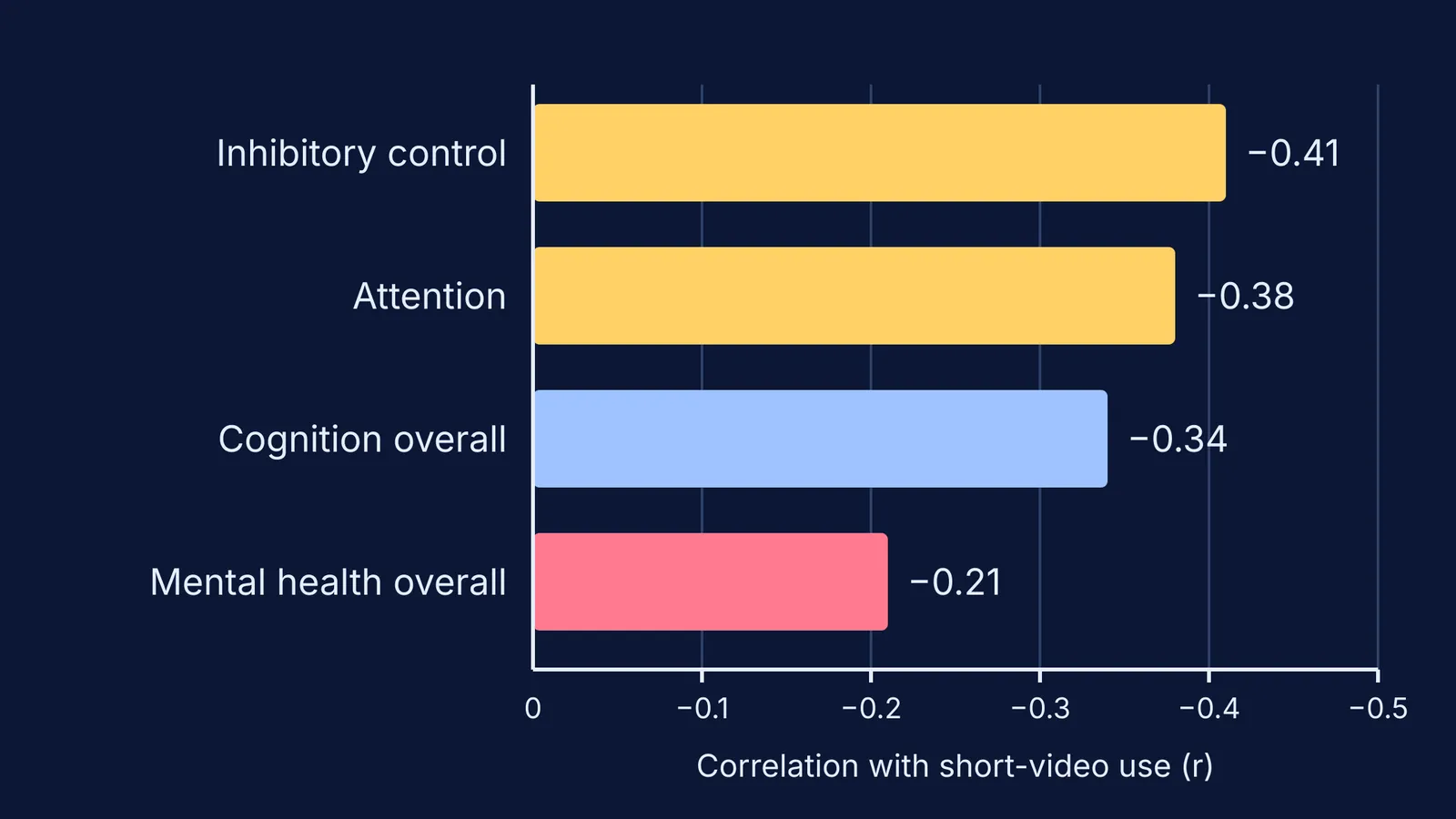
Heavier short-video use was linked to poorer attention (r = -0.38) and poorer inhibitory control (r = -0.41), according to the meta-analysis.
Inhibitory control is the ability to stop yourself from acting on an impulse and stay on task.
The links were consistent across youth and adult samples and across platforms.
Studies using addiction-style questionnaires found stronger links to health outcomes than studies that only measured time spent, as PsyPost's report on the paper explains.
An r of -0.38 is a moderate correlation: a real pattern, with many exceptions.
Short experiments point the same way, though neither tested children with short-video apps. In a 2011 study in Pediatrics, sixty 4-year-olds who watched 9 minutes of a fast-paced TV cartoon did worse straight afterwards on self-control and working-memory tasks than children who watched an educational cartoon or drew. In a 2023 lab study with 60 adults aged 19 to 34, interruptions from TikTok cut their accuracy at spotting the cue for a planned action by almost 40%, while Twitter and YouTube had no similar effect.
What is still not known?
Which comes first. Most studies in the meta-analysis were one-time snapshots, PsyPost notes, so a restless child may be drawn to short videos as much as short videos make a child restless.
Whether effects last. The cartoon and TikTok experiments measured performance during or right after viewing, not months later.
How accurate the numbers are. Many studies rely on people estimating their own screen time.
What the content does. A science explainer and random clips usually count the same; the authors call for research on how different types of content shape these links.
How much screen time is right for young children?
The WHO recommends no screen time for babies under 1, no sedentary screen time for 1-year-olds, and no more than 1 hour a day for children aged 2 to 4, adding that less is better. For older children and teens, a useful family rule is about when and how the feed is used, not only how long.
How do you set family limits without a fight?
Try this two-week plan.
Days 1 to 3: observe, don't judge. Note together when the scrolling happens (after school, in bed, in homework breaks).
Ask four questions together. Do you open the app without deciding to? Do you usually watch longer than you planned? Is it hard to start homework afterwards? Does it push bedtime later? Several yes answers point towards the compulsive pattern the research flags.
Days 4 to 14: agree three rules. No short videos during study blocks, no feeds in the bedroom after a fixed time, and one feed-free hour each evening that parents follow too.
Let the phone help. Set up Focus mode on your teen's phone so feeds stay quiet in study hours.
Day 14: review what got easier and what to change.
A script to start the conversation: “I'm not taking your phone away. Endless scrolling makes it harder for adults to focus too, me included. Can we try a two-week experiment and see if homework feels easier?”
For why the feed is so hard to put down, see our piece on why children watch Instagram Reels for hours.
Which activities build longer attention?
Choose activities with a slow payoff, where staying with something is what gets rewarded:
reading a chapter book or comic, aloud together for younger children (the WHO encourages reading and storytelling with a caregiver)
puzzles, board games, chess, model-making or cooking a full recipe
an instrument or sport skill that takes weeks to improve
one hard maths or physics problem worked to the end, without skipping to the answer
For that last one, the Fermi Problem Library has worked problems with a step-by-step solver that explains the reasoning rather than printing an answer, so a long focus session has a clear finish line. For offline ideas, see our list of screen-free evening activities for school kids.
When should you get more help?
If your child seems anxious or low for weeks, sleeps badly, or cannot concentrate even away from screens, talk to their doctor or school counsellor. In India, Tele MANAS is a free, 24x7 mental health helpline from the Ministry of Health and Family Welfare: call 14416 or 1800-891-4416.


