

On this page
Your five-year-old has just started UKG or Class 1, a phone is always within reach, and every family you know seems to have a different rule. The major guidelines agree more than they disagree. Here is what they say, why sitting with your child changes what they get from a screen, and a day plan you can copy.
How much screen time is OK for a 5-year-old?
For children aged 3 and 4, the World Health Organization's 2019 guidelines say sedentary screen time should be no more than one hour a day, and less is better.
The Indian Academy of Pediatrics (IAP) guidelines, published in Indian Pediatrics in 2022, set a maximum of one hour of supervised screen time a day for children aged 24 to 59 months, and less than two hours a day for children aged 5 to 10.
Canada's 24-hour movement guidelines for children aged 5 to 13 also put the limit at no more than two hours a day of recreational screen time.
So a five-year-old sits right on the line between the one-hour and two-hour brackets. A sensible reading is to aim for about an hour of good content and treat two hours as a ceiling, not a target. The IAP adds that screens should not replace outdoor play, sleep, family time or studies, and that parents should check that content is educational, age-appropriate and non-violent.
The American Academy of Pediatrics (AAP) now puts less weight on counting minutes. Its January 2026 recommendations ask families to make a family media plan, model healthy habits, and keep some spaces free of digital media, such as the car and dinnertime.
Why does watching together matter?
The AAP's earlier policy statement on young children, Media and Young Minds, stressed parent-child shared media use alongside time limits. Young children learn a lot from people, and a parent sitting beside them turns a video into a conversation.
In a study by Gabrielle Strouse and colleagues, published in Developmental Psychology in 2013, 81 parents watched storybook videos with their 3-year-olds over four weeks. Children whose parents paused to ask questions and let them tell parts of the story scored higher on story comprehension and story vocabulary than children in the comparison groups. It is one study of younger children, but the method costs nothing to try.
Sitting together also shows you what the app plays next; our guide to choosing between YouTube Kids and supervised YouTube helps you choose.
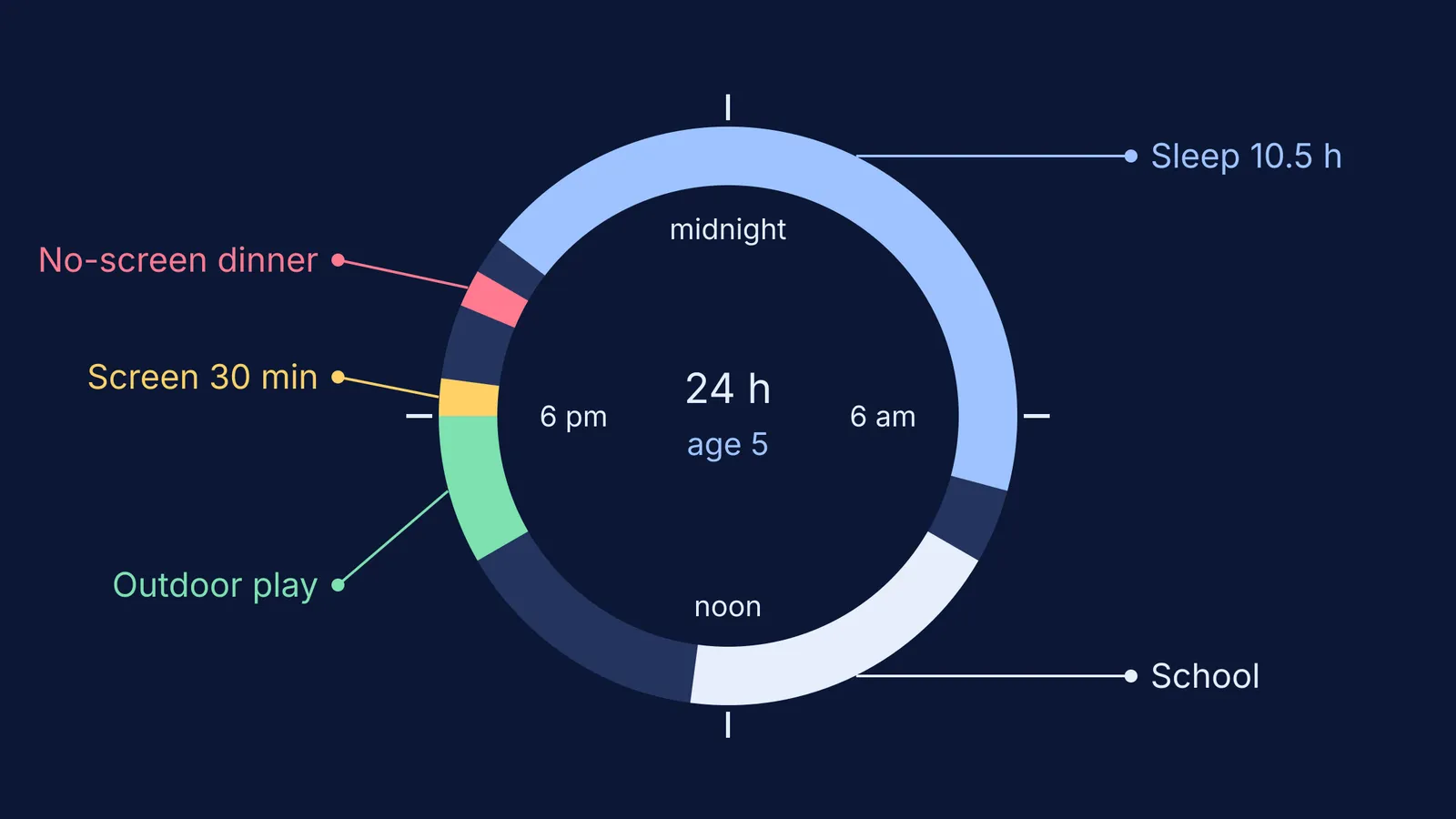
What does a daily plan for a five-year-old look like?
Start with sleep and play, then fit screens into what is left. For children aged 5 to 13, the Canadian guidelines recommend 9 to 11 hours of uninterrupted sleep a night and at least 60 minutes a day of moderate to vigorous activity. The WHO guidance for 3- and 4-year-olds asks for 10 to 13 hours of good-quality sleep and at least 180 minutes of physical activity spread through the day.
Here is a sample school day. Shift the times to fit your child's school.
7:00 am: wake up, breakfast, get ready, no TV in the background.
8:00 am to 12:30 pm: school.
12:30 to 4:00 pm: lunch, a rest or nap if your child still takes one, then quiet play such as blocks, drawing or puzzles.
4:00 to 6:00 pm: outdoor play in the park, the building compound or on the terrace.
6:00 to 6:30 pm: one show or a few short videos, with you or a grandparent beside them.
6:30 to 7:30 pm: bath, a small chore such as setting the table, free play.
7:30 pm: dinner with the TV and phones off.
8:00 pm: books and a story, lights out by 8:30 pm for about 10.5 hours of sleep.
That is 30 minutes on a school day, with room for up to an hour on weekends for a family film or a video call with cousins.
Which screen habits matter most?
No screens at meals. A review on screen time in under-five children in Indian Pediatrics notes that digital media should be restricted while eating and in the hour before sleep. If meals have turned into cartoon time, try these steps for a child who watches the phone while eating.
No screens in the last hour before bed. Move the show earlier, not later.
Give a warning. "Two more minutes, then we switch off and go to the park" is easier than a sudden stop.
Watch your own phone. Children copy what they see.
Later, screens start to include study. An older sibling working through a problem with Fermi's AI tutor, which teaches rather than just handing over answers, is closer to homework than to entertainment. We look at how to count that in how AI tutor time fits into screen time.
If you are worried about your child's speech, sleep or behaviour, talk to your paediatrician. If you are feeling stretched yourself, Tele MANAS, the government's free 24x7 mental-health helpline, is on 14416.


