

On this page
Parents often use a smartphone or tablet to keep a child seated during mealtimes. It works in the short term, giving families a few minutes of quiet and ensuring the child eats something. However, leaving a screen on while eating fundamentally changes how children experience their food and how they interact with the people around them. The long-term costs to their diet and development far outweigh the temporary convenience.
How does screen time during meals affect diet?
Watching a screen pulls a child's attention entirely away from their plate. When children are distracted, they become less aware of internal satiety cues—the physiological signals that tell them they are full. This phenomenon, known as "mindless eating," can lead to chronic overeating because the brain does not register the food being consumed. Conversely, it can also cause a lack of interest in trying new foods, leading to a restricted and picky diet.
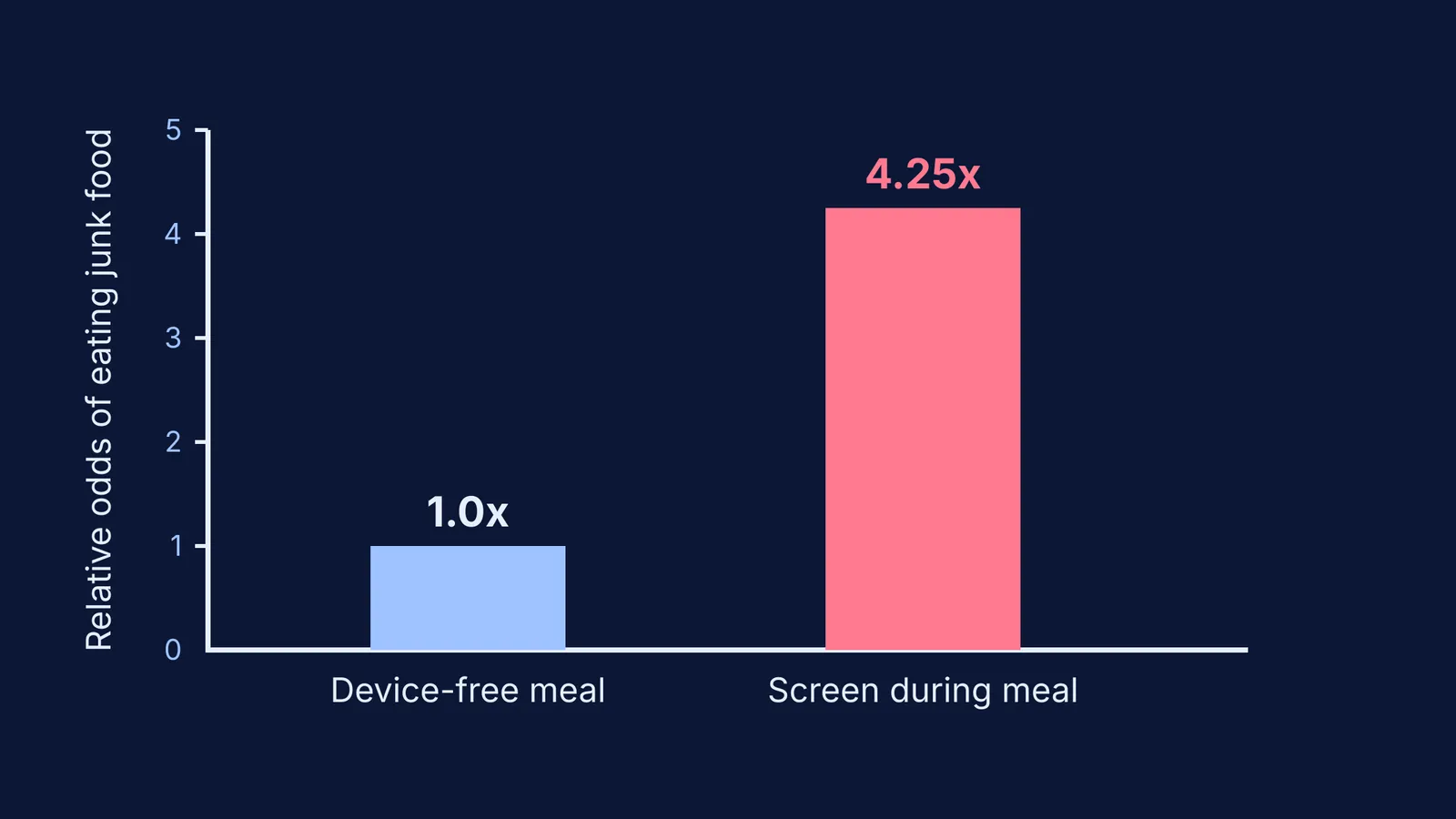
The dietary shift is highly measurable. A 2024 study published in *Academic Pediatrics* tracked the habits of toddlers and found that those who usually had the television on during meals were 4.25 times more likely to consume high amounts of junk food compared to those with screen-free meals (Source). The same study noted that these children had 3.72 times higher odds of consuming sugar-sweetened beverages. When a child is absorbed in a video, they are less likely to engage with the sensory experience of a meal—the crunch of a fresh vegetable or the umami taste of a carefully balanced dish (Kikunae Ikeda and the discovery of umami taste).
This early conditioning matters immensely. Nutritional science emphasizes that childhood diets set the foundation for lifelong metabolic health and physical development (C. Gopalan and the science of nutrition for Indian diets). By removing screens, you allow children to taste their food deliberately. This mindful approach encourages a more varied and balanced diet, making them more willing to explore different textures and flavours.
Why do screens at dinner delay language skills?
Mealtimes have historically been a critical window for social and cognitive development. They are prime moments for "serve and return" interactions. In these exchanges, a caregiver speaks, the child responds with a word or a babble, and a natural conversation builds. These back-and-forth moments are the building blocks of early communication.
Background noise and flashing images disrupt these interactions completely. A 2021 study by the French National Institute of Health and Medical Research (Inserm) followed 1,562 children and found that television exposure during family meals significantly impacted language acquisition (Source). Children who "always" had the TV on during meals at age 2 scored 3.2 points lower on verbal IQ tests by age 5.5, compared to children who were "never" exposed.
The researchers noted that auditory distraction makes it harder for young ears to isolate the phonemes and phonetic structures of language being spoken around them (Parts of the human brain: forebrain, midbrain and hindbrain roles). More importantly, the screen acts as a severe brake on verbal exchanges. Parents speak fewer words when a screen is on, and children vocalise less, drastically reducing the quality of the mealtime environment and delaying their vocabulary growth.
How to start one phone-free meal a day?
Transitioning away from mealtime screens can be challenging, especially if your child has developed a conditioned response where they refuse to eat without watching a video. However, making an abrupt, sweeping change across all meals often leads to friction and tantrums. Instead, start small by designating just one meal a day—perhaps dinner, when the family is together—as a device-free zone.
Here is a simple framework to successfully implement this change without overwhelming your child:
Set the expectation early: Explain the new rule hours before the meal happens. You might say, "Tonight, we are going to keep our phones and tablets in the other room so we can talk to each other while we eat." This prevents the shock of a sudden denial.
Prepare a visual boundary: Place a small basket or tray in another room where everyone (including all adults) leaves their devices before sitting at the table. Modeling the behaviour is crucial.
Introduce a table activity: Replace the passive screen with an active conversation starter. Ask everyone to share one good thing and one hard thing that happened during their day. You can also play a simple word game like "I Spy" to keep young children engaged.
Keep the meal short and realistic: If a child is used to sitting passively for 30 minutes with a screen, they may only last 10 minutes without one before getting restless. Accept this initially and let them leave the table when they are genuinely done eating.
When you establish device-free meals, children become more engaged in their environment and better at regulating their own attention, making it a great time to transition them into active learning. If they sit down to study afterwards, Fermi's AI tutor can build a plan for the session and teach through it, guiding their reasoning step-by-step rather than just printing an answer.
By reclaiming just one meal a day from screens, you can foster better dietary habits and create a rich, distraction-free environment for conversation and family connection.


