On this page
Sending your child on a school bus requires a great deal of trust. While accidents are rare, ensuring that the school follows mandated safety protocols is the best way to keep that daily commute secure. The Supreme Court of India and the Central Board of Secondary Education (CBSE) have laid down strict rules for school transport.
Checking these details with your school's transport manager takes only a few minutes, but it provides lasting peace of mind. Here is a practical framework of what to look for and what to ask.
What are the CBSE guidelines on school bus safety?
The foundational rules for school buses in India come from the Supreme Court's directions in the M.C. Mehta case, which the CBSE enforces for all affiliated schools. A school bus must be painted bright yellow and clearly display "School Bus" on the front and back Source. If the school hires the bus from a private contractor, it must carry a board reading "On School Duty". The name and telephone number of the school must also be written on the exterior.
The interior must meet specific standards to prevent injuries. The windows must be fitted with horizontal grills and mesh wire to prevent children from leaning out Source. Curtains or tinted films are strictly prohibited, ensuring that the inside of the bus is always visible from the outside.
Every bus is required to carry a working fire extinguisher and a fully stocked first-aid kit. To prevent heavy bags from blocking the aisle and causing a tripping hazard during sudden braking, there must be adequate storage space provided under the seats.
Are the drivers and attendants verified?
The people managing the bus are as important as the vehicle itself. A school bus driver must have at least five years of driving experience Source. Furthermore, drivers cannot be employed if they have a history of serious traffic offences such as speeding or drunk driving, or if they have been fined more than three times for minor offences like red-light jumping.
It is not just the driver on board. A conductor or attendant must always be present to help children board and alight safely. If the bus route includes girl students, a female attendant must be on board Source. All transport staff must undergo police verification before they are hired and must wear a uniform with a clear identification card at all times.
Is the bus fitted with GPS, CCTV and speed governors?
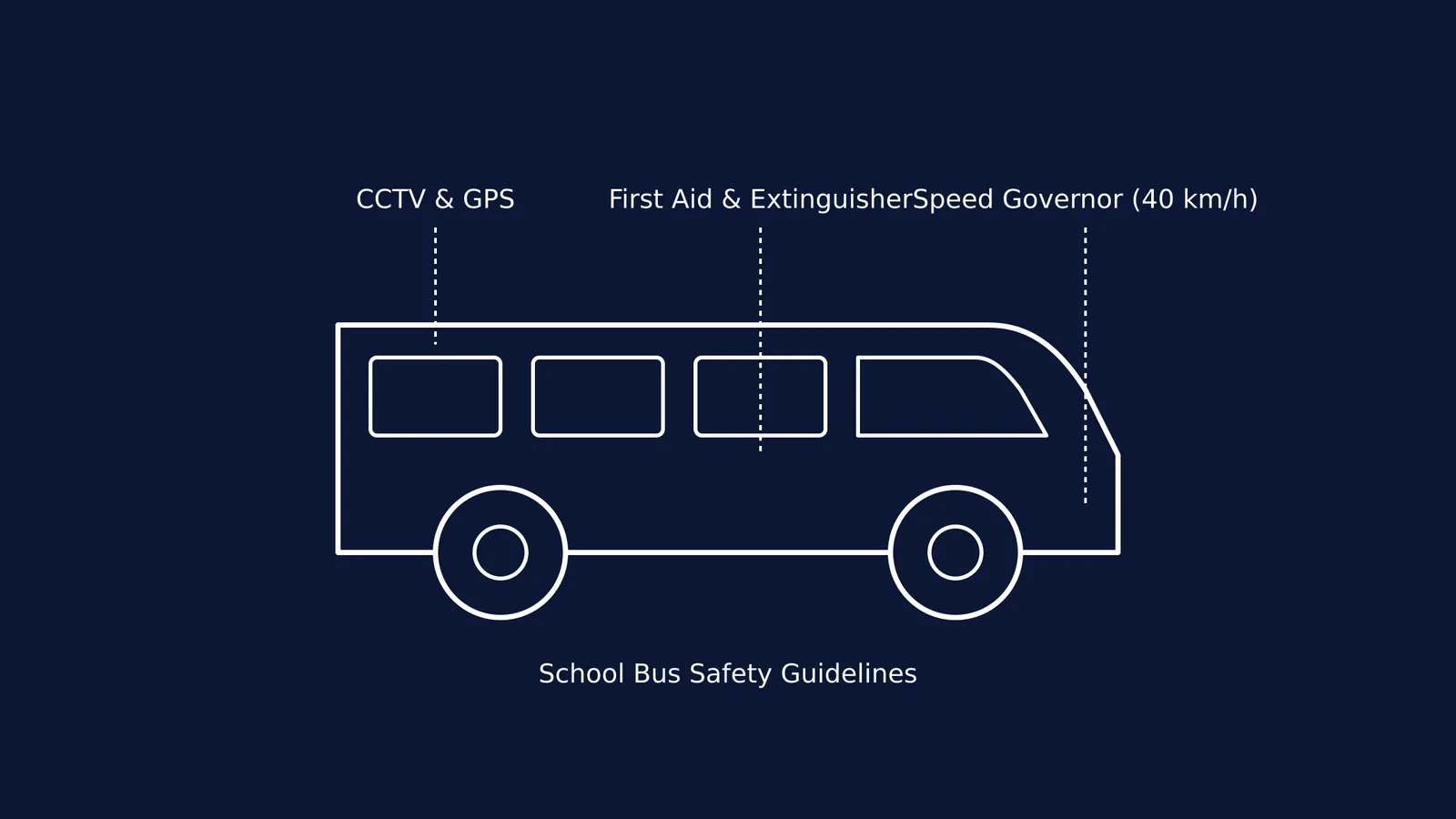
Technology plays a crucial role in modern school transport safety. A speed governor must be installed to limit the bus to a maximum speed of 40 km/h Source.
Additionally, all school buses must be equipped with a functional Global Positioning System (GPS) and CCTV cameras. The school's transport manager is responsible for ensuring these systems are working and monitored regularly. The CBSE also encourages schools to invite parent volunteers to travel on the bus as vigilant observers, ensuring another layer of accountability.
What are the pick-up and handover rules?
The physical safety of the bus is only half the equation; the procedure at the designated stops is just as critical. Schools are required to maintain a complete list of all students on the bus, including their designated stops and blood groups Source.
Children must be actively assisted by the attendant while boarding and alighting. Ask your school about their handover policy: what happens if a parent or designated guardian is not at the stop to receive a younger child? Most schools have a strict policy to bring the child back to the school premises rather than leaving them unattended. Clarifying these rules early prevents miscommunication during emergencies.
Setting up a calm transition at home
Knowing the commute is safe allows you to focus on your child's learning once they arrive home. Establishing a predictable after-school routine helps them shift gears from a noisy bus ride to a focused evening.
Give them time to rest and have a snack before diving into homework. If they struggle with a topic covered in class that day, it helps to have a reliable way to review it without pressure. They can open the Fermi Concept Library to find a clear lesson on any idea in physics, chemistry, biology or mathematics. Fermi's AI tutor can then work out what they already know and build a plan for the session, so they sit down to a clear next step.
When you ask the right questions about school transport, you build a foundation of safety. That security extends from the morning pick-up all the way to their evening study routine.
Read more: