On this page
When a child asks for a coveted gaming accessory, a tablet, or wireless headphones, parents often face a familiar dilemma. Flatly saying no can spark resentment, while purchasing the item immediately robs them of a chance to practice delayed gratification and self-regulation. Setting up a structured savings goal—powered by a visible milestone chart and matched contributions—turns an expensive gadget into an enduring lesson in financial capability.
Why is saving for a gadget so difficult for children?
Saving money requires sacrificing an immediate pleasure for an uncertain, distant reward. In developmental psychology, this capacity matures gradually. Research by Annette Otto and colleagues published in the Journal of Economic Psychology demonstrated that children under age 10 typically rely on all-or-nothing spending habits. They either spend their pocket money immediately or attempt total deprivation, struggling to maintain a dedicated reserve for future targets while navigating everyday temptations.
Longitudinal evidence by Paul Webley and Ellen Nyhus in the Journal of Economic Psychology showed that active parental socialization—such as discussing trade-offs and encouraging structured saving—directly shapes a child's future orientation, which in turn predicts their saving behaviour into young adulthood.
Without structured guidance at home, peer influence often overwhelms young savers. According to the OECD PISA 2022 Financial Literacy Report, 83% of 15-year-old students discuss money for things they want to buy with their parents at least monthly, yet 60% admit to buying items simply because their friends have them. The same report found that high performers in financial literacy are 72% more likely to save regularly, proving that explicit habits make an enormous difference.
How do visual charts and matching contributions work?
To help children sustain motivation over several weeks or months, two behavioral interventions prove decisive: visual progress tracking and matched incentives.
In behavioral research by Dilip Soman and Amar Cheema in the Journal of Marketing Research, earmarking money with a visual reminder of the goal and partitioning savings into distinct physical envelopes substantially increased savings rates and strengthened impulse control. Furthermore, Amar Cheema and Rajesh Bagchi showed in the Journal of Marketing that external visual representations of progress make goals feel psychologically closer, significantly increasing effort and commitment as people approach their target. A wall chart or milestone ladder translates an abstract number into a concrete finish line.
Meanwhile, matching contributions provide an immediate boost that mimics adult savings incentives, like employer retirement matches. In a study on matched savings for school-age children by Kareen Tonsing and Corinne Ghoh in Children and Youth Services Review, providing a 1:1 match for savings up to S$600 shifted children toward a prudent mindset, higher saving intentions, and a significantly lower temptation to spend. Offering to match whatever your child saves (e.g. ₹1 for every ₹1 saved) makes a high-ticket gadget realistic without handing it over for free.
How do you build a step-by-step savings roadmap?
Putting this into practice requires clear ground rules before the first rupee goes into the jar. Use this four-step roadmap:
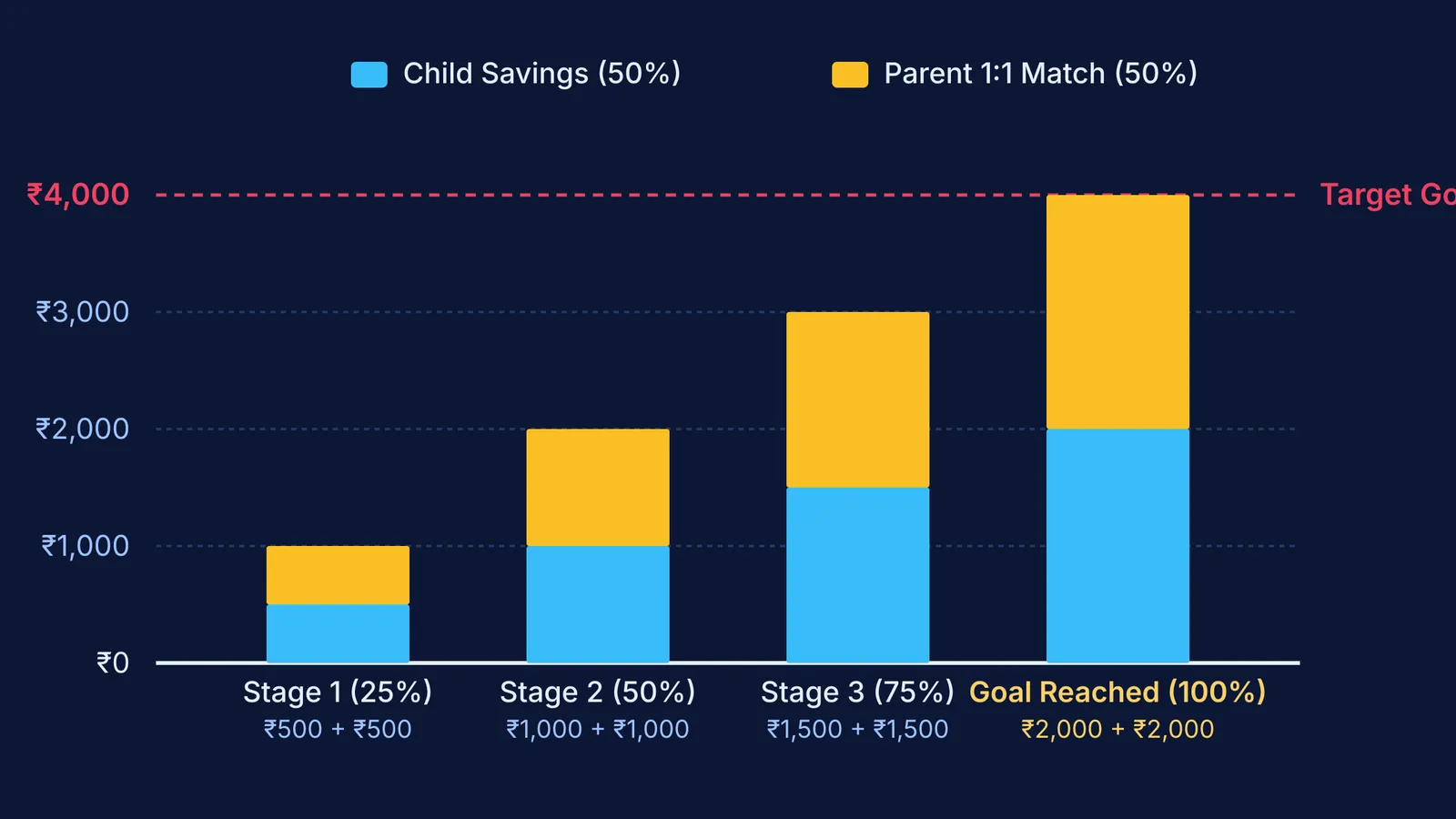
Agree on the exact target and split. Research the gadget's total price including taxes or accessories (for instance, a pair of study headphones costing ₹4,000). Agree on a fair split, such as a 1:1 match where the child saves ₹2,000 and the parent contributes ₹2,000 upon completion.
Build a physical milestone tracker. Draw a ladder or thermometer chart divided into four equal stages (e.g. ₹500 saved by the child earns ₹500 in matching commitment, reaching ₹1,000). Pin the chart on a study board or bedroom wall where the child sees it daily.
Identify distinct earning channels. Clarify how the child will collect their share—whether through regular pocket money, monetary festival gifts, or doing extra household tasks beyond baseline family responsibilities.
Establish clear rules for small setbacks. If an impulse purchase tempts them along the way, encourage a 48-hour pause before spending.
This collaborative approach builds agency, aligning with autonomy-supportive parenting practices that foster internal motivation rather than compliance. It also connects directly to teaching your child to plan their time in structured steps, showing that long-term achievements come from steady, manageable milestones.
What should you do when saving momentum stalls?
A multi-week savings journey inevitably hits moments of boredom or fatigue. When progress slows, use the chart to refresh their perspective:
Celebrate milestone markers. When your child reaches the halfway mark or three-quarters of their target, celebrate the progress with a non-monetary reward, such as choosing the weekend family film or making a favorite meal.
Frame setbacks as planning adjustments. If an unexpected personal expense crops up, treat it as a budgeting recalculation rather than a failure, echoing methods used when setting study goals with if-then plans.
Involve them in practical arithmetic. Calculate remaining weeks together: "If you save ₹250 each week, how many weeks remain until we release the final ₹1,000 match?"
When children work through multi-step arithmetic or budgeting word problems at school, having clear visual explanations makes all the difference. The Fermi Problem Library has worked problems with a step-by-step solver that explains the reasoning rather than printing an answer.
By combining an easy-to-read visual tracker with matched incentives, you do more than help your child acquire a device. You equip them with the patience, planning habits, and executive control that underpin lifelong financial resilience.