On this page
Relocating to another country with a school-age child is rarely just a physical move. For a child, moving means losing their social bearings, adapting to unfamiliar accents, and shifting to an educational system with completely different grading rubrics and classroom expectations.
Planning ahead across curriculum mapping, administrative legalisation, language support, and home routines prevents academic regression and eases the psychological weight of the move.
How do you map curricula across different school boards?
The first hurdle families face is calendar misalignment. Indian school boards such as CBSE and CISCE follow an April-to-March academic year, whereas schools across North America, the United Kingdom, Europe, and international systems in the Middle East run from September to June. Moving mid-year—such as during the July monsoon break or December winter holidays—means entering mid-semester or waiting months for the new session.
The structural arrangement of subjects also differs dramatically. If you are comparing school boards such as CBSE, ICSE, or international curricula, note how STEM subjects progress:
Integrated vs modular science: Indian curricula teach physics, chemistry, and biology concurrently through Class 10. By contrast, traditional American high schools often teach science sequentially—taking biology in Grade 9, chemistry in Grade 10, and physics in Grade 11.
Mathematics pathways: CBSE and ICSE weave algebra, coordinate geometry, and trigonometry into every annual syllabus. International GCSE (IGCSE) and the International Baccalaureate (IB) focus more on investigative tasks, statistical interpretation, and calculator-based analysis.
Assessment style: Indian exams prioritize comprehensive board-style written derivations and numeric precision. International schools often grade heavily on continuous coursework, lab write-ups, and criterion-referenced rubrics.
Before moving, request detailed topic outlines from the new school's admissions office. If your child discovers subject gaps—such as unseen geometry units or unfamiliar calculus notations—the Fermi Concept Library covers every concept in physics, chemistry, biology, mathematics and computing, each with its own lesson and its place in the map, allowing your child to preview prerequisite topics before their first day.
Which documents and apostilles do you need before moving?
Transferring school records across borders requires strict legal authentication. For destinations that belong to the Hague Apostille Convention of 1961, educational documents must receive an official Apostille sticker. For non-member countries (such as the United Arab Emirates or Qatar), records require multi-tiered embassy attestation.
According to guidelines from the Ministry of External Affairs of India, academic certificates and Transfer Certificates (TC) cannot be submitted directly by individuals. They must first be authenticated by the designated Regional Authentication Centre (RAC) or the Higher Education Department of the state where the school is located.
Once authenticated by the state, documents are submitted through authorized agencies such as BLS International or IVS Global. The Ministry of External Affairs charges a statutory fee of ₹50 per apostille sticker, alongside an agency service fee of ₹84 per document.
The Central Board of Secondary Education has phased out physical countersignatures for domestic school transfers in favour of digital verification on school websites. However, foreign educational ministries frequently insist on stamped paper documents. Ensure your transition dossier contains:
Original and apostilled Transfer Certificates: Stamped by the school principal and validated through state education channels.
Detailed academic transcripts: Marksheets and report cards covering the previous three academic years.
Syllabus and practical records: A list of completed course modules and laboratory experiments, which foreign high schools require to award equivalent course credits.
Pediatric vaccination records: Official immunization cards translated into English or the host country's official language.
How long does it take a child to learn in a new language?
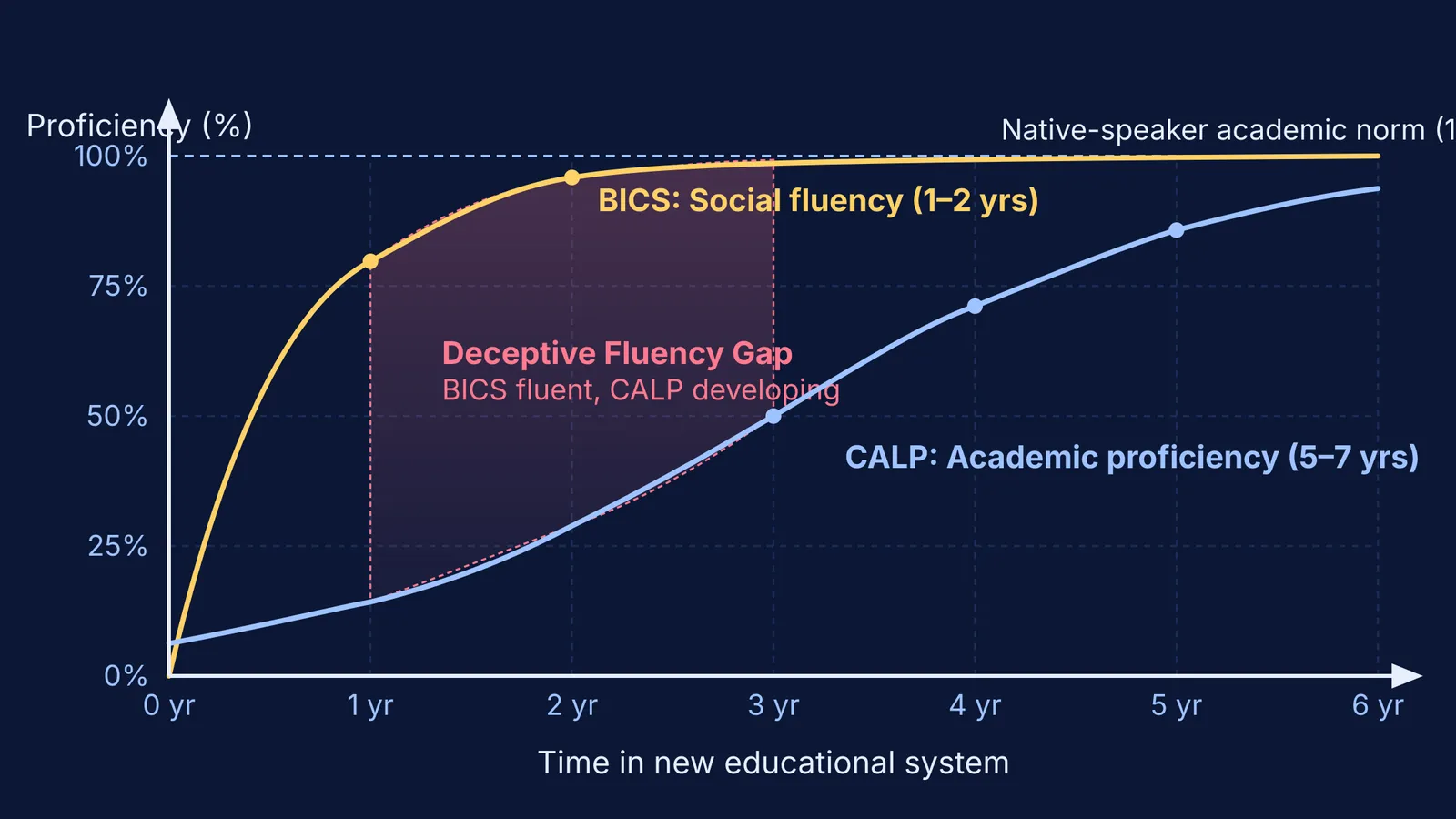
Parents often assume that once a child chats comfortably with classmates on the playground, language is no longer an obstacle. Educational linguistics shows that conversational ease masks deeper academic hurdles.
In seminal research published in the *Review of Educational Research*, Jim Cummins (1979) established the distinction between Basic Interpersonal Communicative Skills (BICS) and Cognitive Academic Language Proficiency (CALP). BICS represents everyday conversational fluency, supported by contextual gestures and vocal cues. Children typically develop BICS within one to two years of immersive exposure.
In contrast, CALP—the context-reduced, abstract vocabulary needed to read textbooks, write persuasive essays, and interpret word problems—requires five to seven years to reach native-speaker parity, as documented by Virginia P. Collier (1987) in *TESOL Quarterly*.
Data from the OECD (2018) report on immigrant student resilience shows that immigrant students who do not speak the language of assessment at home are around 8 percentage points less likely to be academically resilient than immigrant peers speaking the language of assessment at home. In achieving baseline academic proficiency across reading, mathematics, and science, non-native-speaking immigrant students trail native students by 17 percentage points.
When tackling unfamiliar multi-step word problems, students can consult the Fermi Problem Library, which provides worked problems with a step-by-step solver that explains the reasoning rather than printing an answer.
What daily routines help a child settle into a new school?
In *Third Culture Kids: Growing Up Among Worlds*, sociologists David C. Pollock and Ruth E. Van Reken outlined how globally mobile children move through five predictable stages: Involvement, Leaving, Transition, Entering, and Re-involvement.
To help a child depart constructively, Pollock and Van Reken created the RAFT model:
Reconciliation: Resolving interpersonal tensions with peers or teachers before moving.
Affirmation: Expressing gratitude to friends, coaches, and relatives.
Farewells: Saying explicit goodbyes to people, neighbourhood spots, and school spaces.
Think Destination: Exploring photos, street views, and transit maps of the new city together.
Upon arrival, predictable home routines protect children against sensory exhaustion. Start by setting up a dedicated home study space with familiar books and stationery. Maintain consistent bedtimes, preserve home-cooked family dinners, and focus on building a sustainable study routine that leaves generous time for unstructured decompression.
Reassure your child directly that their brain is doing double duty translating instructions, social etiquette, and classroom rhythms, and that an initial dip in grades is completely normal rather than a reflection of their ability.