On this page
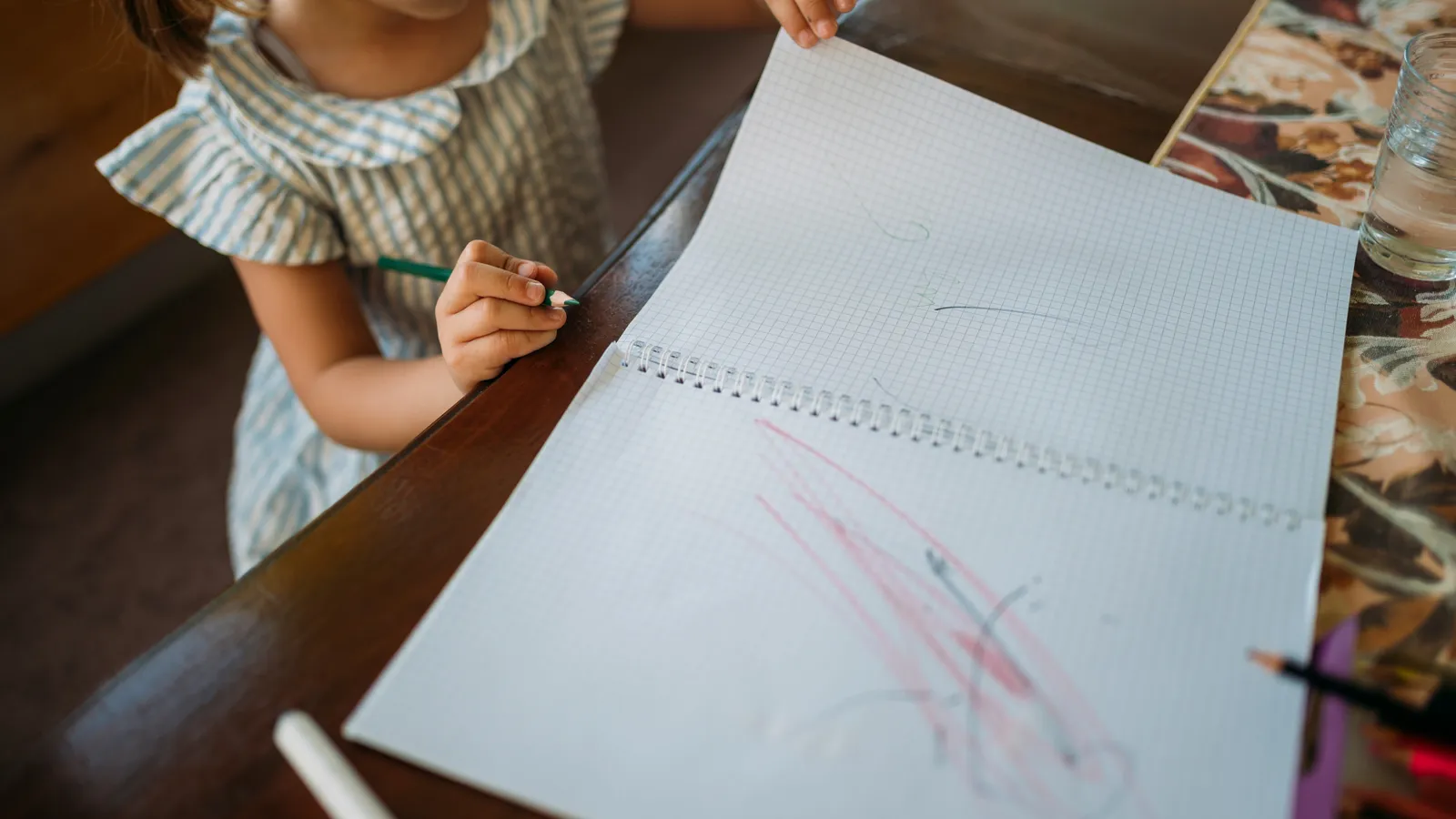
Your four-year-old hands you a crayon and says, “Teach me to write.” That is good news, and you do not need a stack of handwriting worksheets to answer it. The useful job at this age is to keep the interest alive: lots of drawing, lots of mark-making, the letters of their own name, and no pressure about neat rows.
Is four too early to learn writing?
It is not too early to start, but it is early for formal handwriting drills. Children build knowledge about writing long before school teaches it. In a study of 372 preschoolers, Puranik and Lonigan (2011) found that children appear to progress along a continuum from scribbling to conventional spelling, and that children as young as 3 already know features of writing. So the scribbles your child proudly calls “writing” are part of the path, not a detour.
The Illinois Early Learning Project at the University of Illinois describes children aged 3 to 4 making distinct marks, drawing pictures and trying to label them, and writing real letters, especially those in their name. The same toolkit places learning to hold a pencil correctly at ages 5 to 7, and says plainly: “There is no need to rush young children to write with paper and pencil.”
India’s own framework makes a similar point. NCERT’s National Curriculum Framework for the Foundational Stage 2022 says the curriculum for ages 3 to 6 should build on children’s capacities at that age “instead of a downward extension of the curriculum from Grade 1.” In plain words, a four-year-old’s day should not look like a shrunken Class 1 notebook.
Should my child trace letters or write them freehand?
Tracing is fine as a game, but it should not be the main event. In a brain-imaging study, James and Engelhardt (2012) had five-year-olds who could not yet read either print, type or trace letters and shapes. When the children later looked at letters in a brain scanner, a “reading circuit” was recruited only after they had printed the letters by hand, not after typing or tracing them. It was a single lab study, so treat it as a hint rather than a rule. The hint is still useful: a wobbly letter your child makes on their own is doing something a perfect traced one may not.
What can I do at home this week?
Think of it as a ladder. Your child picks the rung; you keep the materials within reach.
Big movements first. A slate, chalk on the floor, or a finger in a tray of sand or atta. Circles, lines, zigzags, rain, waves.
Draw and tell. Ask them to draw something, then say, “Tell me about it.” Write one word or sentence they say under the picture while they watch.
Their name. Make the first letter of their name with play dough, sticks or chalk. The Illinois toolkit suggests writing the letters of their own name with different tools and notes that using only capital letters is fine.
Tracing as play. Trace a big letter with a finger, a toy car or a wet brush. A few minutes is enough.
A freehand try. Ask them to “write” a shopping list, a card for Nani, or a sign for their room. Accept squiggles, letter-like shapes and real letters equally.
Chunky crayons and thick chalk are easier for small hands than thin pencils. Ten relaxed minutes beat a long sitting that ends in tears.
What do I say when they ask “Is this right?”
A short script helps you stay encouraging without correcting every line:
Child: “I wrote Amma!” You: “You did! Read it to me.” Let them read their own marks.
Child: “Is this an A?” You: “It has the pointy top of an A. Want to make another one next to it?”
Child: “I can’t do it.” You: “Let’s make it big on the floor first, then try on paper.”
Child: “I don’t want to.” You: “Okay. Do you want to draw instead?” Then stop.
The Illinois toolkit’s advice to adults sums it up: “Celebrate all attempts at writing.”
When should I slow down or ask for help?
Back off if writing time often ends in frustration, if your child starts avoiding crayons, or if you notice yourself correcting more than playing. Interest comes and goes at four, and that is normal; the crayons will still be there next week.
If you have a real concern about how your child uses their hands, their eyesight, or their speech and language, talk to your paediatrician, who can refer you to an occupational therapist or another specialist. A worksheet is not a diagnosis.
We build learning tools for older students. Fermi’s AI tutor starts each session by working out what the student already knows and building a plan, and the same habit helps at home with a four-year-old: notice what they can do now, then offer the next small step.
For tonight, leave paper and a few fat crayons where your child can reach them, and wait to be shown what they have “written”.