On this page
When your child comes home from a NEET mock and says “I got 540” or “I lost 40 to negatives”, the numbers only make sense if you know how the paper is built. The good news is that the structure is simple, and once you know it you can ask better questions than “Why not more?” For context, close to 20 lakh candidates appeared for NEET (UG) 2026 and 11.21 lakh qualified, according to the NTA results press release of 16 July 2026.
What subjects are in NEET and how many marks is each worth?
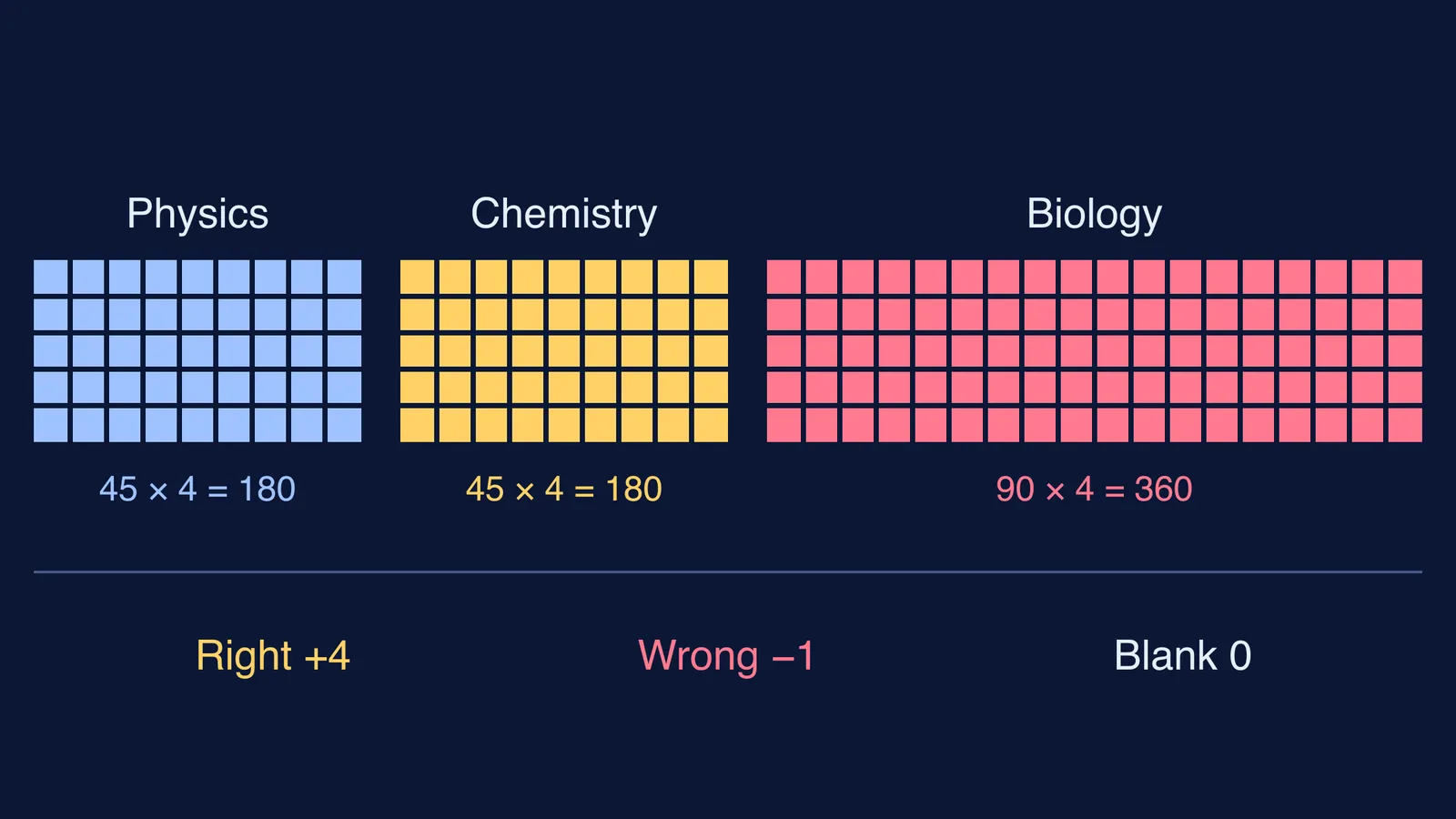
NEET-UG has three subjects: Physics, Chemistry and Biology. Before the 2026 re-examination, the National Testing Agency (NTA) set out the split, as reported by ETV Bharat:
Physics: 45 questions, 180 marks
Chemistry: 45 questions, 180 marks
Biology: 90 questions, 360 marks
Total: 180 questions, 720 marks
Biology is half the paper. A child who is strong in Biology but weak in Physics can still do well, but the 180 Physics marks are too many to give up.
The writing time is 180 minutes, according to NTA's application notice for NEET (UG) 2026. For the June 2026 re-examination, NTA extended the window to 195 minutes, from 2:00 pm to 5:15 pm, to cover signing and other formalities, as its 12 June 2026 notice explains. The 2026 paper was pen and paper, in 13 languages, according to NTA's re-examination notice. Our post on the NEET-UG paper pattern, sections and timing goes into more detail.
How does NEET negative marking work?
Every question is multiple choice, with answers given as option numbers 1 to 4 in NTA's final answer key, and every question follows one rule, per NTA's stated marking scheme:
Right answer: plus 4
Wrong answer: minus 1
Left blank: 0
So a wrong answer does more than miss 4 marks. It also takes 1 away. That is why aspirants talk about “negatives” and why skipping a question is sometimes the smart choice. For when a guess is worth the risk, read negative marking in JEE and NEET: when is guessing worth it?
How do you read a NEET mock test score?
Here is a worked example with two students who come home with almost the same total.
Aarav attempts 160 questions: 130 right, 30 wrong, 20 blank. Score = 520 - 30 = 490.
Meera attempts 140 questions: 125 right, 15 wrong, 40 blank. Score = 500 - 15 = 485.
The totals are 5 marks apart, but the stories are different. Aarav got 130 of his 160 attempts right, and his 30 wrong answers cost him 150 marks: the 120 he could have earned plus the 30 deducted. His next step is accuracy: slowing down and skipping what he is unsure of. Meera got 125 of her 140 attempts right but left 40 questions untouched. Her next step is coverage: closing topic gaps or working faster.
The same total can need opposite advice. So ask for three numbers, not one:
How many questions were attempted?
How many of those were right?
Which subject lost the most marks?
Our guide on how to analyse a mock test in 60 minutes shows how your child can turn those numbers into a plan.
What is changing for NEET-UG 2027?
The 2026 cycle was disrupted. The exam held on 3 May was cancelled on 12 May amid paper-leak allegations, ETV Bharat reported, and NTA held a re-examination on 21 June 2026, as its results press release records. On 15 May 2026, Union Education Minister Dharmendra Pradhan said NEET would move to a computer-based test from 2027, The Quint reported.
Exam rules change, so treat the numbers above as the 2026 pattern. When NTA publishes the NEET (UG) 2027 information bulletin on neet.nta.nic.in, check the subjects, marks, timing and mode there before your child plans around them.
What should you say in a progress conversation?
Swap “What did you get?” for questions that point to a next step:
“How many did you attempt, and how many were right?”
“Which subject cost you the most marks this time?”
“For the wrong ones, did you know the topic but slip, or did the topic feel new?”
“What is one thing you will change before the next mock?”
Then listen more than you advise. If the answer is “I knew the topic but used the wrong method”, the Fermi Problem Library has worked problems with a step-by-step solver that explains the reasoning rather than printing an answer. If it is “the topic felt new”, the Fermi Concept Library has a lesson for each concept in physics, chemistry and biology.
If your child seems stressed for weeks, talk to their school counsellor or a doctor. Tele MANAS is a free, 24x7 national mental-health helpline from the Ministry of Health and Family Welfare, reachable on 14416 or 1800-891-4416, according to the IIT Kanpur counselling page.
Start with the three numbers after the next mock, and let your child do most of the talking.