

On this page
Class 6 often happens in the same building, with the same friends, so it can look like a small step. It is not. The timetable fills with new subjects, a different teacher walks in every period, and homework stops being a quick worksheet. Children who settle well tend to get used to the new routines quickly, so build them in the first term, before the work gets heavy.
What actually changes in Class 6?
Under India's National Curriculum Framework for School Education 2023 (NCF-SE), Class 6 is the first year of the Middle Stage, which runs from Grades 6 to 8. Three changes matter most at home.
Subject teachers. In Classes 3 to 5, the framework says teachers "continue to be generalists". In the Middle Stage, "subject-specific Teachers handle different Curricular Areas", so your child adjusts to several teachers, each with their own rules for notebooks and deadlines.
New subjects and harder ideas. Science and Social Science become separate areas, children get exposure to Vocational Education, and the framework describes "a shift to more abstract ideas". It says the wider range of subjects and the more abstract ideas "could be challenging for students".
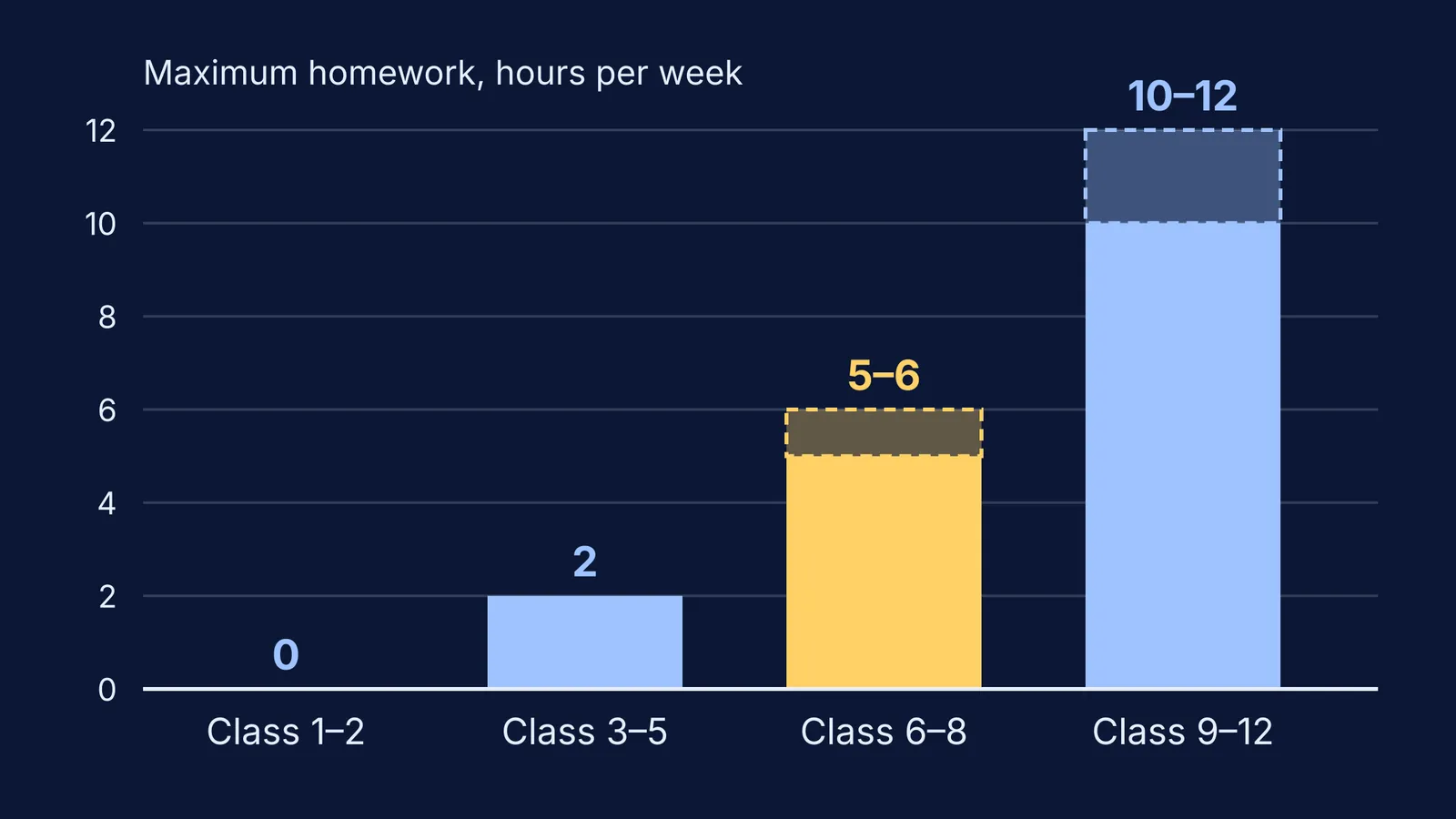
More homework. The Ministry of Education's School Bag Policy 2020 recommends no more than two hours of homework a week in Classes 3 to 5, and up to one hour a day (about five to six hours a week) in Classes 6 to 8.
If your child is in a CBSE school, there may be one more change. CBSE circular Acad-17/2026 of 9 April 2026 directs schools to teach a third language (R3) from Class 6 in 2026-27, so check with the school which language your child will take.
How do children cope with moving up to middle school?
Most cope well, especially with help from home. One large study of this move comes from England, where children change schools at 11, so read it as a guide rather than an exact match for Indian schools. In a survey of 550 children by Maria Evangelou and colleagues for England's Department for Children, Schools and Families, 84% said they felt prepared for secondary school, and many said family or teachers helped by explaining what to expect.
The same study found that only 3% of children were worried or nervous a term after starting secondary school. One of the five signs of a successful transition it identified was getting used to new routines and school organisation. Children who had problems dealing with different teachers and subjects, or with making new friends, tended to have a harder time.
What study habits should a Class 6 child build in the first term?
Build one habit at a time, in this order, over about twelve weeks.
Weeks 1 to 2: the timetable. Copy the class timetable and stick it near the study table. Each evening, your child packs tomorrow's bag from it, alone.
Weeks 3 to 4: one homework diary. Every subject's homework goes in one place, with the date it is due. Tick items off when done.
Weeks 5 to 6: a fixed homework slot. Same time daily, phone in another room. Keep the School Bag Policy's ceiling of one hour a day in mind; if work regularly runs much longer, raise it with the class teacher.
Weeks 7 to 8: a ten-minute review. After homework, your child explains one thing they learnt that day in their own words. If they cannot, that is the topic to reread.
Weeks 9 to 12: planning ahead. On Sunday, look at the week's tests and projects together and split big tasks into small daily pieces.
For more on that last step, see our guide to teaching your child planning skills. A quiet, fixed spot also helps; here is how to set up a home study space.
New science words can trip up Class 6 students. When an idea does not make sense from the textbook, the Fermi Concept Library covers every concept in physics, chemistry, biology, mathematics and computing, each with its own lesson, so your child can look it up before asking the teacher.
How can parents help without taking over?
Ask about the system, not just the marks. Try these at dinner in the first weeks:
"Which teacher is the strictest about notebooks?"
"What is due this week, and which one looks hardest?"
"Did anything today feel confusing? Who could you ask tomorrow?"
Resist packing the bag or writing the diary for them, even when it is faster. The point of the first term is that your child does it, slowly at first.
If homework becomes a nightly battle, our piece on how much homework is reasonable can help you judge whether the load or the routine is the problem.
Some nerves in the first weeks are normal. If worry lasts beyond the first term, or affects sleep or eating, talk to the class teacher or school counsellor. Tele MANAS, the free 24x7 national mental-health helpline, is on 14416.
Start this week with the timetable on the wall and one diary in the bag.


