

On this page
Messy handwriting is often not about effort. It usually comes down to how each letter is formed: where it starts, which way the pencil travels and where it stops. That can be practised at home in a few minutes a day.
Why is my child's handwriting so messy?
A common cause at ages 5 to 9 is letters started in the wrong place. An "o" drawn clockwise from the bottom, or a "d" made as a circle plus a separate stick, can look fine alone but tends to fall apart when the child speeds up.
Pages of copying can make this worse. The Department for Education's writing framework for schools in England (July 2025) warns that asking children to copy from the board or book, trace around dotted letters or practise without supervision "can hinder their ability to build a strong mental model of the movement patterns that underpin letter formation". The framework says handwriting should be taught daily, in small steps, and demonstrated by the teacher.
Does pencil grip matter for neat handwriting?
Less than many parents think. In a 2012 study in the American Journal of Occupational Therapy, Heidi Schwellnus and colleagues videotaped 120 typically developing Grade 4 children and found that pencil grasp patterns did not influence handwriting speed or legibility. A 2013 study by the same team concluded that interventions for handwriting difficulties "should focus more on speed and letter formation than on grasp pattern."
The DfE framework still asks schools to teach beginners a grip. It says most pupils find the tripod grip easiest to learn: pinched between thumb and index finger just above the sharpened point, resting on the middle finger, held relaxed.
Ages 5 to 6: show the tripod grip and gently remind. A sticker where the fingers go can help.
Ages 7 to 9: if the grip is comfortable, the writing readable and nothing hurts, leave it and work on letter formation.
Any age: if writing hurts, the paper tears from pressure, or your child avoids writing, talk to the class teacher.
What are letter families in handwriting?
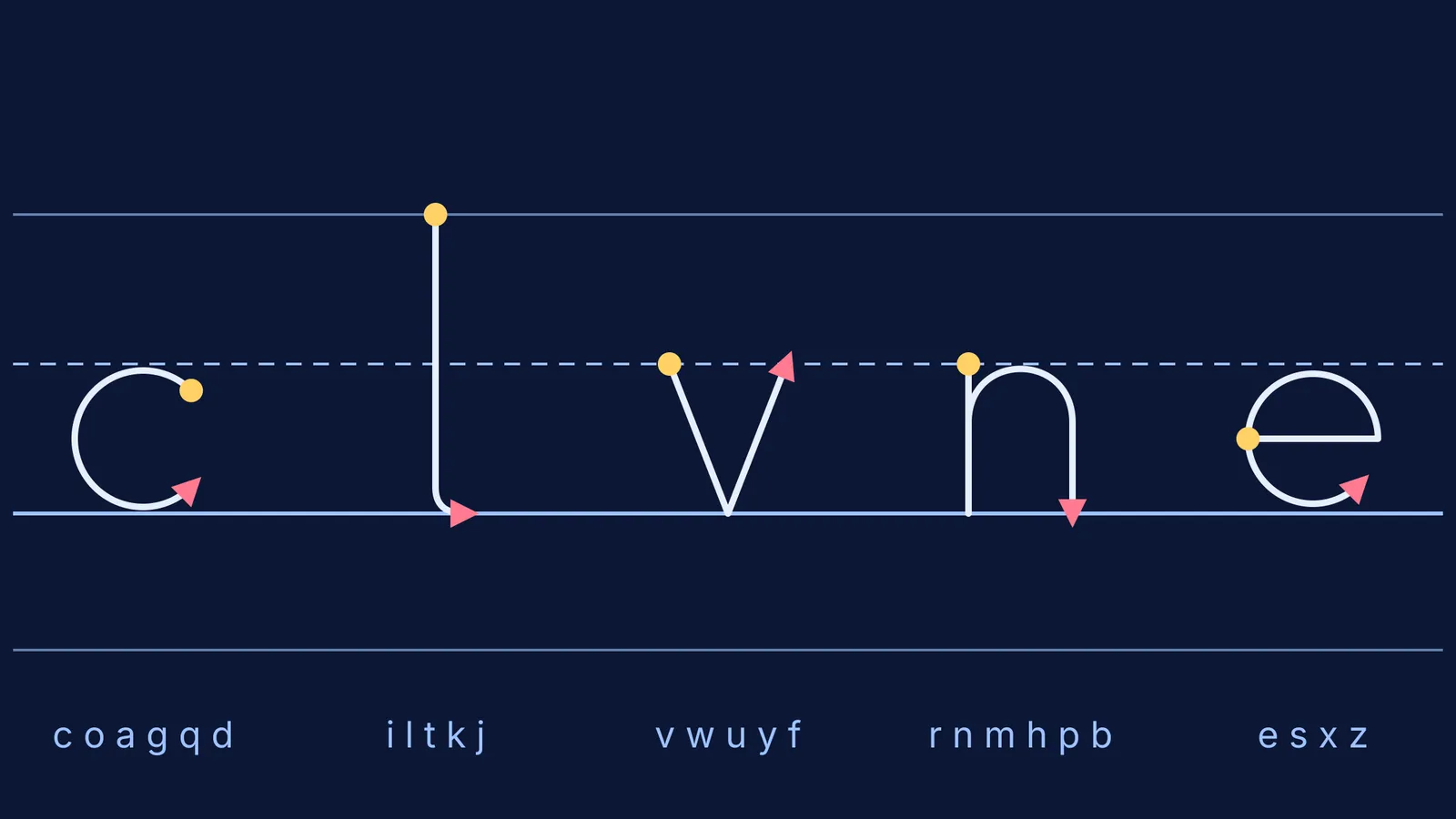
Letter families are groups of lower-case letters formed in similar ways. The DfE's handwriting guidance groups them by where each letter starts and lists these typical families:
c o a g q d
i l t k j
v w u y f
r n m h p b
e s x z
Practising one family at a time means one correct movement gets repeated, then reused. The "c" letters, for example, start at the top right and go round anticlockwise, so once "c" starts in the right place, "a", "d", "g" and "q" follow. Families differ slightly between schemes, so ask which one the class uses.
What does five minutes of handwriting practice look like?
In a study by Steve Graham, Karen Harris and Barbara Fink, first graders with handwriting and writing difficulties had 27 fifteen-minute sessions on accurate, fluent letter writing. Compared with a group taught phonological awareness, they made greater gains in handwriting and in how fluently they composed, and the gains were still there six months later. A meta-analysis by Tanya Santangelo and Steve Graham found that teaching handwriting improved legibility (effect size 0.59) and fluency (0.63), while motor instruction on its own did not.
Those sessions were longer. This five-minute routine is our own starting point, built on the framework's advice; use wide-lined paper, most days:
Minute 1, get ready: feet flat, back against the chair, pencil in one hand, the other hand holding the paper.
Minute 2, you show: write one letter from today's family slowly, saying the movement aloud: "start at the top, down, back up, over and down" for "n".
Minute 3, they try: your child writes it three times, saying the words. Watch the start point, not the neatness.
Minute 4, family words: dictate two or three short words using the family, such as "man" or "hop", not a page to copy.
Minute 5, circle the best: your child circles their neatest letter and says why.
When a letter goes wrong, say "Show me where you started," then model it once more.
Move to the next family only when the current one starts correctly most of the time. If your child resists writing altogether, see why a Class 1 child refuses to write; if b and d keep swapping, read what helps when a child mixes up b and d. The framework says joined writing should wait until print letters are formed correctly and consistently, as our piece on whether a Class 4 child should learn cursive explains.
When should you get help for handwriting?
Talk to the class teacher if, after a few weeks of short daily practice, others still cannot read your child's letters, they write far more slowly than classmates, or their hand hurts. They can advise whether a specialist should take a look.
When your child is older and brings a scanned assignment to Fermi's AI tutor, the tutor works out what they already know and builds a plan for the session.
Start tonight with one family, the "c" letters, and five minutes.


