

On this page
In Class 4, the volume of schoolwork suddenly increases, and the debate over handwriting comes into sharp focus. Should you insist on cursive practice when exams often just demand a legible answer? While typing and print dominate the digital age, a growing body of research shows that the connected loops of cursive writing do much more than look pretty—they fundamentally change how a child's brain processes information.
What do CBSE and schools expect?
If your child struggles with cursive, it helps to know the official rules. There is no current CBSE circular that makes cursive writing mandatory for primary students. Instead, CBSE’s consistent requirement is simply legibility and neatness.
Historically, a 2005 CBSE circular (No. 21/05) included "Handwriting (Cursive)" in the grading scale for Classes I and II, but shifted to general "Handwriting" for Classes III to V. Recent NCERT textbooks, such as the *Mridang* series for early classes, lean toward print-style letters rather than cursive instruction.
However, many schools still encourage cursive by Class 4 because it promotes writing fluency. At this stage, teachers evaluate whether a child can maintain uniform letter size and spacing while writing at a speed that keeps up with longer answers. As long as the examiner can easily read what is on the page, the specific style does not matter for final marks.
The cognitive benefits of continuous loops
While neat print is perfectly acceptable in an exam, cursive offers unique cognitive benefits that go beyond the page. A January 2024 study published in *Frontiers in Psychology* by Audrey van der Meer at the Norwegian University of Science and Technology used high-density EEG to compare brain activity during writing and typing.
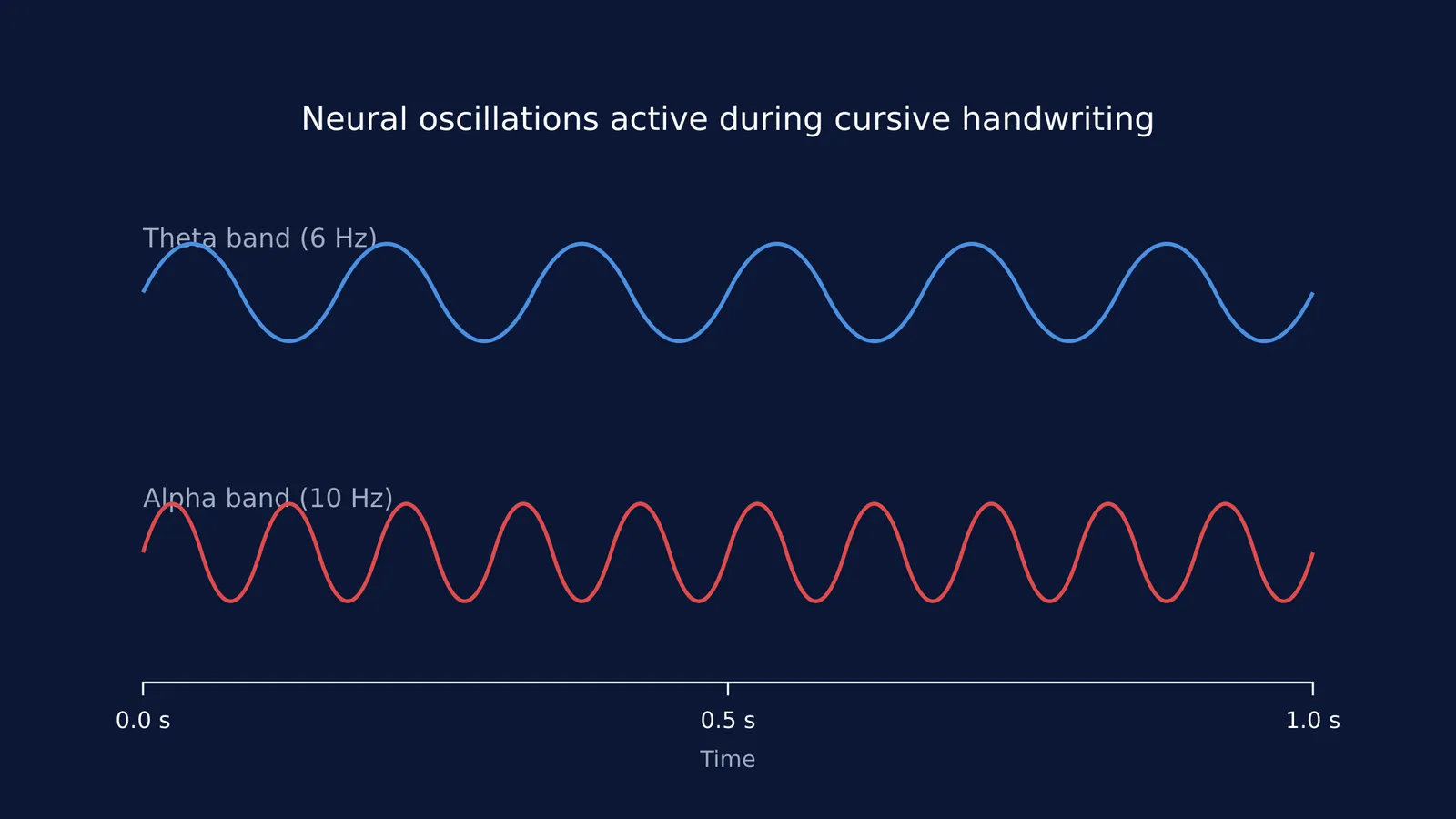
The researchers found that writing in cursive with a digital pen produced elaborate connectivity across the brain's parietal and central regions. Specifically, it triggered activity in the theta (3.5–7.5 Hz) and alpha (8–12.5 Hz) frequency bands, which are strongly linked to working memory and attention. Van der Meer concluded that the intricate motor movements of cursive create more "hooks" for the brain to hang memories on. Typing, by contrast, provided minimal sensory-motor stimulation because it involves the exact same repetitive finger motion for every single letter.
This enhanced connectivity helps develop automaticity. When a child no longer has to actively think about forming individual letters, their cognitive load drops significantly. They can dedicate their working memory to the actual content of their answers, rather than the physical mechanics of transcription.
Gentle home practice that avoids tears
If your school expects cursive, or you want to help your child build those neural memory hooks, home practice should not feel like a punishment. Here is a framework to keep it light and effective:
Focus on flow, not perfection: The goal is automaticity. Do not erase a word just because a loop is slightly crooked. The cognitive benefit comes from the continuous, uninterrupted movement, not from drawing a perfect replica of a standard font.
Try short sessions: Long, repetitive drills cause fatigue and resentment in young learners. Keep focused handwriting practice short, to a few minutes a day.
Start where they succeed: Fermi's AI tutor works out what a student already knows and builds a plan for the session, so you sit down to a clear next step; you can take exactly the same approach at home by beginning with the easiest letters (like 'e' and 'l') before moving to complex shapes.
Use a whiteboard: Practising on a whiteboard or a tablet lowers the stakes compared to a pristine notebook. Mistakes can be wiped away instantly, making the process feel less permanent and stressful.
Let them choose the words: Instead of standard drill sentences like "The quick brown fox," ask them to write the names of their favourite foods, game characters or places they want to visit.
What if my child still struggles?
Some students, especially those with learning differences like dyslexia or dysgraphia, find the motor demands of cursive overwhelming. If cursive remains a daily battle by Class 4, switching to a neat print or a semi-cursive "joined-up" style is a perfectly valid choice.
The ultimate objective of handwriting is for your child to confidently put their thoughts on paper. If learning the loops gets in the way of their expression, a clear print style is a practical and widely accepted alternative. Understanding how the brain processes these tasks—such as Alan Baddeley's working memory model, explained for students—can help you see why reducing the mechanical effort of writing is so crucial. When the cognitive load of holding a pencil drops, the quality of their ideas will naturally begin to shine through.


