On this page
Getting a seat in a Kendriya Vidyalaya (KV) is highly competitive because of the standardised curriculum and affordable fees. Originally set up for the children of transferable central government employees, KVs now follow a strict priority and lottery system to allocate seats fairly.
If you are planning to apply for the upcoming academic year, here is a breakdown of how the age limits, reservations and service categories work in practice.
What is the age limit for Class 1 in Kendriya Vidyalaya?
Following the National Education Policy (NEP) 2020, KVS has updated its minimum age requirement to align with the new schooling structure. A child must be at least 6 years old as of 31 March in the academic year they are applying for.
Minimum age: 6 years old (children born on 1 April are also considered eligible for that year).
Maximum age: The child must be less than 8 years old as of 31 March.
Relaxation: The school Principal can grant a two-year relaxation on the maximum age limit for Children with Special Needs (CwSN), giving them more time to enter formal schooling.
These cut-offs are strictly enforced by the online portal, so entering the correct date of birth from an official certificate is critical.
What are the priority categories for KV admission?
Because Kendriya Vidyalayas were created to ensure continuous education for children whose parents are frequently transferred across state lines, the school gives admission preference to certain professions. For Civil and Defence sector KVs, the priority order is structured as follows:
Category I: Children of transferable and non-transferable Central Government employees and Ex-servicemen. This category also includes Foreign National employees on deputation.
Category II: Children of transferable and non-transferable employees of Autonomous Bodies, Public Sector Undertakings (PSUs) or Institutes of Higher Learning of the Government of India.
Category III: Children of transferable and non-transferable State Government employees.
Category IV: Children of employees of State PSUs, Autonomous Bodies or Institutes of Higher Learning of the State Governments.
Category V: Children from any other category, including private sector employees, business owners or self-employed parents.
How does the KV lottery system work?
Being in Category I does not guarantee a seat automatically. KVS applies a computerized lottery sequence to ensure strict statutory reservations are met before filling the remaining seats by service priority.
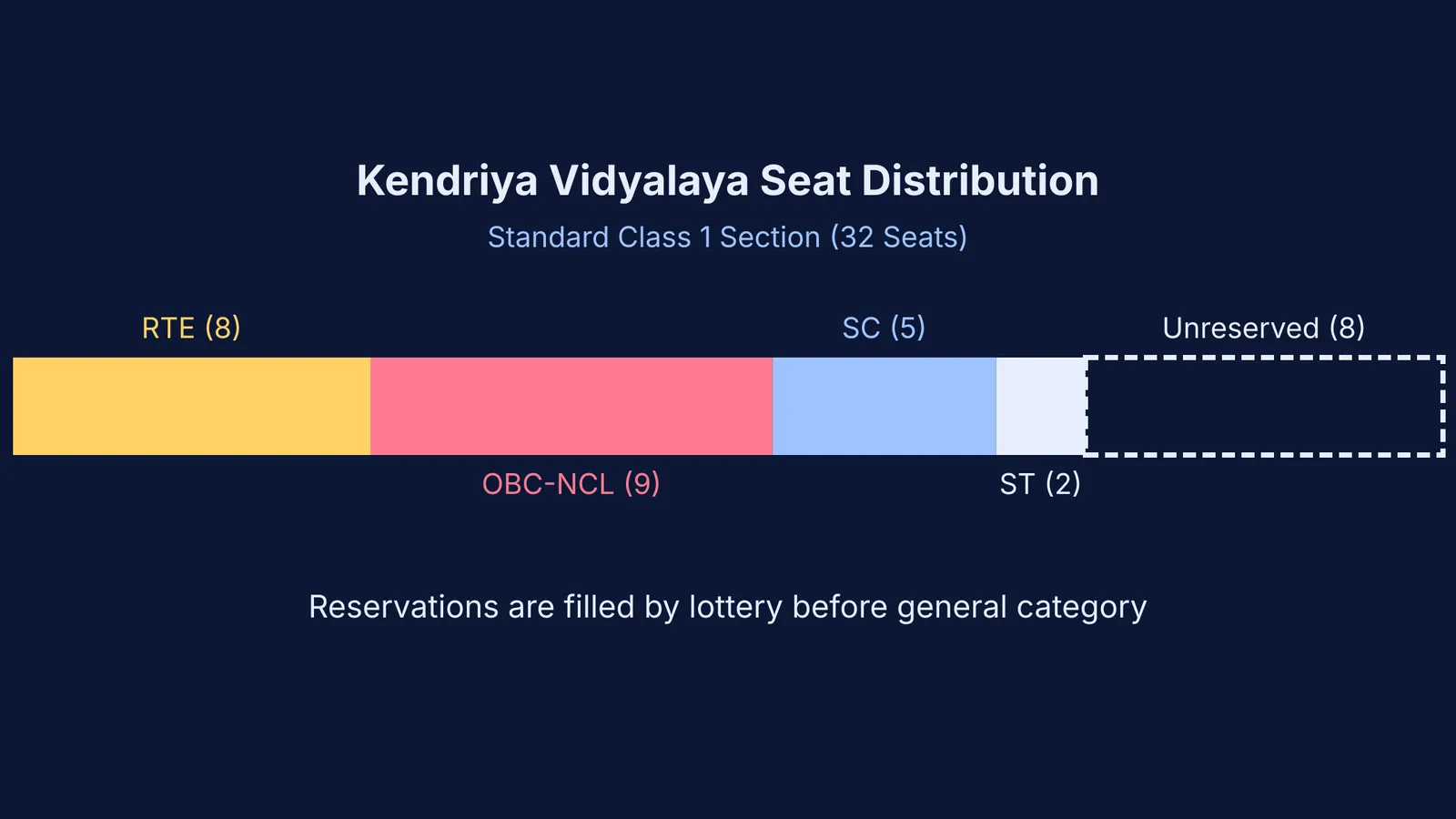
Right to Education (RTE): 25% of the total seats are reserved for children from economically weaker sections and disadvantaged groups living within a certain radius of the school.
Social Categories: The guidelines mandate 15% of seats for Scheduled Castes (SC), 7.5% for Scheduled Tribes (ST) and 27% for Other Backward Classes (OBC-NCL).
Horizontal Reservation: There is a 3% horizontal reservation for Differently Abled children (CwSN) applied across all categories.
The online system runs the lotteries in a specific order. It draws the RTE lottery first, followed by the CwSN lottery and the caste-based reservation lotteries. Only after these reservation quotas are completely filled does the school admit general category students, moving strictly down the service priority list.
How to apply for Kendriya Vidyalaya admission
Class 1 admissions are fully online and transparent. Parents must submit their application via the official KVS portal.
The registration window typically opens in early April and stays open for two to three weeks. You will need a digital copy of your child's birth certificate and a recent passport-sized photograph. If you are applying under RTE, SC, ST, OBC or a service priority category, you must also prepare the relevant certificates and proof of transfers to upload or present during document verification.
For Class 2 and above, admissions are mostly handled offline by individual schools and only take place if a seat becomes vacant.
Setting your child up for a new school environment is just the first step. Creating a predictable routine early on makes learning much easier. Reading together and Setting up a good study space at home: a parent's checklist can build lasting habits. Later on, when they encounter harder topics in middle school, the Fermi Concept Library has a lesson for every concept in physics, chemistry, biology, mathematics and computing, while our guide on CBSE, ICSE or state board: how families can compare them helps you evaluate the long-term academic path.