

On this page
Most parents of a JEE aspirant think about a Plan B. The worry is that saying it out loud sounds like "we don't think you'll make it". That worry is reasonable, and the research on backup plans shows both why and how to get past it.
Does talking about a backup plan make a JEE aspirant try less?
It can, if it comes up the wrong way. In three experiments, people randomly assigned to think through a backup plan then performed worse at their main goal, and part of the drop was explained by them wanting that goal less (Shin and Milkman, 2016). According to the University of Wisconsin–Madison summary of the study, the task was unscrambling sentences to win a snack or leave early, not an entrance exam, so treat it as a warning sign rather than a forecast.
The same summary says the researchers do not expect a backup plan to hurt goals that come down to luck or innate skill. JEE preparation depends heavily on effort, so the warning applies. Jihae Shin, the study's lead author, suggests: "You might want to wait until you have done everything you can to achieve your primary goal first."
Psychologists Christopher Napolitano and Alexandra Freund describe backup plans as sometimes "a safety net supporting goal pursuit" and sometimes an unnecessary cost that can "undermine motivation to persist" with the first choice (Napolitano and Freund, 2016). In their view, which one you get varies with the person, the situation and the goal.
So the question is not whether to have a Plan B, but when, how and how often you raise it.
When is the right time to bring up a backup plan?
Other exams have their own form deadlines, so raise it once, briefly, in an ordinary week, then let it rest. Good moments:
A calm weekend with no test the next day
When forms for other entrance exams are due anyway, because that gives you a neutral reason to talk
After a decent test result, when your child can't read it as a reaction to failure
Moments to avoid:
The evening after a bad mock test
The final weeks before JEE Main or JEE Advanced
Result day, or in front of relatives
How do you raise a backup plan without signalling doubt?
Talk about the goal, not the exam. Shin and Milkman define a backup plan as another way to reach the same higher goal if the first route doesn't work out (Shin and Milkman, 2016). For most aspirants that higher goal is something like "work on hard engineering problems", not "get into one particular IIT". Here is a script you can adapt:
Open with support: "This isn't about your mocks. You're working hard, and we're fully behind Plan A."
Give the reason: "I'd like us to spend one hour listing other routes to the work you want to do. Then neither of us has to carry it around in our heads."
Hand over the pen: "You write the list. I'll ask questions and handle the forms and dates."
Close it: "That's done. We won't bring it up again until the forms open."
Avoid "just in case", "let's be realistic" and anything that compares your child with a cousin.
If you and your partner see the options differently, agree between yourselves before you talk to your child.
What options should go on the list?
Start by showing that Plan A is wider than one college. For 2026-27, JoSAA allocates seats at 138 institutes: 23 IITs, IISc Bengaluru, 31 NITs, IIEST Shibpur, 26 IIITs and 56 other government-funded technical institutes (JoSAA). Then let your child add routes under the same goal:
State and university engineering entrance exams
A BSc in physics, maths or computer science, with a path into research or industry
A drop year, weighed honestly with this drop-year decision worksheet
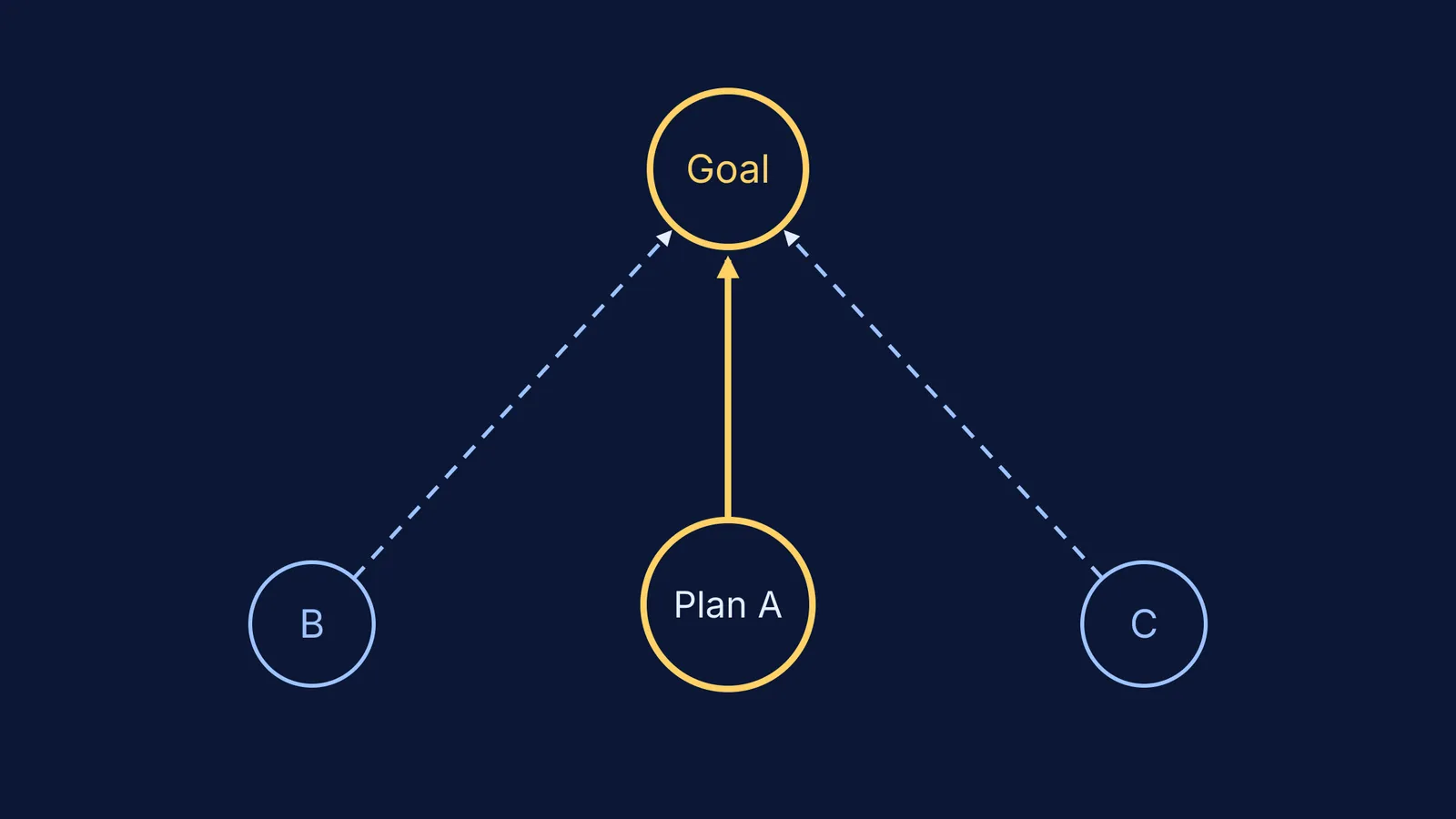
Worked example. Suppose your child's goal is "build things that use electronics". The one-page sheet might read: Plan A, JEE and JoSAA. Route B, a state engineering entrance exam, with the parent checking when its form opens. Route C, a BSc in physics and electronics, with the parent checking the university's admission notice. Each line has one owner and one date to check.
If making the list shows that your child doesn't know where to start with a weak chapter, Fermi's AI tutor can work out what they already know and build a plan for the session, so study time goes back to Plan A.
What if your child gets upset?
Listen first, and don't argue the list point by point. Say the plan is there to protect their effort, not replace it, and offer to finish another day. For what to say if results do fall short, read how to discuss a backup plan if JEE does not work out.
If your child seems hopeless, stops eating or sleeping, or talks about harming themselves, get help from a doctor or counsellor. Tele MANAS is a free, 24x7 national mental-health helpline on 14416 or 1800-891-4416, offering counselling and referrals in around 20 languages (IIT Kanpur counselling centre).
Write the list this weekend, put it in a drawer, and go back to backing Plan A.


