

On this page
The start of the academic year brings a new school calendar. Many families stick it on the fridge and only consult it when a test is near or a long weekend approaches. But using it to plan the whole family year in advance can drastically reduce stress, protect your child's mental well-being, and build a routine that actively supports learning. Taking a broader view of the academic year ensures that predictable rhythms are established before the heavy workload begins.
Why does predictability matter for mental health?
Children and teenagers thrive when they know what is coming next. A 2026 study published in *Nature Mental Health* analysed nearly 30,000 children and found that unpredictability in daily routines is a distinct and modifiable form of childhood adversity (10.1038/s44220-026-00681-x). The researchers, led by Laura M. Glynn and Tallie Z. Baram, discovered that inconsistent schedules—such as rapidly changing routines and uncertainty about what happens next—are strongly linked to depression, externalizing symptoms, anxiety and sleep disorders. The study demonstrated that screening for unpredictability uniquely identifies vulnerable individuals who might be missed by standard childhood adversity screenings, emphasising just how deeply a chaotic schedule affects young minds.
When a child's environment is unpredictable, their brain's stress response systems remain on high alert. By marking the school calendar early, you provide a biological safety signal. They can see exactly when the busy exam periods are, when assignments usually peak, and when they can expect a break. This lowers their baseline stress and removes the cognitive load of constantly guessing what the next week holds, making for a much calmer exam season at home.
How much does missing school for a holiday affect learning?
When you plan family trips or events without consulting the school's rhythm, you risk crossing a critical attendance threshold. According to Attendance Works, missing just 10% of the academic year—typically about 18 days—is defined as chronic absenteeism.
While a single family trip during term time might not seem harmful, these absences add up quickly when combined with inevitable sick days or family emergencies. Students who miss more than 10% of the year are significantly less likely to read at grade level by the end of third grade, or perform well in cumulative subjects like mathematics and physics later on. Mathematics, in particular, is taught in a linear sequence; missing a foundational concept makes the next three weeks of lessons incomprehensible. Chronic absence is also a leading early warning sign that a student will drop out of high school.
Educational travel can be highly beneficial, but planning it strictly around the official holidays ensures your child does not lose crucial instructional time or face the intense pressure of catching up on missed coursework.
How do you map the year with your teenager?
A calendar is a tool for autonomy. Instead of surprising your child with a suddenly restricted schedule a week before their exams, involve them in the planning from day one. Fermi's AI tutor works on a similar principle: it can work out what you already know and build a plan for the session, so you sit down to a clear next step. You can give your child that same clarity for their whole year by mapping out the calendar together.
Here is a practical framework and script for setting up your family year:
1. Set the stage: Approach the planning as a collaboration, not a dictate. You might say: *"I have got the new school calendar. Let's sit down for twenty minutes this weekend and map out the big events so we know when your busy weeks are, and when we should plan some downtime or a family trip."*
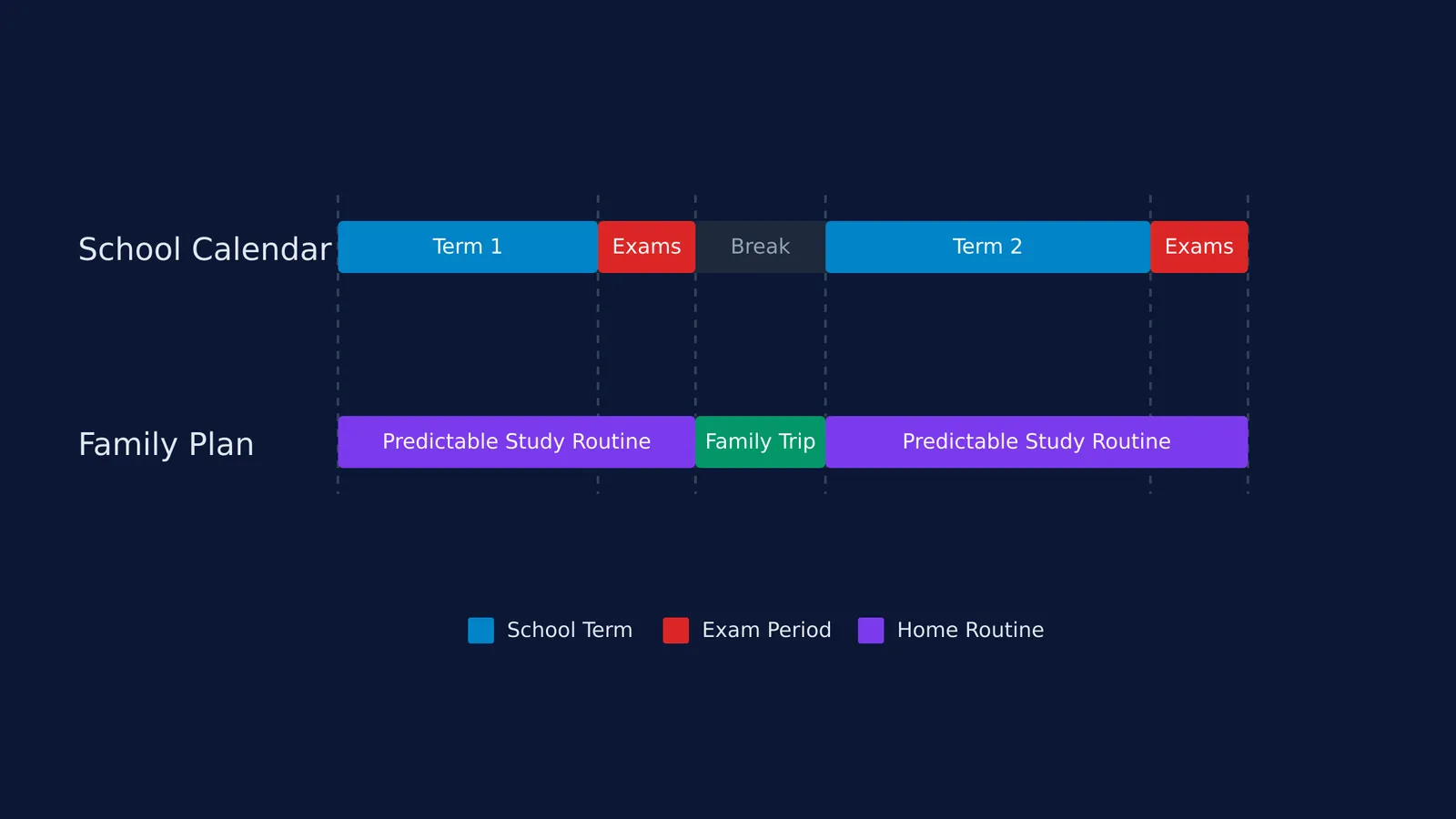
2. Mark the anchor dates: Block out term dates, known exam weeks, and mandatory school events. These are the non-negotiable anchors around which the rest of your family life will orbit. Make sure these dates are highly visible to everyone in the household.
3. Schedule the downtime first: Mark family events, holidays and designated rest weeks. A teenager is far more likely to study hard in late November if they can see a clear, guaranteed break scheduled for December. Highlighting these rest periods gives them something concrete to look forward to during stressful academic stretches. Knowing there is a planned reward helps sustain their focus.
4. Set up weekly check-ins: A yearly plan only works if you review it. Instead of hovering daily to ask if they have homework, you can help children learn without pressure by letting them manage the details. Set a weekly check-in in a quiet home study space every Sunday evening to look at the week ahead. You can ask: *"What are your main priorities this week, and is there anything on the calendar that might get in the way?"*
By turning the school calendar into a shared, predictable map of the year, you replace anxiety and unpredictability with a structured, supportive environment that helps your child focus fully on learning and thriving.


