

On this page
In short
According to the Holmes and Rahe Stress Scale, a psychological tool that quantifies the emotional toll of life events, a change in residence adds 20 points to a person's stress load, while a change in schools adds another 20 points (MindTools). When a move falls during a child's board exam or JEE preparation year, parents must insulate their study routine by packing strategically, relocating their study environment on moving day, and unpacking their desk first.
Moving house disrupts every routine a family has. The physical exhaustion of packing and the mental load of logistics often spill over into the weeks before and after moving day. When this upheaval coincides with Class 10 or 12 board exams, or competitive exams like JEE, the stakes are higher. Students rely on environmental cues—a dedicated desk, familiar books, and a quiet room—to trigger deep focus and maintain a study routine that lasts. When those cues are boxed up, focus breaks down. However, with deliberate planning, you can move house without derailing their exam preparation.
Is it a good idea to move house during an exam year?
If you have complete control over the timing, it is usually best to avoid moving in the four months leading up to a major exam. The final stretch requires uninterrupted revision, mock test practice, and a stable environment to minimize test anxiety. Students often build specific mental associations with their study desk, which helps them transition into a focused state quickly. Disrupting this environment can temporarily lower their efficiency while they adjust to a new setting.
However, moves are often dictated by lease expirations, job transfers, or financial necessity. If a move is unavoidable, the goal shifts from prevention to insulation. The student's primary job is to study; the parents' job is to act as a buffer between the student and the moving logistics.
How can you pack study materials without losing them?
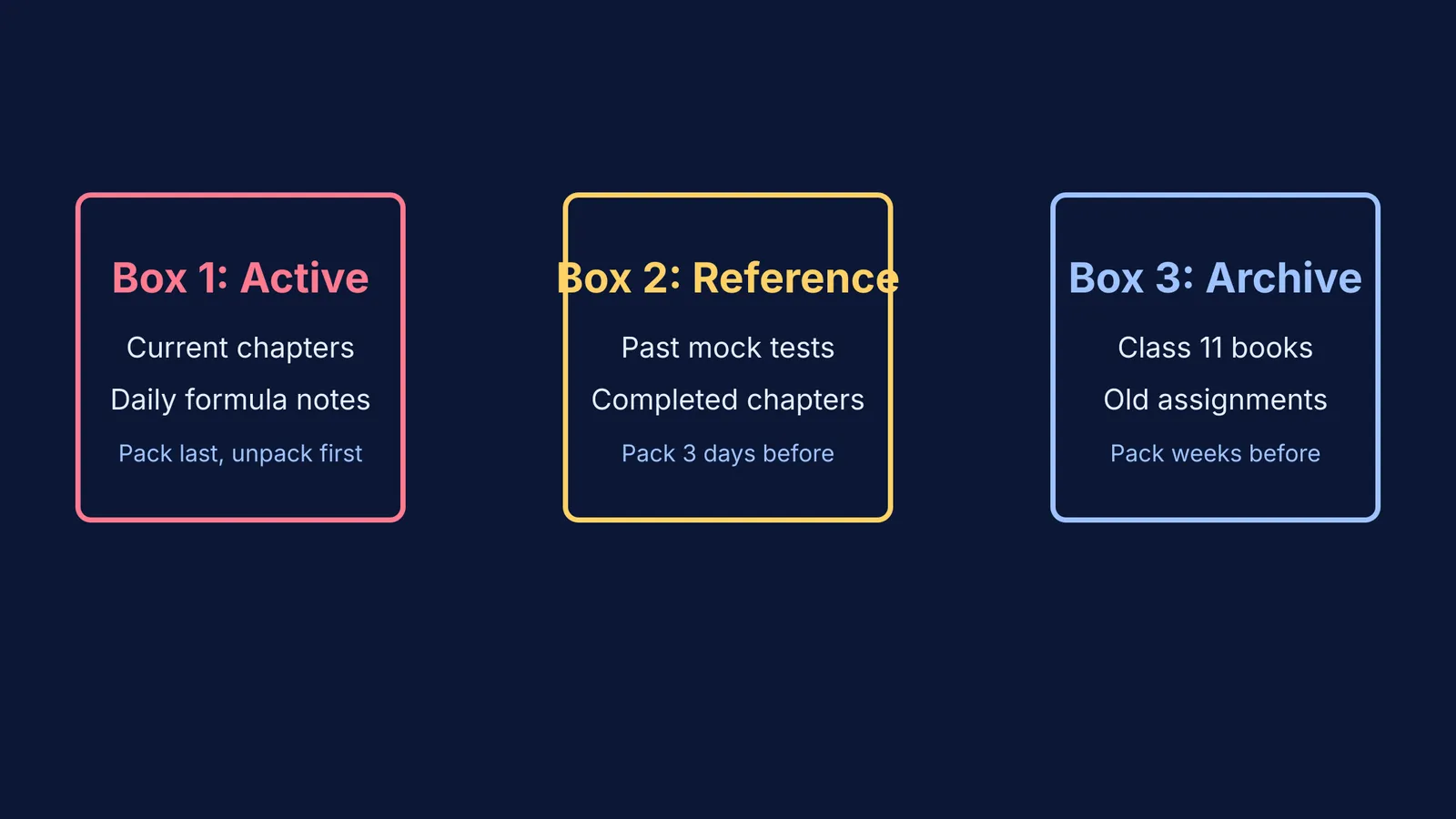
The biggest risk during a move is the "lost notebook" scenario, where a crucial formula book or past paper is sealed in an unmarked box at the bottom of a stack, completely inaccessible when the student needs to check a concept. To prevent this, use a three-box packing system exclusively dedicated to study materials:
Box 3: The Archive. Pack this several weeks before the move. It holds Class 11 textbooks, completed assignments, and reference books that are not needed for daily revision.
Box 2: Secondary Material. Pack this three days before the move. It contains past mock tests, extra stationery, and chapters that have already been revised.
Box 1: The Active Box. This is the survival kit. It stays open until the morning of the move and is the first box opened at the new house. It holds current chapter notes, daily formula sheets, the scientific calculator, and the primary textbooks.
If physical books must be packed away for a few days, digital tools can bridge the gap. The Fermi Problem Library has worked problems with a step-by-step solver that explains the reasoning rather than printing an answer. This allows students to continue practicing physics and maths on a phone or tablet without needing their heavy reference books.
How can you maintain a study routine during a move?
The week of the move will be noisy, dusty, and chaotic. A student cannot be expected to sit in the middle of a living room full of boxes and focus on organic chemistry.
Relocate the study environment: On the days of heavy packing and the actual moving day, send the student to a local library, a quiet café, or a relative's house.
Maintain the schedule, not the location: If they normally study from 4 PM to 8 PM, they should stick to those hours, even if they are sitting at a kitchen island instead of their desk.
Use AI for immediate doubts: Without their usual teachers or peers nearby during transit, doubts can stall progress. Fermi's AI tutor can work out what they already know, build a plan for the session, and teach through it.
How should you set up the new study space?
When you arrive at the new house, the student's study area should be the first zone you unpack and set up.
Before tackling the kitchen or the living room sofa, assemble their desk, plug in their lamp, and open "Box 1". As with any good study space at home, re-establishing their physical environment signals that the disruption is over and routine has resumed.
Lighting: Ensure the desk is near a window for natural light and has a bright, cool-toned study lamp.
Ergonomics: Set up the chair and desk at the correct height so they are not hunched over.
Familiarity: Place their timetable, sticky notes, and formula sheets on the wall exactly as they were in the old house.
Moving house is a major project, but by treating the student's study routine as the most fragile item in the move, you can establish routines that help the whole family during exam season. You can get to the other side with their exam preparation intact.


