On this page
Hearing a crash from the other room and finding a shattered vase is stressful enough. It is infinitely more frustrating when you ask what happened, and your child—standing next to the pieces—looks you in the eye and denies any knowledge of the event. In these moments, it is easy to panic and assume your child is developing a malicious habit of lying.
However, child psychologists view lying as a developmental milestone rather than a character flaw. How adults react in these high-stakes moments dictates whether a child learns to trust them or learns to become a much better liar.
Why do children hide when they break things?
Lying is a surprisingly normal part of growing up. By age four, more than 80% of children will lie to conceal a transgression, according to research presented in a TED Talk by developmental psychologist Kang Lee. Constructing a lie requires significant cognitive sophistication. A child must develop "theory of mind"—the understanding that you do not automatically know what they know—and the executive function to suppress the truth.
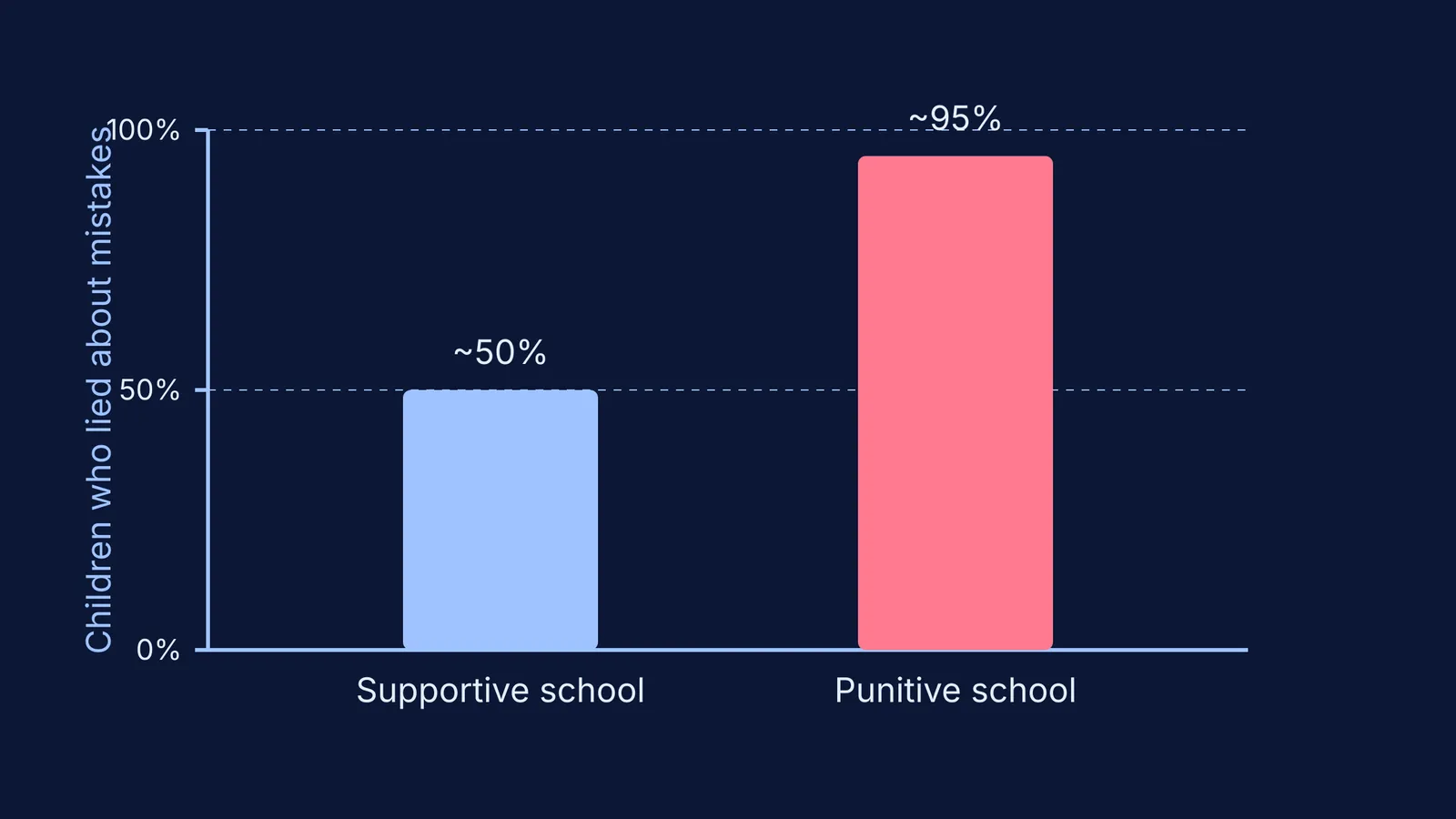
However, the primary reason a child hides a broken object is fear. A landmark 2011 study by Victoria Talwar and Kang Lee observed 84 3- and 4-year-olds in West Africa. The researchers compared children attending a harshly punitive school, where physical discipline was used for minor offences, with those in a non-punitive, supportive school.
During the experiment, children were left alone with a toy and told not to peek at it. Most children in both groups succumbed to temptation and peeked. But when the experimenter asked if they had looked, the results diverged sharply. Nearly all the children from the punitive environment lied, while only about half from the non-punitive environment did. Furthermore, the children facing harsh punishment were much more skilled at maintaining their deception during follow-up questions.
The conclusion is clear: a punitive environment does not create honest children. Instead, it creates sophisticated liars whose primary goal is to survive without punishment.
How should you react when your child confesses?
If your child eventually admits they broke something, or if you gently coax the truth out of them without shouting, your immediate reaction is critical. You must separate the broken object from the act of telling the truth.
Take a deep breath and praise their honesty before addressing the mess on the floor. You might say, "I am upset that the vase is broken, but I am very proud of you for telling me the truth. I know that was hard." This demonstrates that their relationship with you, and their integrity, is valued more highly than a material possession. Prioritizing emotional safety over immediate correction is a core principle of how parents can help children learn without adding pressure.
Calm consequences over punishment
Praising the truth does not mean there are no consequences for breaking things, especially if the breakage happened due to deliberate carelessness. However, logical and natural consequences are far more effective than punitive ones.
If they broke a glass because they were running in the kitchen, the natural consequence is helping to safely sweep it up and wipe down the floor. If they broke a sibling's toy in a moment of frustration, the consequence might be using their own pocket money to replace it or offering a genuine, written apology. This approach focuses the child's mind on repairing the damage rather than defending themselves against your anger. To reinforce this positive behaviour, focus on how to praise children for taking responsibility, rather than criticizing their clumsiness.
Applying this to academic honesty
The instinct to hide mistakes out of fear extends far beyond broken vases and spilled milk. If a child is terrified of your reaction to a bad grade, they will hide their report card. If they are afraid of looking foolish in front of a teacher, they will copy a friend's homework rather than ask for help.
A learning environment that penalizes every error creates the exact same survival-driven dishonesty as a punitive home. When students feel safe making mistakes, they engage more deeply with the material and ask questions when they are confused. Fermi's AI tutor builds a plan that treats wrong answers as a normal and expected step in learning, helping students find a clear next step instead of leaving them staring at a blank page. You can explore how to set healthy boundaries around schoolwork and technology in our guide on AI and homework honesty: where help ends and copying begins. By making it safe to fail, you make it safe to learn.