

On this page
The half-yearly answer sheets are back, and the total on the front page is the least useful number on them. The marks lost inside each chapter tell you what to do next, and that is what a finals plan is built from. Sit down together, one subject at a time.
How do you read half-yearly marks chapter by chapter?
Take one subject's answer sheet and the question paper. For every question where marks were cut, write down three things: the chapter, the marks lost, and the cause. Use only three causes:
Concept gap: you did not know the idea or the formula, or left the question blank.
Method: you knew the idea but chose the wrong steps, got stuck halfway, or ran out of time.
Slip: a copying, sign or unit error in a question you could otherwise do.
Then add up the marks lost per chapter and per cause. Be honest: calling a concept gap a slip hides the chapter that needs the most work.
What does a worked example look like?
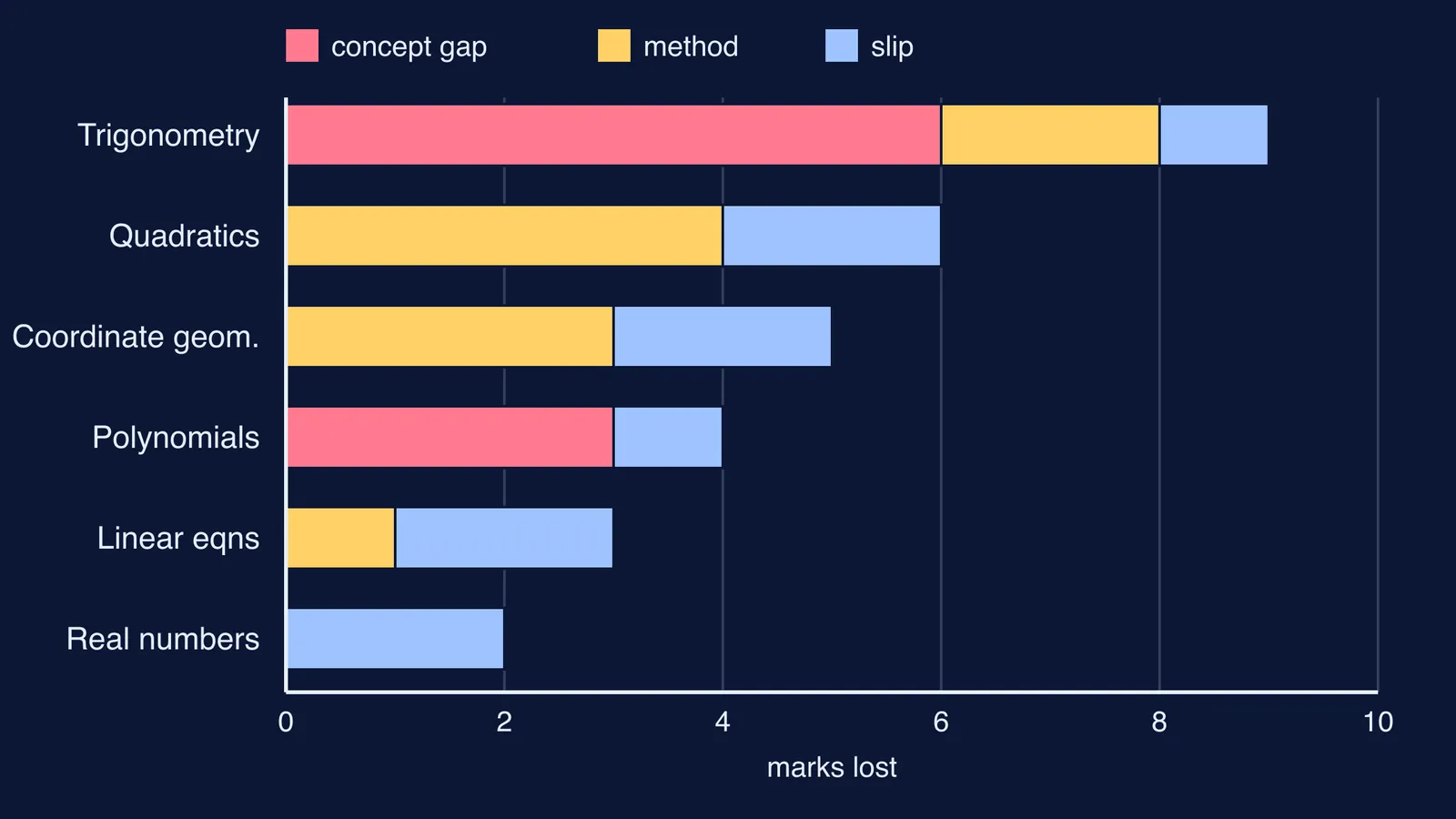
Say a Class 10 student scored 51 out of 80 in half-yearly maths and lost 29 marks. Sorted by chapter, with causes:
Trigonometry: 9 lost (6 concept, 2 method, 1 slip)
Quadratic equations: 6 lost (4 method, 2 slip)
Coordinate geometry: 5 lost (3 method, 2 slip)
Polynomials: 4 lost (3 concept, 1 slip)
Linear equations: 3 lost (1 method, 2 slip)
Real numbers: 2 lost (2 slip)
Nine of the 29 marks are concept gaps in just two chapters, so those come first. And 10 marks are slips spread across all six chapters, so the fix there is a checking routine in every paper, not more chapters.
Half-yearly papers cover only part of the syllabus, so the plan also has to make room for chapters still being taught. Check the full list of units for your class in the current syllabus (CBSE posts it on its curriculum page for 2026-27) or your school's blueprint.
How do you plan weekly targets until finals?
Two findings shape the plan. In Roediger and Karpicke's 2006 experiments, students who took recall tests on a passage remembered more after two days and one week than students who reread it, even though rereading looked better after five minutes. A 2013 review of 10 study techniques by Dunlosky and colleagues rated practice testing and distributed practice as high utility, and rereading and highlighting as low.
Spacing matters too. In a 2008 study of more than 1,350 people, the best gap between first study and review was about 20 to 40% of the time until the test when the test was a week away, falling to about 5 to 10% when it was a year away. For finals three or four months off, that roughly points to revisiting each chapter every couple of weeks, not once at the end.
Here is the worked example as a 14-week plan, with three maths sessions of about 45 minutes a week:
Weeks 1-2: relearn trigonometry ratios and identities; finish with a 10-question self-test from memory.
Weeks 3-4: worked practice on quadratics and coordinate geometry; one short trigonometry quiz each week.
Weeks 5-6: relearn polynomials; quick mixed quiz on everything fixed so far.
Weeks 7-10: keep pace with new chapters in class; one 20-minute mixed quiz from old chapters every week.
Weeks 11-14: one timed full paper a week, then mark it with the same three causes and fix the top chapter before the next paper.
In every timed paper, keep five minutes at the end for a slip check: signs, units, copied numbers. For a full-syllabus review, our guide to a three-pass revision plan fits on top of this one, and revising only your mistakes explains where an error log helps and where it is not enough.
If a concept gap is the big item, the Fermi Concept Library gives each concept in physics, chemistry, biology and mathematics its own lesson. For method marks, the Fermi Problem Library has worked problems with a step-by-step solver that explains the reasoning rather than printing an answer.
What should parents say about the half-yearly result?
Start with the papers, not the total. Something like: "Let's find which chapters cost you the most marks, and why. Then you pick which one to fix first." Let your child choose the order within the plan; it is easier to keep a plan you helped make.
Each week, ask for the self-test score on that week's chapter, not the hours studied. If marks fell sharply compared with earlier tests, work through our calm checklist for a sudden drop in marks before blaming effort.
Tele MANAS, the national mental health helpline, takes calls on 14416 or 1800-891-4416, toll-free and around the clock.
Tonight, pick one subject, mark every lost question with its chapter and cause, and write week 1's target at the top of the page.


