On this page
Most families choose a school on two signals: the fee and what the neighbours say. Neither tells you much about what your child will learn. In India, almost 50% of students are enrolled in government schools and 41% in private schools, with the rest in government-aided schools, according to UDISE+ 2024-25 figures reported by All India Radio. So the useful question is not which type is better, but which school near you suits your child.
Are private schools better than government schools in India?
On raw scores, private schools usually look ahead. In rural India in 2024, 59.3% of Std V children in private schools could read a Std II level text, against 44.8% in government schools, according to the ASER 2024 national findings.
That gap is not the same as what the school adds. In Andhra Pradesh, a school choice programme gave private-school vouchers by lottery, so winners and losers started out alike. Economists Karthik Muralidharan and Venkatesh Sundararaman studied it. After two and four years, they found no difference between the groups in Telugu, maths, English, or science and social studies; voucher winners did score much higher in Hindi, which the government schools did not teach (Quarterly Journal of Economics, 2015). The authors say this suggests the large score gaps between public and private schools mostly reflect other differences between their pupils, not the schools themselves. A school's label tells you less than a visit does.
What should I ask about the teachers?
For classes VI to VIII, the RTE Act's schedule asks for at least one teacher each for science and mathematics, social studies and languages, and at least one teacher for every 35 children (RTE Act 2009, Schedule). Treat that as the floor, then ask:
Who teaches maths and science in my child's class, and what did they study?
How many teachers left last year?
Can I sit in on one lesson?
How often is a period covered by a substitute, or left free?
Attendance is fair to ask about too. In the government primary schools ASER visited in 2024, average teacher attendance was 87.5% (ASER 2024).
How big will my child's class actually be?
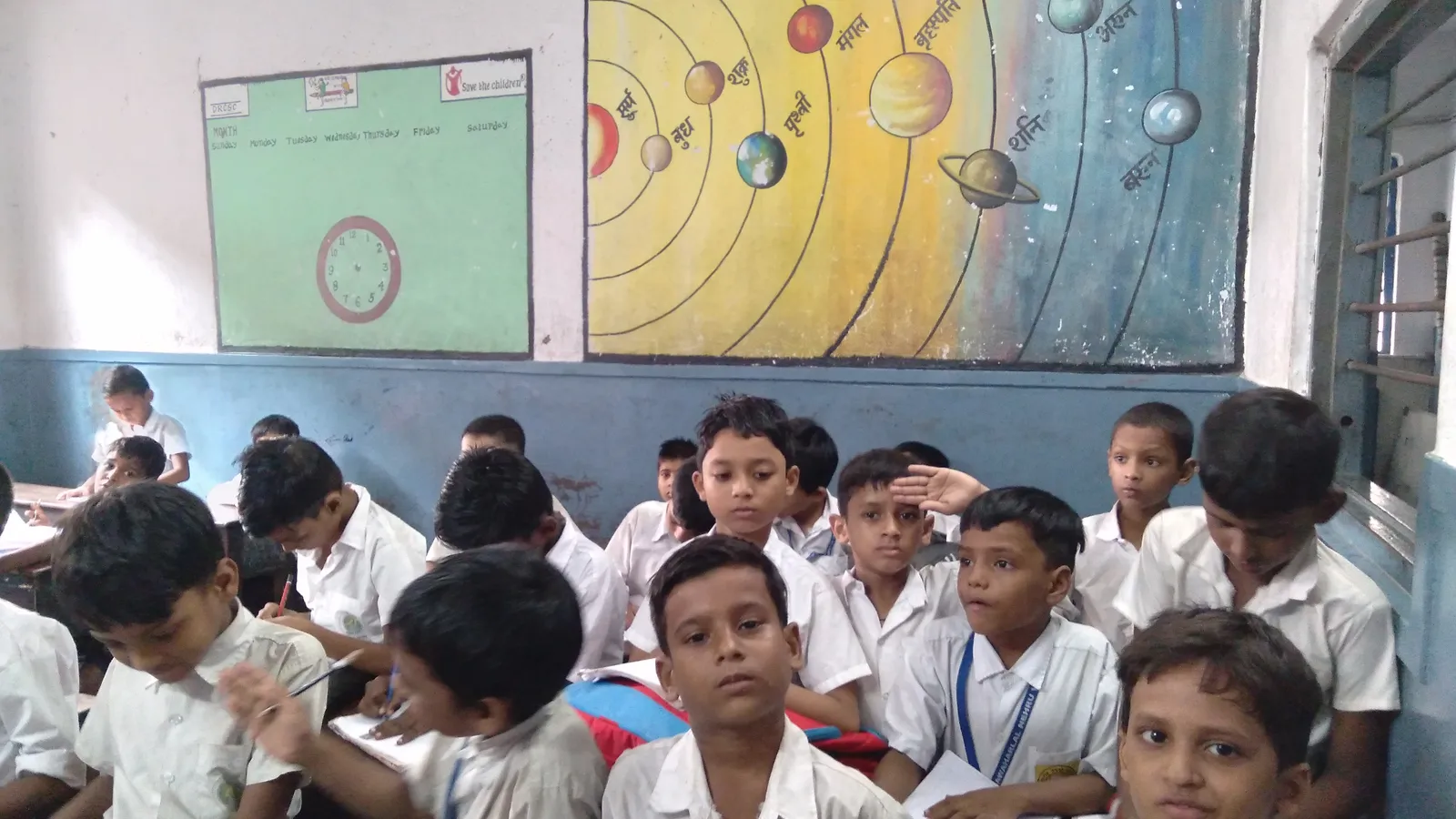
The pupil-teacher ratio is not the class size. UDISE+ 2024-25 reports national ratios of 10, 13, 17 and 21 students per teacher at the foundational, preparatory, middle and secondary stages (All India Radio), but a classroom can be much fuller, because the ratio counts every teacher on the staff. Ask how many children are in your child's section this year.
In small schools, also ask whether grades sit together. ASER found that two-thirds of Std I and Std II classrooms in the government primary schools it visited were multigrade (ASER 2024).
How do I judge results without trusting the toppers' board?
A banner of toppers shows the best few, not the typical child. Ask:
What share of the whole class passed, and how many scored below 50%?
What happens when a child falls behind in maths in Class 6?
Can I see a few corrected notebooks?
Once your child is enrolled, our guides to reading a report card beyond the marks and parent-teacher meeting questions that lead to follow-up help you keep checking. If the board is still undecided, see how to compare CBSE, ICSE and state boards.
What about activities and travel time?
Ask for the weekly timetable, not the brochure: how many periods of games, library and lab work actually happen? Basic facilities are not universal; in 2024, 66.2% of the government schools ASER visited had a playground (ASER 2024).
Then time the journey at school hours. An hour on a bus each way is at least ten hours a week that cannot go to sleep, play or reading.
A scorecard for school visits
Give each school 0, 1 or 2 on each line:
Subject teachers for maths and science in your child's class
Few teachers left last year
A section size you are comfortable with
Whole-class results shared, not only toppers
A clear plan for children who fall behind
Games, library and labs on the real timetable
A journey your child can manage without losing sleep
Your child felt at ease on the visit
A worked example: say a private school has a 45-minute bus ride, sections of 45 and shares only toppers' marks. It might score 2, 1, 0, 0, 1, 2, 0, 1, a total of 7 out of 16. A government school a 10-minute walk away, with subject teachers and sections of 32, might score 2, 1, 2, 1, 1, 1, 2, 2, a total of 12. Now the fee is no longer deciding for you; the evidence is.
No school covers every gap. If your child is stuck on a topic the class has moved past, Fermi's AI tutor works out what they already know and builds a plan for the session, and the Fermi Concept Library has a lesson for every concept in physics, chemistry, biology, mathematics and computing.