On this page
When a teenager asks questions that go beyond the school textbook, a mentor can show them what real science looks like. Mentors—whether they are university students, engineers, or career researchers—help teenagers design experiments, enter science fairs, and see what a career in STEM involves. Having someone to answer their specific, advanced questions can transform a fleeting interest into a deep, sustained passion for discovery.
Where can high school students find science mentors?
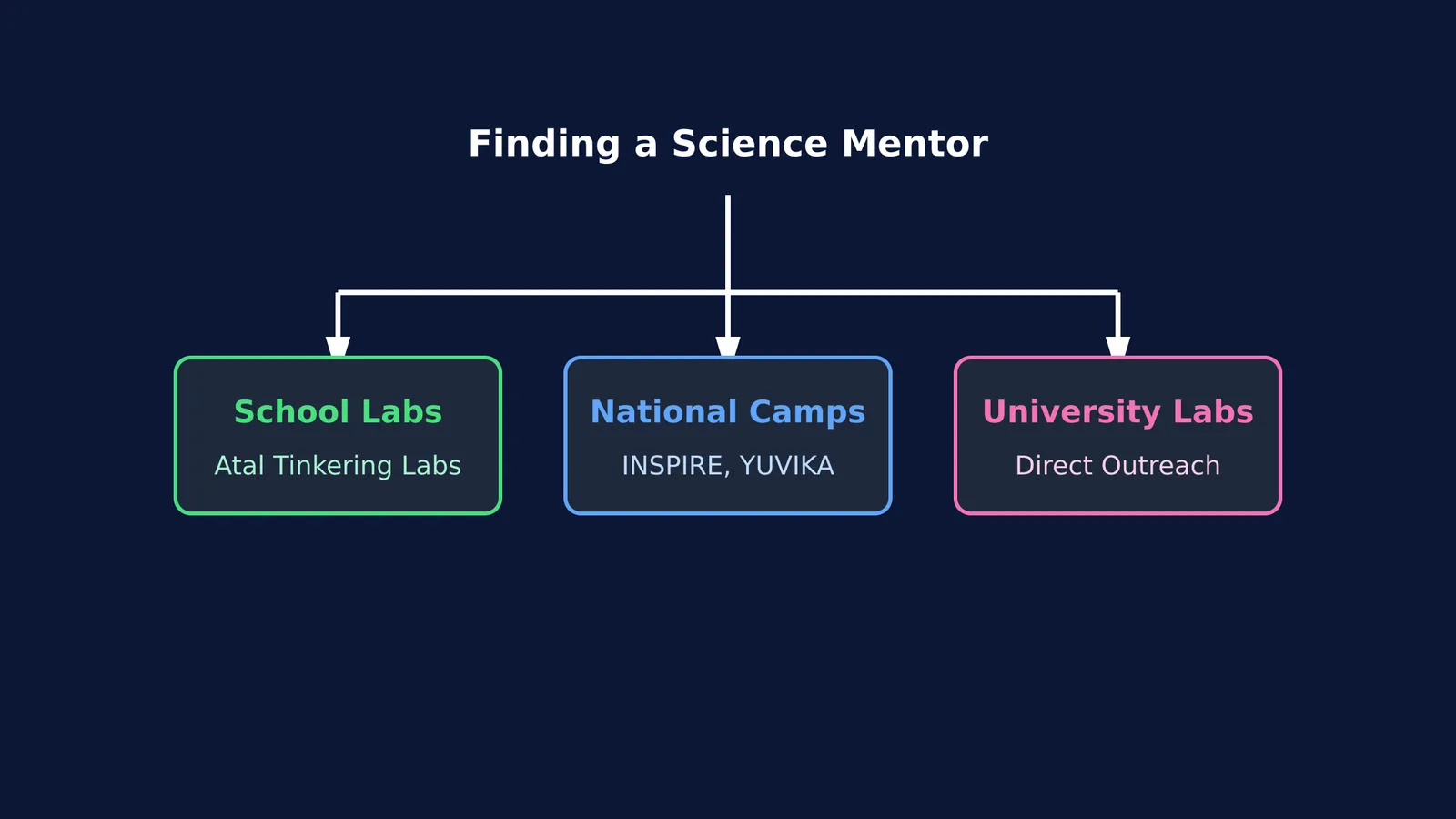
Many structured mentorship programmes exist in India to connect students with working professionals. The Government of India’s Atal Innovation Mission runs the Mentors of Change programme, which places skilled volunteers in more than 10,000 Atal Tinkering Labs across 722 districts (AIM). These mentors visit school labs to guide students in design thinking and physical computing. If your child’s school has an ATL, ask the lab in-charge about meeting the assigned mentor.
The Department of Science and Technology (DST) also runs the INSPIRE scheme to encourage top students. The INSPIRE Internship Science Camps are 5-day residential camps fully funded by the DST (INSPIRE). They are open to Class 11 science students who scored in the top 1% of their Class 10 board exams. At these camps, students interact with and learn from eminent scientists and researchers.
Getting more from science museum and planetarium visits
How do government programs help students connect with scientists?
Beyond school labs, national institutes open their doors to young students. The Indian Space Research Organisation (ISRO) runs the YUVIKA (YUva VIgyani KAryakram) or Young Scientist Programme. This is a two-week residential programme for students who are studying in Class 9, fully funded by the Department of Space (ISRO). Students attend lectures by scientists, visit ISRO launch facilities, and assemble model rockets.
When teenagers study independently for these competitive programmes, they often need help with hard concepts at odd hours. Fermi's AI tutor can step in here. When a student brings a topic, a course, or a problem set, the tutor works out what they already know, builds a plan for the session, and teaches through it—writing on a board, drawing the figure, running the simulation, and checking understanding as it goes.
Trying an AI tutor with your child: a 20-minute parent's guide
What should a student write in a cold email to a researcher?
If structured programmes are not a fit, students can reach out directly to university faculty or researchers at institutes like the CSIR labs. This teaches the teenager how to read basic scientific literature and advocate for themselves. A short, polite email is the best way to start this conversation.
AI tutor or private tutor? What each does well and how to combine
Here is a script for a polite, specific cold email to request a brief meeting:
Subject: High school student interested in your work on [Topic]
Opening: Dear Dr [Last Name],
Introduction: My name is [Name] and I am a Class [X] student at [School] in [City].
The Hook: I read your recent work on [Specific topic] on your faculty page, and I was particularly interested in [One specific detail you found fascinating].
The Ask: I am hoping to learn more about how research in this field works. Would you have 15 minutes for a brief video call next week? Alternatively, if there is a graduate student in your lab who might be willing to guide a short high school project, I would be grateful for an introduction.
Closing: I have attached my CV. Thank you for your time. Sincerely, [Name].
Direct outreach takes patience; researchers are busy, and students may need to email several people before getting a reply. While waiting, a student who wants to explore advanced topics can use the Fermi Concept Library, which holds every concept in physics, chemistry, biology, mathematics and computing, each with its own lesson and its place in the map. This self-study helps them build a strong foundation, so when they do meet a mentor, they are prepared to ask thoughtful questions.
Mentorship requires a good fit. Whether it is an ISRO scientist, a local engineering student, or an AI tutor, the right guide helps a teenager turn a general interest into a concrete, lifelong pursuit of science.