

On this page
It is easy to hand a child a tablet when you need thirty minutes of quiet. However, leaving children alone with digital devices turns a powerful tool for connection into an isolating habit. Shifting from solitary scrolling to a shared family movie night does more than bring everyone into the same room; it changes how a developing brain processes information.
Why is solitary screen time risky for development?
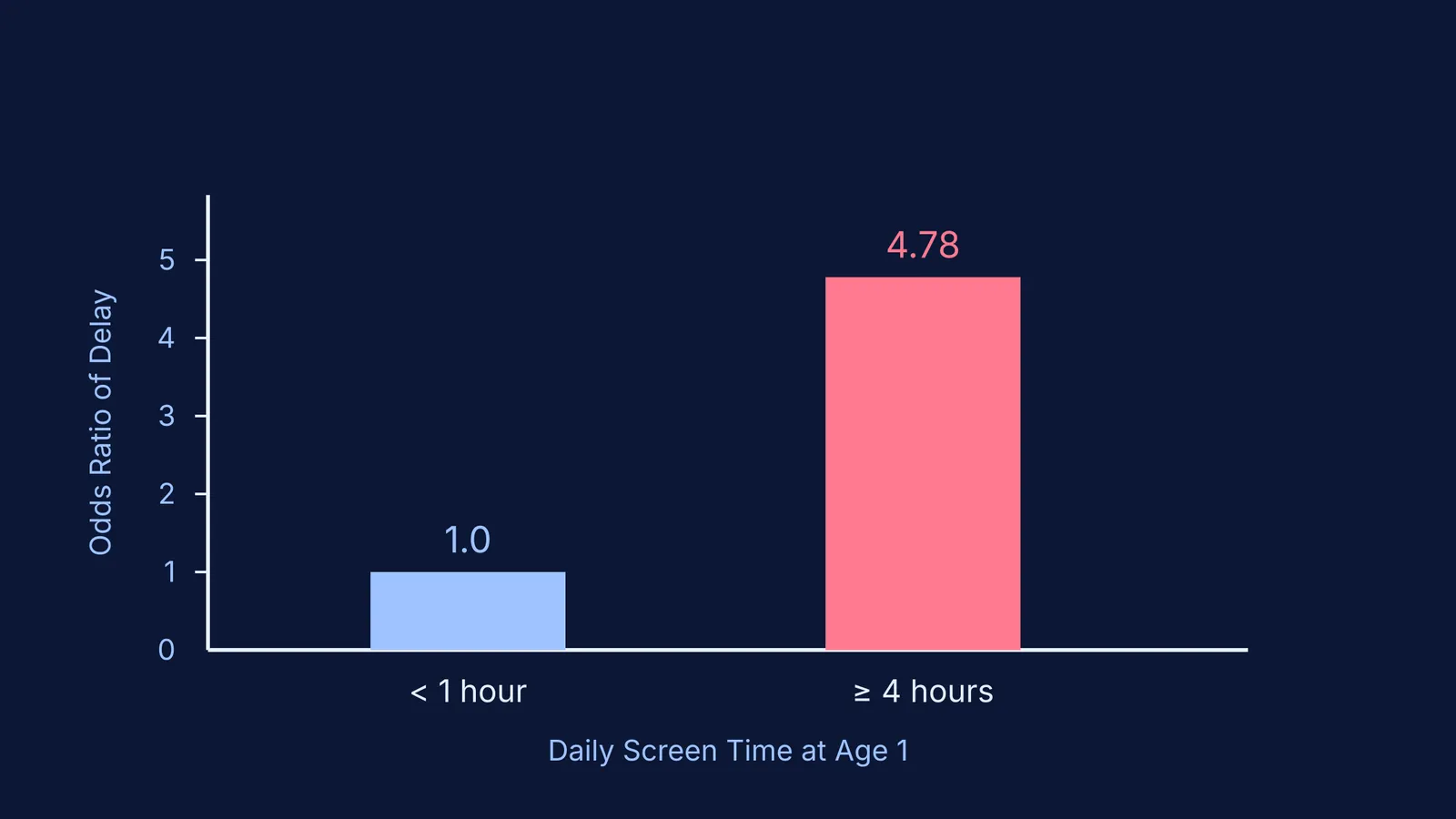
When young children watch screens alone, they miss out on the back-and-forth social cues required for healthy cognitive growth. A 2023 study published in JAMA Pediatrics found that one-year-olds exposed to four or more hours of daily screen time had a 4.78 times higher risk of communication delays by age two, compared to those with less than one hour (Takahashi et al., 2023).
Without an adult to provide context, the fast-paced images on a screen are difficult for a young mind to translate into real-world meaning. Research on language acquisition demonstrates that toddlers learn novel words from screens only when the interaction is socially contingent (Roseberry et al., 2014). This means an adult must be actively participating, responding to the child's reactions, and drawing connections to their surroundings. When a parent points at the screen and names an object, the child learns to map that word to reality. Understanding how environmental inputs shape the roles of different parts of the human brain highlights why this active, two-way participation is so critical for establishing early language pathways and emotional regulation.
What are the long-term benefits of co-viewing?
Watching together transforms passive consumption into active learning. The American Academy of Pediatrics advises that for children aged two to five, screen time should be limited to one hour per day of high-quality programming (AAP Guidelines, 2016). Crucially, the guidelines emphasise that parents should co-view media with their children to help them understand what they are seeing and apply it to the world around them.
When you sit down to watch a film with your child, you are doing more than just supervising. You are interpreting the story, modeling how to react to challenging situations, and demonstrating how to manage emotions. This habit of shared attention pays dividends as children grow into teenagers. Just as a biologist might observe and interpret understanding animal behaviour through direct interaction, a parent sitting alongside their child can guide their interpretation of complex media. Early habits set the stage for later resilience. Researchers studying data from the Future of Families and Child Wellbeing Study found that parent-child television co-viewing at age five is linked to significant increases in positive adolescent traits, such as optimism and perseverance, by age fifteen (Manisha & Schneider, 2025).
If an older student is struggling with a hard-to-picture idea in science, exploring the Fermi Simulation Lab together can spark the same kind of active discussion as a well-chosen documentary. By working through problems side by side, parents model how to ask questions, test hypotheses, and remain curious when faced with a difficult concept.
How do you transition to shared media use?
Moving a family from separate devices in separate rooms to a single shared screen requires intentional planning, especially if solitary viewing has become the default. Start by picking a regular night of the week dedicated entirely to a family film or a high-quality educational series. Consistency is key; when children know they have a dedicated block of shared time to look forward to, they are often more willing to disconnect from solo devices.
To make this transition successful, replace rigid time limits with a focus on connection. Let children take turns selecting the film, provided it fits within an agreed age rating. This gives them a sense of ownership over the new routine and allows them to share their own interests with the rest of the family. Once the film starts, put all secondary devices, such as mobile phones and tablets, out of reach. This signals that the film, and the people watching it, are the sole focus of the evening.
Pick films that match your child's emotional maturity, not just their chronological age.
Pause during high-emotion scenes to check their understanding and ask open-ended questions.
Discuss the ending as a family, focusing on character motivations and alternative choices.
Relate the story to real-world events or challenges your child is currently facing.
By watching together and talking about the content afterwards, you turn screen time from a solo distraction into a shared foundation for empathy and critical thinking.


