On this page
Your son is in Class 11. The family runs a textile shop his grandfather started, and everyone assumes he will join after college. Then he says he wants to study physics, or design. The conversation goes better when you treat this as information about your child, not a rejection of the family.
How common is it for a child not to want the family business?
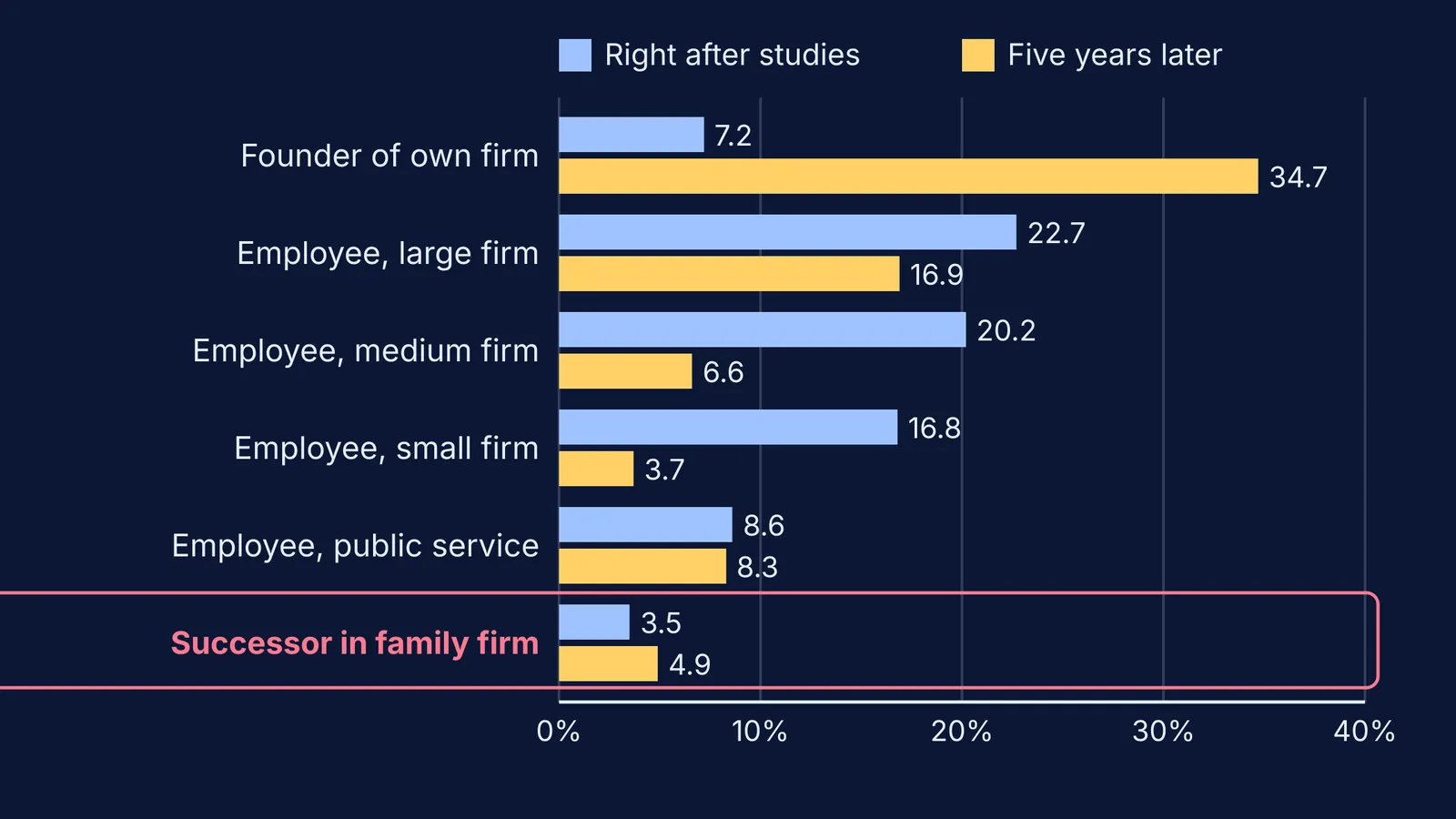
Very common. The Global University Entrepreneurial Spirit Students' Survey (GUESSS) collected responses from 34,113 university students with a family business background in 34 countries between October 2013 and April 2014, analysed by the University of St.Gallen and EY in Coming home or breaking free?
Only 3.5% planned to take over their parents' firm directly after their studies.
4.9% planned to do so five years after graduating.
Nearly 20% were generally open to becoming a successor at some point.
34.7% wanted to be running a company they founded themselves five years after their studies.
The authors estimated that succession intentions had fallen by around 30% since their 2011 study. India was not among the countries surveyed, so treat this as an international pattern. A child who wants something else first is the norm, not a failure of upbringing.
Why does pushing harder usually backfire?
Julia Dietrich and Bärbel Kracke studied 359 German adolescents and described three kinds of career-related behaviour by parents: support, interference and lack of engagement (Journal of Vocational Behavior, 2009; ERIC record). Parental support was linked with more career exploration. Interference and lack of engagement were linked with more difficulty making career decisions.
In a business family, interference sounds like “The shop is your future, why waste years?” Lack of engagement sounds like “Do whatever you want,” said in anger. Support sits between them: you stay involved, share what you know, and let your child test their own idea.
The GUESSS report also found that students who had worked in the family firm had stronger succession intentions than those who had not (St.Gallen and EY). The report also notes that heavy screening of potential successors has been found to scare them off. Real work helps; endless screening does not.
What should parents say when a child wants a different path?
Try this order, and have the talk away from the shop.
Listen first: “Tell me what draws you to it. I want to understand before I say anything.”
Name your feeling without making it their job: “I'll be honest, I hoped you'd join us. That hope is mine to deal with, not your duty.”
Ask what they know: “What does a normal week in that work look like?”
Share real information about the business, including the hard parts and what you would need from a successor.
Agree a next step with a date, not a final answer: “Let's both find out more and talk again in a month.”
Your child can prepare a line too: “I respect what you built. I'm not saying never. I'm asking for a fair chance to try this first.”
A worked example: a one-year plan that keeps both doors open
Take a hypothetical case. Aarav is in Class 11 with PCM. His mother runs a medicine distribution business in Indore; he wants a BSc in physics. Here is one possible plan.
Months 1 to 3: Aarav researches degrees and entrance routes on official websites and talks to two people in the field. His mother writes down what the business would need from him, and by when.
Months 4 to 6: He works a few hours a week in the business during holidays, doing real tasks.
Months 7 to 9: He tests the subject itself with a summer project, an olympiad or reading beyond the syllabus.
Month 12: A review with three questions. What did you learn about each option? What do you want now? Who else could meet the business's needs: a sibling, a manager, a partner?
The aim is to choose with evidence, not to win. If the path your child is testing depends on a subject they are still shaky in, Fermi's AI tutor can work out what they already know and build a plan for each study session, so the trial months go into learning rather than guessing where to start.
What if the talks keep turning into fights?
Bring in a calm third person, such as a trusted relative or the school counsellor. Our guide on when to meet the school career counsellor and what to ask helps you prepare. If the two parents want different things, settle that first; see when parents disagree on a child's career. For the underlying skill, see how to teach your teenager to make good decisions.
If your child seems withdrawn or talks about feeling trapped, speak to a doctor or counsellor. Tele MANAS, the government's free 24/7 mental health helpline, answers on 14416 or 1800-89-14416 in 20 languages (PIB, Ministry of Health and Family Welfare).
Tonight, ask one question about the path your child wants, and just listen to the answer.