On this page
Many children can recite “percent means out of a hundred” long before they can work out what a 15% discount saves. The fix is not a better formula. It is two easy anchors, 50% and 10%, and a picture of a hundred squares your child can shade.
What does percent actually mean?
A percentage is a number expressed as a fraction of 100, and the word comes from the Latin per centum, “by a hundred” (Wikipedia: Percentage). So 37% is 37 out of every 100, whether those are runs, rupees or students in a school.
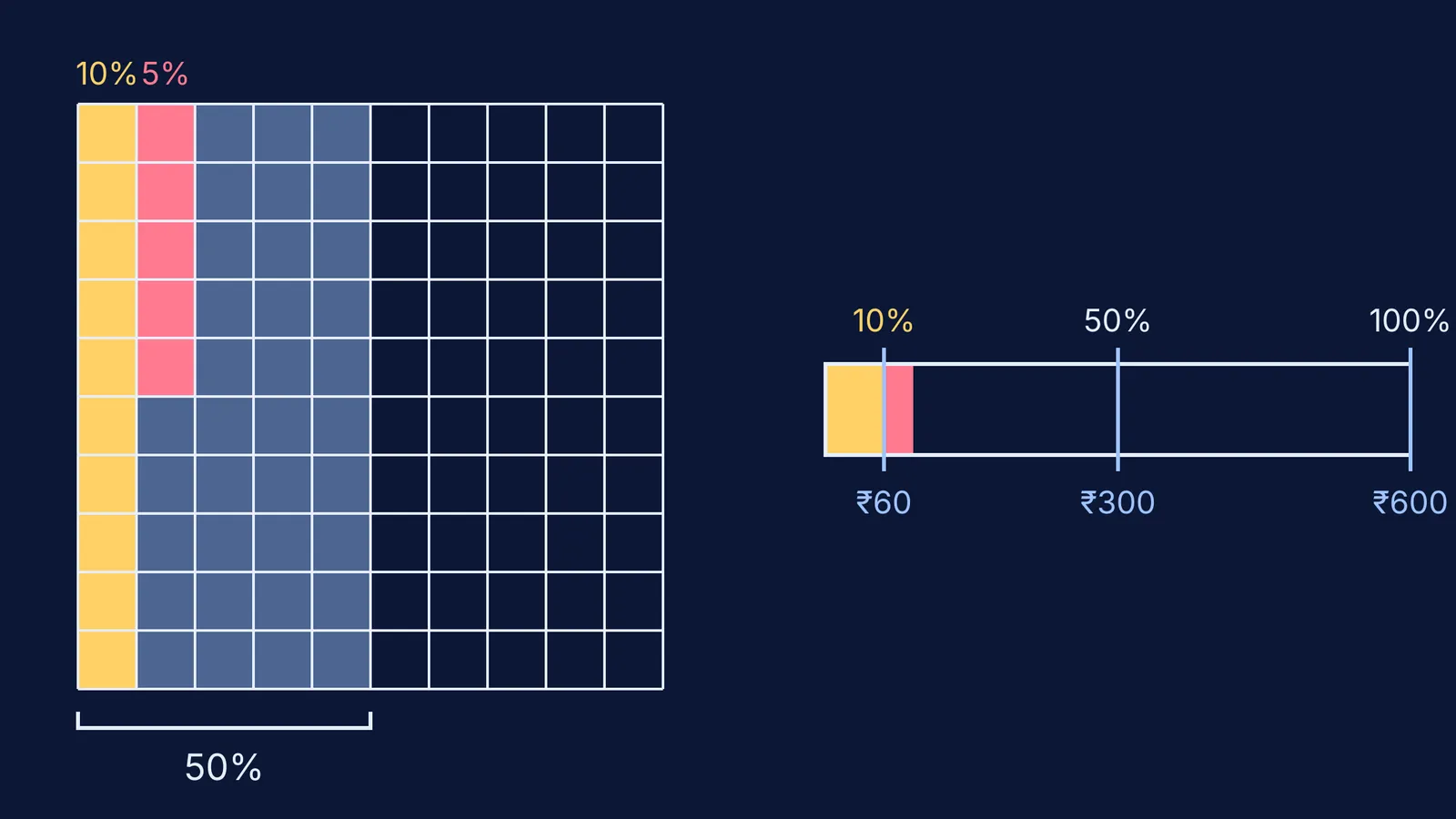
Make that visible before you write anything down. Draw a 10 by 10 grid of a hundred small squares. Shade one column: 10 squares out of 100, so 10%. Shade five columns: half the grid, so 50%. Now 25% is two and a half columns, 1% is one square and 100% is the whole grid.
Why do children find percentages hard?
Knowing the definition is not the same as using it. In a study published in 2013, Frans van Galen and Dolly van Eerde described how Grade 7 students were given a written test of percentage problems, including a €600 bike with a 15% discount (van Galen and van Eerde, Journal on Mathematics Education, 2013). Only 4 of the 14 students tested gave the correct answer, and 8 of the 14 divided 600 by 15, the original price divided by the discount percentage.
None of the students drew a picture to sort out what was given and what was asked; they worked in their heads, and it often went wrong. In one short lesson they were then taught a percentage bar, a long rectangle marked 0% to 100% with the amounts underneath. The authors concluded that the bar “deserves a central place in the teaching of percentages.” Their worked route for the bike is the one we use below: 50% of €600 is €300, 10% is €60, 5% is €30, so 15% is €90.
Percentages also rest on fractions. An analysis of long-term data on children in the US and UK found that knowledge of fractions and division in primary school predicted algebra and overall maths achievement in high school, 5 or 6 years later (Siegler and colleagues, Psychological Science, 2012). We wrote more about that in our summary of the fractions and algebra study.
How do I explain percentages to my child with a sale tag?
Take a real tag or invent one: shoes at ₹800. Say each step out loud and let your child do the sums.
50% off. “Half price. What is half of ₹800?” ₹400 off, so you pay ₹400. Shade five columns of the grid.
10% off. “Split ₹800 into ten equal parts. One part is?” ₹80 off, so you pay ₹720. Shade one column.
5%. “Half of 10%.” ₹40.
20%. “Two lots of 10%.” ₹160.
15%. “10% plus 5%.” ₹80 + ₹40 = ₹120 off, so you pay ₹680.
25%. “Half of 50%.” ₹200 off.
Then ask the question that caught the students in the bike study: “Is ₹120 what we save or what we pay?” Draw a bar, mark the ₹120 piece, and the ₹680 left over becomes obvious.
For a teenager, add a trap. “40% off, then an extra 10% off” sounds like 50%. On ₹1,000, 40% off leaves ₹600, and 10% of ₹600 is ₹60, so the price is ₹540, not ₹500. The second discount is taken from a smaller amount.
How can cricket scores help with percentages?
Cricket already uses “per hundred”. A batter's strike rate is the average number of runs scored per 100 balls faced (Wikipedia: Strike rate). Ask: “30 runs off 20 balls. At that pace, how many off 100 balls?” Twenty balls go into 100 five times, so 30 × 5 = 150, a strike rate of 150.
The same scaling turns any score into a percentage. Winning 7 of 10 matches is 70%. A test score of 18 out of 25 becomes 72%, because 25 × 4 = 100 and 18 × 4 = 72.
When should the formula come in?
Bring in “part ÷ whole × 100” once your child can do these without help:
Shade any whole-number percentage on the hundred-square grid.
Find 50%, 10%, 5% and 1% of a round price in their head.
Say whether an answer is the discount or the price paid, and check it with a bar.
Explain why 40% then 10% off is not 50% off.
Then the formula is a shortcut for something they already understand. If you are rusty, our guide to helping with maths you've forgotten suggests asking questions rather than giving answers, and everyday number conversations work well for younger children.
If your child gets stuck on the idea underneath, the Fermi Concept Library has a lesson for each concept in mathematics, so they can go back to fractions and ratios before trying percentages again.