On this page
Ask a child in Class 5 or 6 which is bigger, 0.5 or 0.25, and you will often hear "0.25, because 25 is bigger than 5". It sounds careless, but it is a sensible rule applied in the wrong place. The fix is giving decimals a size your child can see and touch, using things already in your home: coins, a measuring tape and some masking tape on the floor.
Why does my child think 0.25 is bigger than 0.5?
In a 1989 study, Lauren Resnick and colleagues traced children's decimal mistakes to two main sources, and one was applying the rules for whole numbers to decimals (Journal for Research in Mathematics Education). With whole numbers, more digits really do mean a bigger number, so 25 beats 5. Your child is using a rule that has worked for years.
The same study found a second source: trying to read decimals as fractions. One way this shows up is a child deciding that anything in hundredths must be smaller than anything in tenths, so the shorter decimal always wins. That gets 0.3 against 0.25 right for the wrong reason, and 0.3 against 0.35 wrong. The researchers argued that such errors are a natural part of linking new material to old knowledge, and that teachers can use them to see what a child is thinking (Resnick et al., 1989). For parents, a wrong answer shows which rule your child is using.
How do I explain decimals with rupees and paise?
Money works because the rupee is already split into 100 parts. India's Coinage Act, 2011 says the rupee "shall be divided into one hundred units" (Coinage Act, 2011, section 7), and we call those units paise. In a 2019 press release, the Reserve Bank of India listed the 50 paise coin among the coins in circulation (RBI press release, 26 June 2019), so you may have one in a drawer.
Try this worked example at the table:
Write ₹0.50 and ₹0.25 on a slip of paper.
Ask: "How many paise is each one?" (50 paise and 25 paise.)
Ask: "Would you rather have 50 paise or 25 paise?"
Now write 0.5 next to 0.50. Ask: "Is half a rupee different from fifty paise?"
Finish with 0.3 and 0.25: 30 paise against 25 paise.
How do metres and centimetres help with decimals?
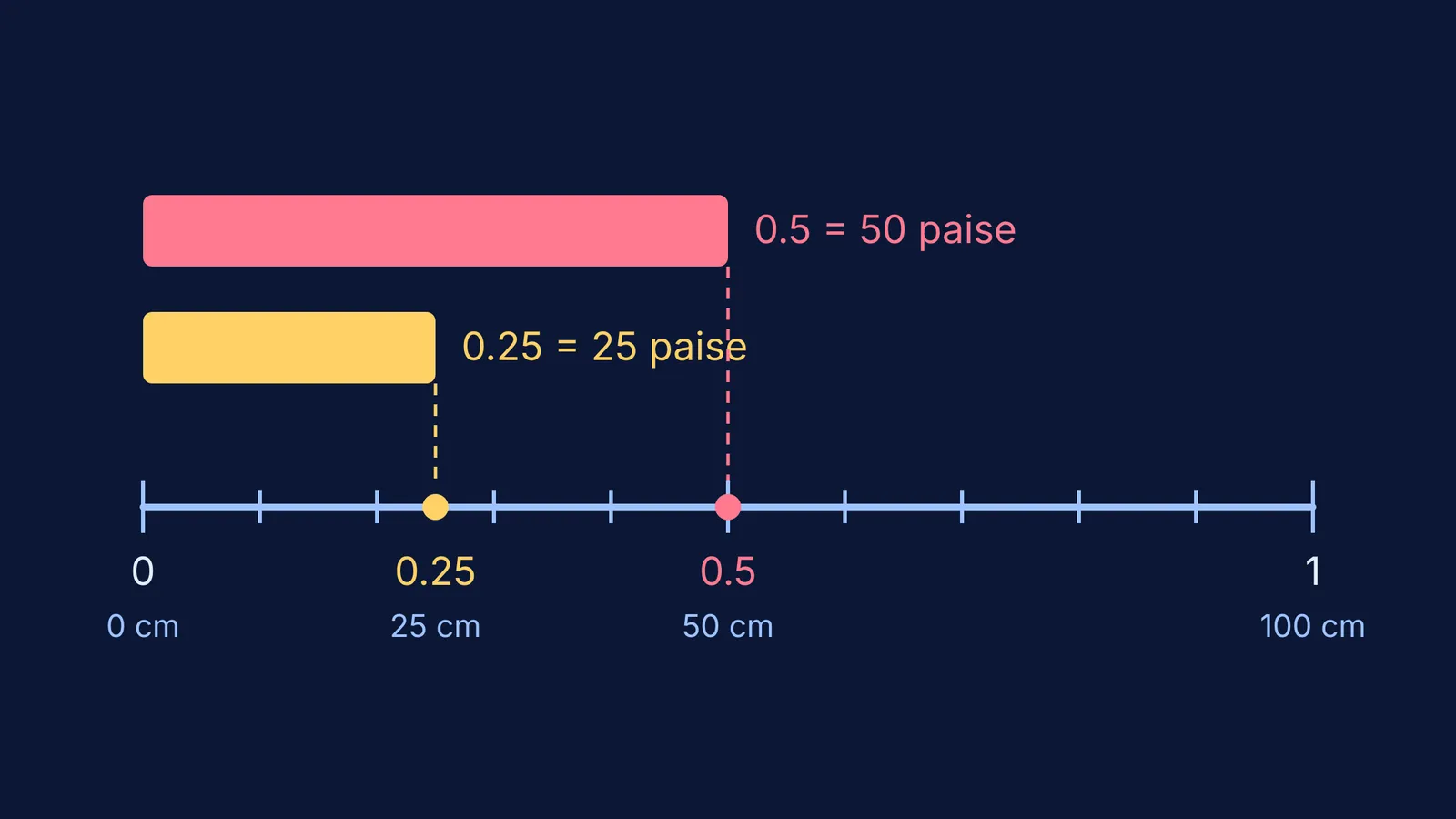
Money stops at two decimal places, so add a second picture: length. A metre is 100 centimetres, so 0.5 m is 50 cm and 0.25 m is 25 cm. Hand your child a tailor's tape and ask them to find both. The 50 cm mark is plainly further along.
This also matches school. The NCERT Class 7 textbook, Ganita Prakash, opens its decimals chapter by measuring screws on a ruler where the unit between two numbers is divided into 10 equal parts, then reads a length like 2 and 7 tenths centimetres from it (NCERT, A Peek Beyond the Point). For the classroom side of the topic, see our guide to place value and comparing decimals in Class 7.
How do you make a number line on the floor?
Number lines are worth the effort. In a 2017 study, Noora Hamdan and Elizabeth Gunderson compared number-line training, area-model (shaded shape) training and a non-numerical control activity for second and third graders, and only the number-line training carried over to an untrained task of comparing fraction sizes (Developmental Psychology). The study used fractions rather than decimals, but decimals sit on the same line.
Here is a 15-minute plan for a floor version:
Use the tape to measure exactly 1 metre along the floor and stick down masking tape.
Write 0 at one end and 1 at the other.
Every 10 cm, mark 0.1, 0.2, 0.3 and so on up to 0.9.
Ask your child to stand on 0.5. Then ask where 0.25 must be: between 0.2 and 0.3, at 25 cm.
Ask: "Which one is further from zero?" Let them walk it.
Place a few more: 0.3, 0.75, 0.05. Ask them to say each one in paise and in centimetres too.
Fractions sit on the same line; we wrote about the 2012 study linking fractions and division to later maths.
What should I say when my child gets it wrong?
Keep the tone curious, not corrective. A short script:
"Tell me how you decided." (You find the rule they are using.)
"Would you rather have 0.25 of a rupee or 0.5 of a rupee? How many paise is that?"
"Show me both on the tape."
"So which rule should we use for decimals?"
You do not need to remember the textbook method. If the maths has faded for you, our piece on helping with maths you've forgotten has more questions to ask. If your child wants to go over decimals again on their own, the Fermi Concept Library gives every mathematics concept its own lesson and shows where it sits in the map.
Tonight, start with two coins and a question: which would you rather have?