On this page
The Class 10 paper your child will sit asks less "write the definition" and more "here is a graph, what does it tell you?" Here is the structure, from CBSE's own 2026-27 documents, and a plan for home.
How is the CBSE Class 10 exam marked?
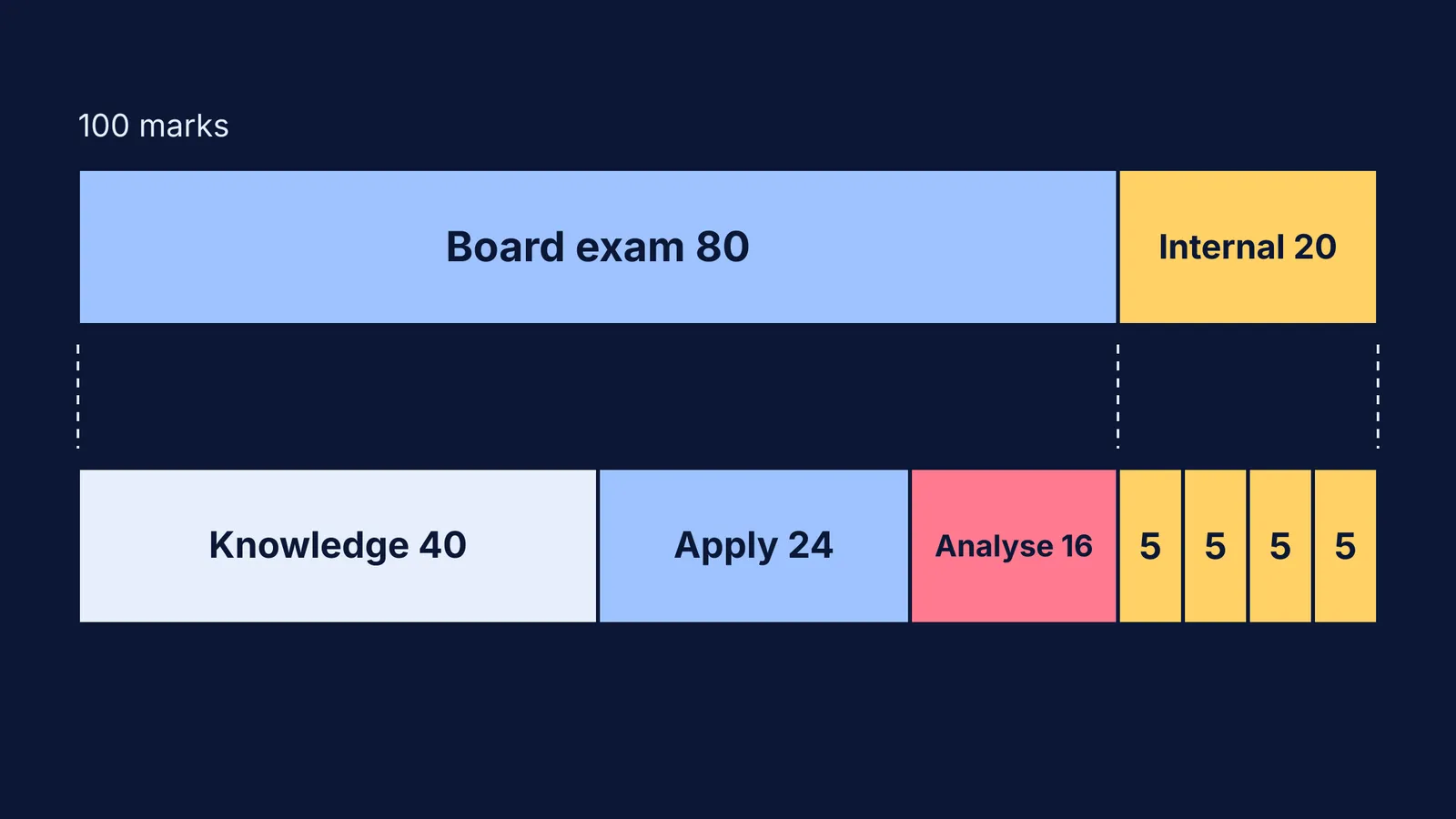
In Science and Maths, each subject is marked out of 100: 80 for the board exam and 20 for internal assessment. CBSE's Class 10 Science syllabus for 2026-27 sets an 80-mark theory paper lasting 3 hours plus 20 internal marks, and the Class 10 Mathematics syllabus uses the same 80 + 20 split.
The 20 internal marks are not one test. In Science they come in four parts of 5 marks each: periodic assessment, multiple assessment, portfolio and subject enrichment (practical work), according to the Science syllabus. In Maths, 10 marks come from pen-paper tests and multiple assessment, 5 from a portfolio and 5 from lab practicals, according to the Maths syllabus.
So internal marks are earned across the year, and a missing practical file costs real marks. Our guide to internal assessment marks and projects explains how schools award them. The Science syllabus also lists topics taught but assessed only formatively, such as evolution, so they will not appear in the board paper.
What are competency-based questions in CBSE Class 10?
A competency-based question checks whether a student can use an idea in an unfamiliar situation, not only recall it. CBSE's Science syllabus lists the question types: objective and assertion-reasoning questions, short and long answers, and source-based, case-based, passage-based or integrated questions.
The weightage shows how much of each paper goes beyond knowing and understanding. The figures below come from the 2026-27 Science syllabus and Maths syllabus:
Science: 50% knowledge and understanding, 30% application, 20% formulate, analyse, evaluate and create.
Maths Standard: about 54% remembering and understanding, 24% applying, 22% analysing, evaluating and creating.
Maths Basic: about 75% remembering and understanding, 15% applying, 10% analysing, evaluating and creating.
The official 2026-27 Science sample paper has 39 questions in three sections (Biology, Chemistry and Physics), with a choice inside some questions. Question 28 shows five metal rods heated at a central point and a bar graph of how long the candle on each rod takes to drop. The student picks the best conductor from the graph, places gold (better than aluminium, worse than copper) on the time scale, then explains what happens if every rod is 20% longer, or whether rods of different thickness make a fair test.
Knowing which metals conduct heat well helps with the first part, but most of the question needs reading data and reasoning about a fair test. That is the shift to watch for at home.
Why does Class 10 now have two board exams?
CBSE introduced two board exams for Class 10 from 2026, in line with NEP 2020. In 2026 the main exam ran from 17 February to 11 March and the second from 15 to 21 May, and for regular students the better of the two performances counted, according to a CBSE press release of 18 July 2026. Of the 5,13,955 students who sat the second exam to improve, 3,08,095 (59.95%) did better than in the main exam, the same release reports.
Treat the second exam as a safety net, not the plan. Dates and eligibility are notified each year, so check the current circular. Our explainer on how the two CBSE Class 10 board exams work has more detail.
What can parents do at home?
A five-step plan for the year:
Download the sample paper and marking scheme for each subject from the official CBSE sample paper page and read the general instructions together once. Our guide on how to use the CBSE marking scheme shows what examiners look for.
Ask your child to keep an internal assessment tracker: subject, component, due date, status. Look at it together once a fortnight, not every evening.
Swap "Did you finish the chapter?" for "Explain it with an example from our kitchen or your phone." If they cannot, that is a concept gap to fix first.
Once a week, pick one case-based question. Your child underlines the data and says in one sentence what is really being asked before writing.
After each school test, sort lost marks into three bins: did not know the idea, applied it wrongly, misread the question.
The bins tell you what to do next. If "did not know" keeps filling up, the Fermi Concept Library has its own lesson for every concept in physics, chemistry, biology and mathematics. If it is "applied it wrongly", the Fermi Problem Library has worked problems with a step-by-step solver that explains the reasoning rather than printing an answer.
If exam worry starts affecting your child's sleep, meals or mood, talk to the school counsellor or your doctor. Tele MANAS, the government's mental health helpline, is free on 14416 or 1-800-891-4416, according to the Press Information Bureau.
Start this week: open the Science sample paper with your child and try question 28 together.