

On this page
Many parents remember grammar as a list of rules. So when a Class 4 worksheet comes home covered in red ink, the instinct is to drill the rules again. The research points elsewhere: children learn grammar by hearing it, saying it and playing with it.
Does teaching grammar rules improve children's writing?
Not on its own. Two systematic reviews of studies on 5- to 16-year-olds, led by Richard Andrews, found “little evidence” that teaching formal grammar improves writing, and a more positive effect for sentence combining, though they said the research was not strong enough to prove either case (Andrews et al., British Educational Research Journal, 2006).
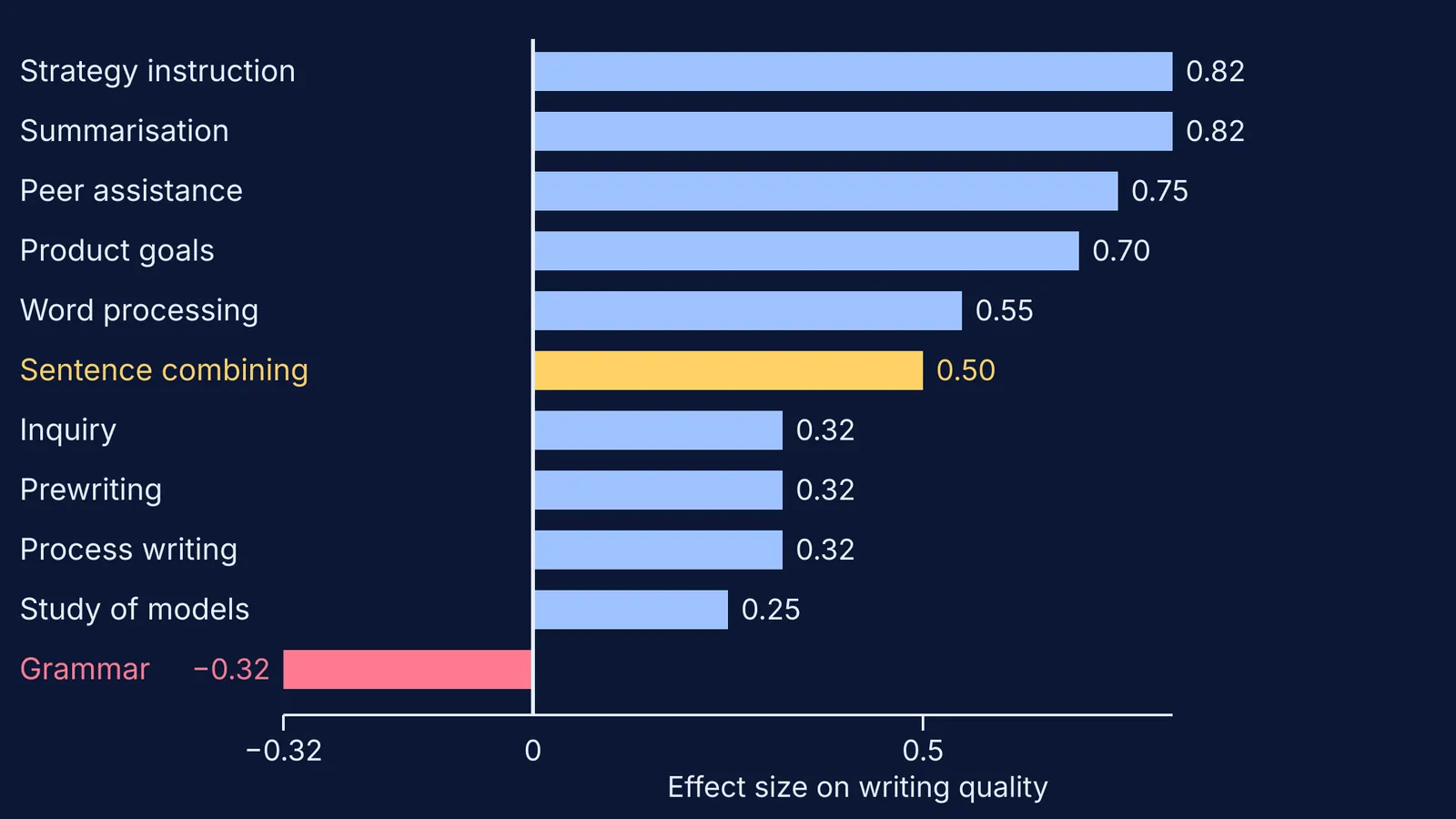
A meta-analysis of writing interventions for pupils in grades 4 to 12 gave grammar instruction an average effect size of −0.32 on writing quality, the only negative result among the 11 approaches it compared (Graham and Perin, Journal of Educational Psychology, 2007). Sentence combining, where students join short sentences into longer ones, had an average effect size of 0.50 in the same analysis.
That does not make grammar useless. In a randomised trial with 744 students in 31 schools in England, Debra Myhill's team found a significant positive effect from grammar teaching built into writing lessons, though the benefit was stronger for more able writers. Teachers named discussion and “playful experimentation” among its most salient features (Myhill et al., Research Papers in Education, 2012). The lesson for home: grammar sticks when it is attached to real sentences your child is trying to say or write.
Why does talking help children learn grammar?
The Education Endowment Foundation's guidance on literacy for 5- to 7-year-olds puts speaking and listening first among its eight recommendations and rates the evidence for it as extensive (EEF, Improving Literacy in Key Stage One, 2017). It suggests children read books aloud and talk about them, and that teachers show how to combine several simple sentences into more complex ones.
In schools, oral language approaches add an average of six months' extra progress over a year, based on 154 studies (Evidence for Learning toolkit, adapted from the EEF).
Many Indian children learn English as a second or third language, so the amount of English they hear matters. Keep talking richly in your home language too; our piece on home language and learning under NEP 2020 explains why that helps rather than hurts.
What grammar games can you play at home?
Each of these takes about ten minutes and needs no worksheet.
Sentence stretch. Start with “The dog ran.” Take turns adding where, when, how or why: “Yesterday the hungry dog ran across the road because it smelt samosas.” Then ask which words you can remove and still have a sentence. Your child has just found the subject and verb without needing the labels.
Combine two. Say two short sentences: “Riya was tired. She finished her homework.” Ask for one sentence, three ways: “Riya was tired, but she finished her homework.” “Although Riya was tired, she finished her homework.” “Riya finished her homework even though she was tired.” Ask which sounds best and why.
Spot the slip. Say a sentence with one deliberate error, such as “Yesterday we goes to the market.” Your child catches it and says it correctly, then makes up one for you. Keep the errors to the pattern school is working on.
Time machine. Tell a short event in the present tense. Your child retells it as yesterday, then as tomorrow.
Echo reading. Read a paragraph aloud with expression and have your child read it back. At each full stop, ask “What did your voice do there?” Punctuation becomes something they can hear.
What should you say when your child makes a grammar mistake?
In conversation, repeat it back correctly. If your child says “I goed to Aarav's house,” try “Oh, you went to Aarav's house? What did you do there?” You show the right form without stopping the story.
In writing, pick one thing. Instead of marking every error, say “Read this sentence aloud to me. Does it sound right?” Children can often catch their own slips by ear.
Give the rule when they ask why. “We say ‘went’ because it already happened. That's the past tense.” A label lands better once the sound is familiar.
For younger children, shared reading that turns a picture book into a conversation builds the same habits. If speaking or reading seems much harder for your child than for classmates, talk to the class teacher; our guide to signs of dyslexia and how assessment works explains the next steps.
A simple one-week plan
Monday: sentence stretch at dinner.
Tuesday: echo reading with one page of their school reader.
Wednesday: spot the slip on the way to school.
Thursday: combine two, using sentences from their homework.
Friday: your child writes three sentences about the week, reads them aloud and fixes one thing they hear.
Talk helps in maths and science too, where children must put reasoning into words. Fermi's AI tutor decides whether to explain, ask or show, and checks understanding as it goes, so your child practises saying what they think rather than just copying answers.
Start tonight with one stretched sentence at dinner.


