

On this page
Drones have a unique ability to capture a teenager's attention. If your child is asking for a quadcopter, you might wonder if it is just an expensive toy or a tool that will actually teach them something useful.
Research shows that piloting and programming a drone is a powerful form of active learning. A 2020 study published in *TechTrends* found that project-based learning with aerial drones effectively increased high school students' interest and technical problem-solving skills in programming (doi:10.1007/s11528-020-00502-7). When a teenager connects lines of code to a physical object that flies across the room, the learning clicks in a way that reading a textbook rarely matches.
If you are considering this hobby, you need to understand both the educational benefits and the legal restrictions for flying in India.
What do teenagers learn from flying drones?
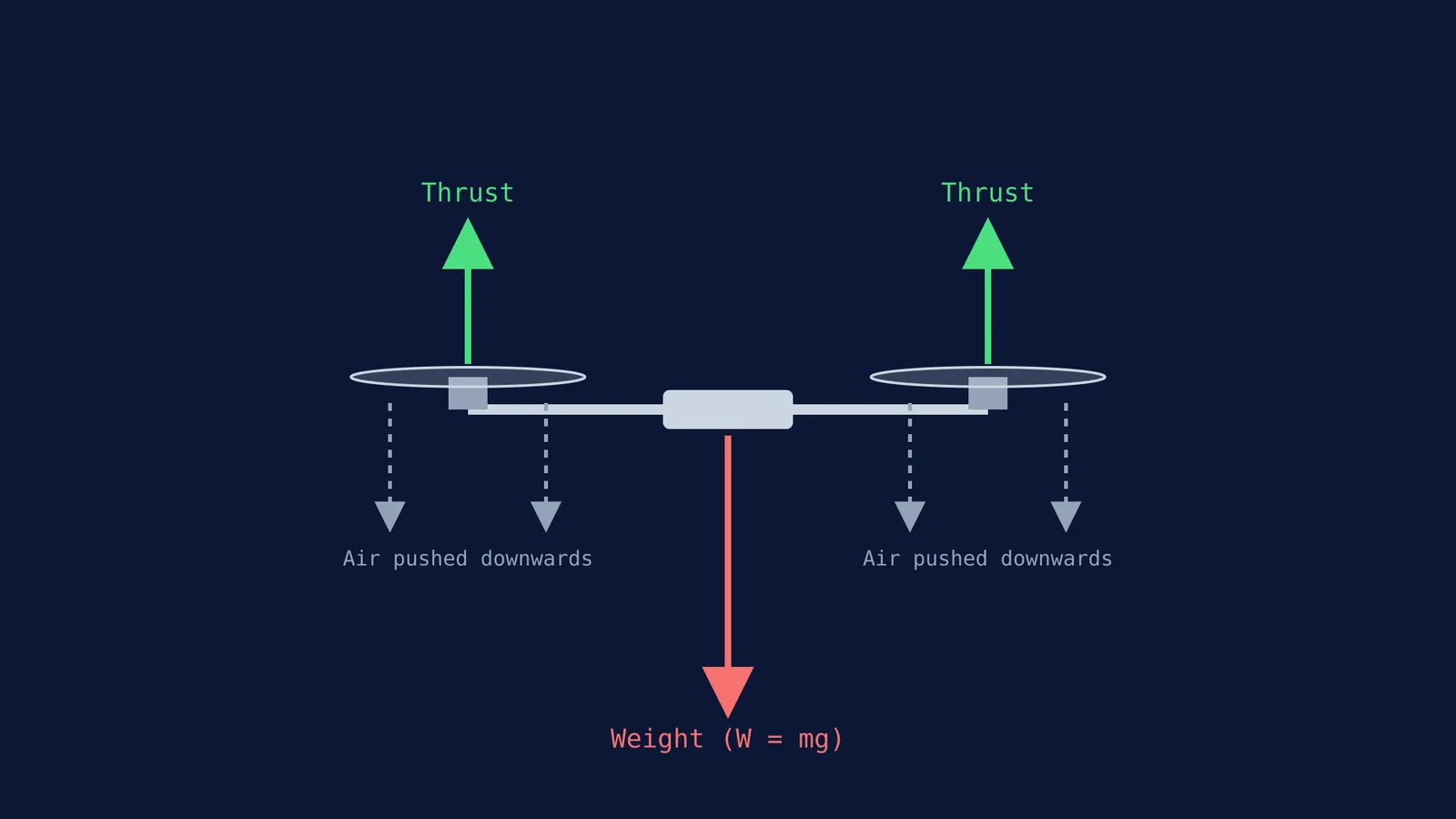
A drone is a flying physics laboratory. To keep a quadcopter stable in the air, a teenager has to understand how four fundamental forces interact: lift, weight, thrust and drag. They get a hands-on lesson in Newton's third law of motion every time the drone takes off: the spinning rotors push air downwards, and the air pushes the drone upwards.
If they adjust the speed of one rotor, they immediately see the physical consequence. This tangible feedback loop turns abstract science into a memorable experience. For complex aerodynamic ideas that are harder to picture in the field, students can use the Fermi Simulation Lab. It provides interactive simulations for the ideas that are easier to see than to read, so they can isolate variables like thrust and drag on a screen before testing them outside, much like learning projectile motion with a simulation.
Beyond physics, many entry-level educational drones introduce programming. Instead of just using a joystick, teenagers can write scripts to automate flight paths. Using languages like Python or visual blocks like Scratch, they can command the drone to take off, fly a specific geometric pattern, collect sensor data, and land autonomously. This active engagement requires deep focus and iteration, proving that hobbies do not have to hurt academic marks when they align with STEM learning.
What are the rules for flying drones in India?
India's Directorate General of Civil Aviation (DGCA) updated the Drone Rules in 2021 to make civilian flying simpler while maintaining safety. Drones are classified by their weight, which dictates the legal requirements you must follow.
Nano drones (up to 250 grams): This is the ideal category for teenagers. According to the DGCA rules, Nano drones flown for non-commercial purposes do not require a Unique Identification Number (UIN) or a Remote Pilot License. They are effectively treated as toys, provided they stay within safe altitude limits.
Micro drones (250 grams to 2 kg): If you buy a heavier drone, it becomes subject to mandatory registration. You must register it on the government's Digital Sky platform to obtain a UIN before it can be legally flown.
Regardless of the weight category, all drones must respect the airspace zones outlined on the Digital Sky map. You can fly freely up to 400 feet in Green Zones, but flights are strictly prohibited in Red Zones (such as near airports, military installations or government buildings) and Yellow Zones without prior permission.
How to start safely
If you decide to support this hobby, it is best to start small and focus on the learning process.
Choose a Nano drone: Buy a model that weighs less than 250 grams to avoid complex licensing and registration hurdles. Look for models explicitly designed for education, ideally equipped with propeller guards to protect both the drone and your furniture.
Check your zone: Download the official Digital Sky app to confirm your local park or neighbourhood is in a Green Zone before heading out.
Plan the first flight: Treat the first few flights as scientific tests rather than playtime. Start in a large, clear indoor space if possible, or an empty field on a calm day.
If your child starts asking deeper questions about the electronics, the battery chemistry, or the maths behind their programmed flight paths, Fermi's AI tutor can help. The tutor works out what the student already knows and explains the reasoning step by step, which you can explore in our 20-minute parent's guide to trying an AI tutor.


