

On this page
What is a day boarding school, and how does it work?
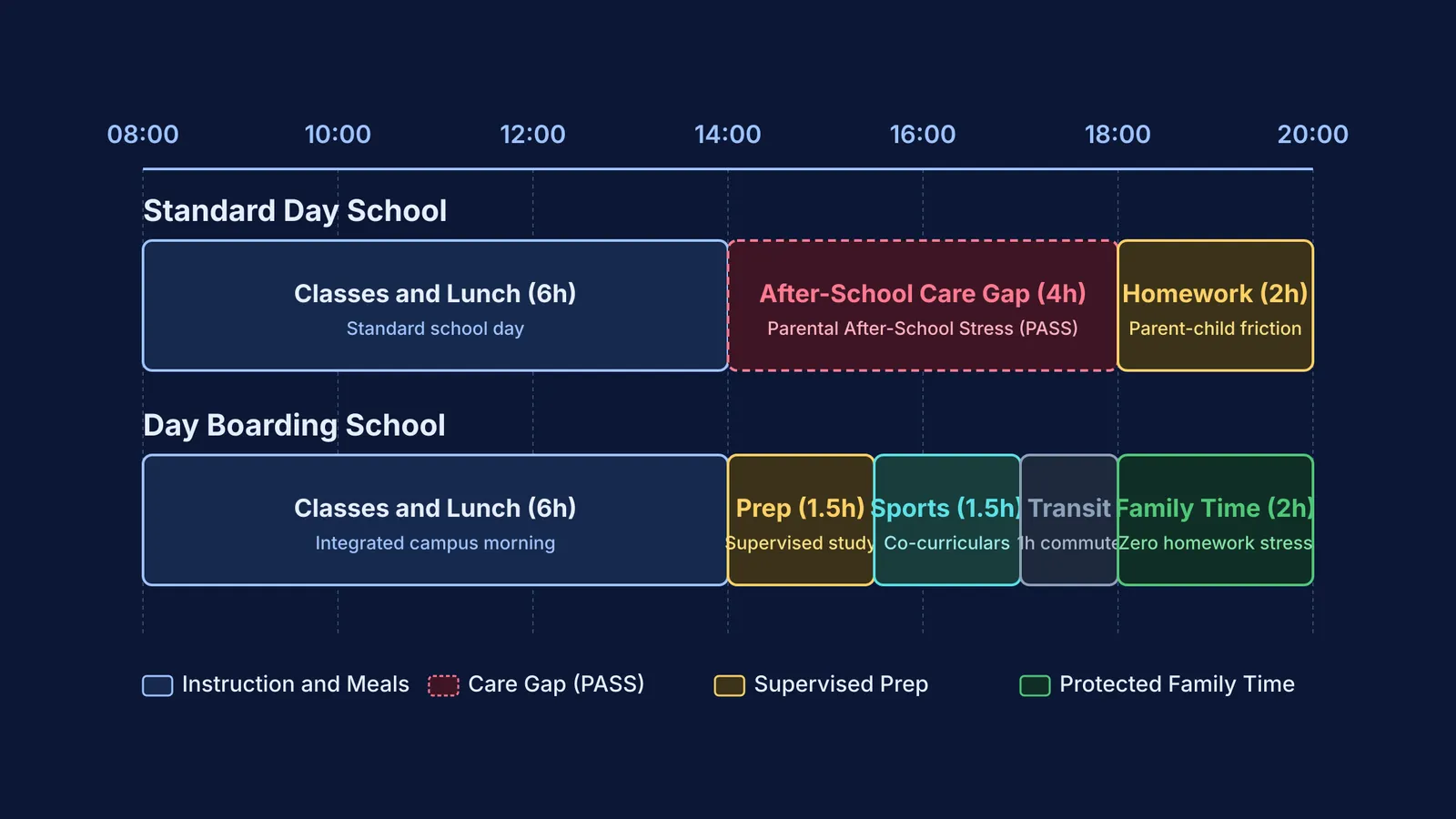
A day boarding school provides an extended campus day—typically running from 8:00 AM to 5:00 PM—without requiring students to reside away from home. While standard Indian day schools dismiss students by 2:00 PM, day boarding integrates morning academics with lunch, outdoor sports, hobby clubs, and a dedicated self-study block known as prep.
For dual-career families in Indian metropolitan cities, this structure bridges the daily gap between early school dismissal and the end of the working day. Students complete their coursework, practice sports on school grounds, and tackle daily assignments under teacher supervision, returning home for dinner, conversation, and rest.
Why do working parents choose day boarding?
The primary appeal for working parents is the elimination of the afternoon childcare vacuum. In a 2006 study published in the *Journal of Marriage and Family*, researchers Rosalind Chait Barnett and Karen C. Gareis surveyed 243 employed parents of school-age children and identified Parental After-School Stress (PASS)—the persistent anxiety parents feel between 2:00 PM and 6:00 PM regarding their children's safety, nutrition, and unsupervised screen time. Barnett and Gareis found that after-school care disruptions directly impair parental well-being and work focus.
Day boarding addresses this logistical strain on three fronts:
Safety and nutrition: Children remain in a secure campus with balanced hot lunches and evening snacks rather than returning to an empty house.
Integrated extracurriculars: Coaching for football, swimming, or classical music occurs on campus, eliminating cross-town transit between private lessons.
Reclaiming family evenings: When assignments are completed before dispersal, evening hours at home are freed from arguments over notebooks.
Does supervised school prep actually solve the homework problem?
Homework is often the central battleground in working households. A research synthesis by Erika A. Patall, Harris Cooper, and Jorgianne Civey Robinson (2008) examining 14 parent training studies and 20 correlational studies revealed that direct parental tutoring frequently induces emotional conflict, particularly in middle school and mathematics. The authors found that while parental rule-setting aids achievement, direct homework intervention often backfires when exhausted parents and children clash.
Day boarding moves this workload into structured school hours. An international report by the OECD (2014) recorded that 15-year-old students spend an average of 4.9 hours per week on homework across member countries, with socio-economically advantaged students spending 1.6 hours more per week than disadvantaged peers due to home support. The OECD recommended that schools provide supervised study spaces to equalize learning conditions. Examining how much homework helps across different age groups and when to help with homework and when to step back clarifies how to assess these campus hours.
Yet prep time depends heavily on supervision quality. In strong programmes, subject teachers circulate to explain concepts. In weaker setups, prep becomes a passive study hall where exhausted staff merely keep order and students copy answers.
When assignments require deeper conceptual reasoning than a busy study hall can provide, self-study tools can assist. For STEM subjects where a student needs guided practice, Fermi's AI tutor works out what the student already knows, notices where they are stuck, and decides whether to explain, ask or show. To build genuine problem-solving skills, the Fermi Problem Library provides a step-by-step solver that explains the underlying reasoning rather than printing an answer.
What are the hidden drawbacks of an extended school day?
Despite the logistical convenience, an extended school day carries clear trade-offs:
Cumulative physical fatigue: An 8:00 AM to 5:00 PM schedule plus heavy traffic creates an exhausting day away from home. Primary students frequently suffer sensory overload and fatigue.
Diminishing returns for young children: A research synthesis by Harris Cooper, Jorgianne Civey Robinson, and Erika A. Patall (2006) found that homework correlates positively with academic achievement in secondary school (grades 7–12), but has negligible correlation in elementary school (grades K–6). Enrolling young children in extended academic prep produces little academic gain.
Constrained senior preparation: Senior secondary students preparing for competitive entrance examinations often need flexible, self-paced revision that rigid school prep cannot match.
Premium fees: Day boarding tuition is substantially higher than conventional day schooling to fund hot meal programmes, dedicated sports coaches, and extended campus operations.
How should parents evaluate day boarding prep?
Before choosing day boarding, visit the campus during afternoon prep and evaluate these criteria:
Active teacher guidance: Verify that qualified subject teachers supervise prep rather than non-teaching proctors.
The completion rate: Ask enrolled families whether students truly finish daily homework on campus or if assignments still spill into evenings.
Real nutritional value: Check that the afternoon meal and evening snack offer balanced nutrition before physical training.
Total transit limits: Ensure daily bus travel remains short enough that road commute fatigue does not negate the benefits of campus prep.
Home balance: Even with campus study hours, setting up a dedicated study space at home gives children a calm spot for weekend reading and independent review.


