On this page
If your child will only read comics, you may worry that they are dodging "proper" books. The research suggests otherwise. Small studies show graphic novels take real reading skill, and a large UK survey links comics with enjoying reading. The useful question is not whether to allow them, but how to build on them.
Are comics and graphic novels good for my child's reading?
In early 2023 the UK's National Literacy Trust asked 64,066 children and young people aged 8 to 18 about comics (National Literacy Trust, 2023). About 2 in 5 (40.3%) said they read comics or graphic novels, on paper or on screen, at least once a month.
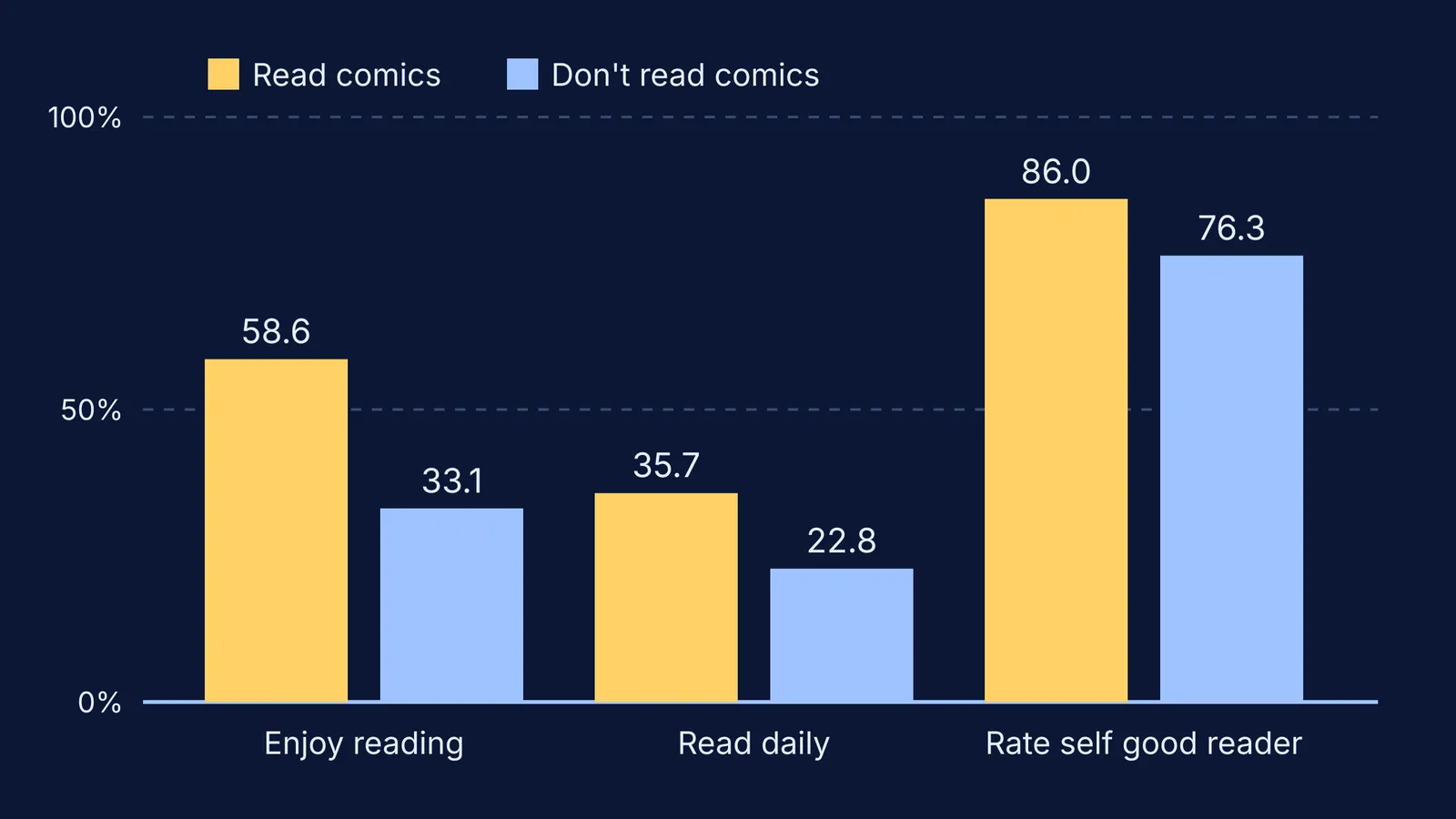
Children who read comics in their free time were more likely to say they enjoy reading: 58.6%, against 33.1% of children who did not. They were also more likely to read daily (35.7% against 22.8%), and 86.0% rated themselves good or very good readers, against 76.3%.
This is a survey, so it shows a link, not a cause: children who already like reading may simply pick up comics too. But it does suggest that comic readers have not given up on reading.
The same survey found that comics reading falls with age, from 49.7% of 8-to-11-year-olds to 31.4% of 14-to-16-year-olds, with little change after that (32.1% of 16-to-18-year-olds). So the early teens are when the habit most often fades.
Is a graphic novel easier to read than a novel?
Not as much as people assume. In a study in the Journal of Literacy Research, Laura Jimenez and Carla Meyer asked eight readers aged 16 to 20 to trace their attention across the opening pages of five graphic novels (Jimenez and Meyer, 2016). Experienced graphic novel readers looked at the pictures first to work out the genre, the characters and likely plot, then read the words, then put the two together. Strong readers of ordinary books mostly read the words and did not use the pictures to build meaning. The authors say this complicates the idea that graphic novels are easy reading.
A second small study followed one Grade 4 class reading graphic novels (Brenna, 2012). The children used strategies specific to the graphic novel form, and also general comprehension strategies, which Beverley Brenna called "master keys", that could carry over to other kinds of text. Their liking for graphic novels grew during the study. Both studies are small, so treat them as signs, not measured effects.
How do you pair comics with other books?
Add, don't replace. Keep the comics shelf open and put one bridge book next to it. Each step keeps one thing your child already loves and changes one other thing.
Same story, new form. A graphic adaptation of a novel, then the novel itself.
Same world or creator. A prose book set in a series or universe they already know.
Same topic, more words. A science or history comic, then an illustrated nonfiction book on the same subject.
Fewer pictures, short chapters. An illustrated chapter book, where a picture still appears every few pages.
A worked example: a 12-year-old who reads only mythology comics. In week one, a prose retelling of the same myths appears on the shelf. In week two, you read its first chapter aloud together at bedtime and stop at a cliffhanger. In week three, they compare: which version made the battle scene feel bigger, and why? The comics stay; the prose book has become part of the same interest.
Two things undo this. Making comics a reward for finishing a "real" book tells your child which kind counts. Taking comics away during exams often removes the only reading they do for fun. Our guide to helping teenagers read for pleasure has more on protecting that time.
For a teenager whose science comic has started a question, the Fermi Simulation Lab has interactive simulations for ideas that are easier to see than to read, a natural next step from pictures.
What should you say about the comics your child reads?
Pick one or two:
"Show me your favourite page. Why that one?"
"What did you know from the picture before you read the words?"
"What happened between these two panels that nobody drew?"
"If this were a novel, how would the writer describe this panel?"
Avoid "When will you read a real book?" It can make a reader feel they are not one. With younger children, reading a comic together works much like shared reading with young children: point, ask, let them lead.
Our explainer on dyslexia and other learning differences covers what to ask the school. For most families the plan is simple: keep the comics, add one bridge book, and ask one good question this week.