

On this page
A board year often brings stress, and tension over phones and late-night studying can quickly derail the family peace. Setting up a written family agreement moves the dynamic from nagging to collaboration, giving the student a sense of autonomy while maintaining necessary boundaries.
Why do you need family rules for the Class 10 board year?
If rules are only brought up when a student is caught scrolling on their phone, the result is usually an argument. A family agreement establishes expectations in advance. When the rules are written down and agreed upon together, parents become a support system rather than a constant supervisor.
There is strong evidence that this supportive approach works better than strict monitoring. A 2017 study of over 26,000 students published in *Psicothema* (DOI: 10.7334/psicothema2017.181) found that parents with a communicative profile—offering high support but low control—had children with significantly better academic results. The researchers concluded that high levels of parental control can actually undermine a child's sense of autonomy and intrinsic motivation. The goal is to agree on boundaries that allow the student to build a study routine that lasts, rather than policing their every move.
What should your board exam family agreement cover?
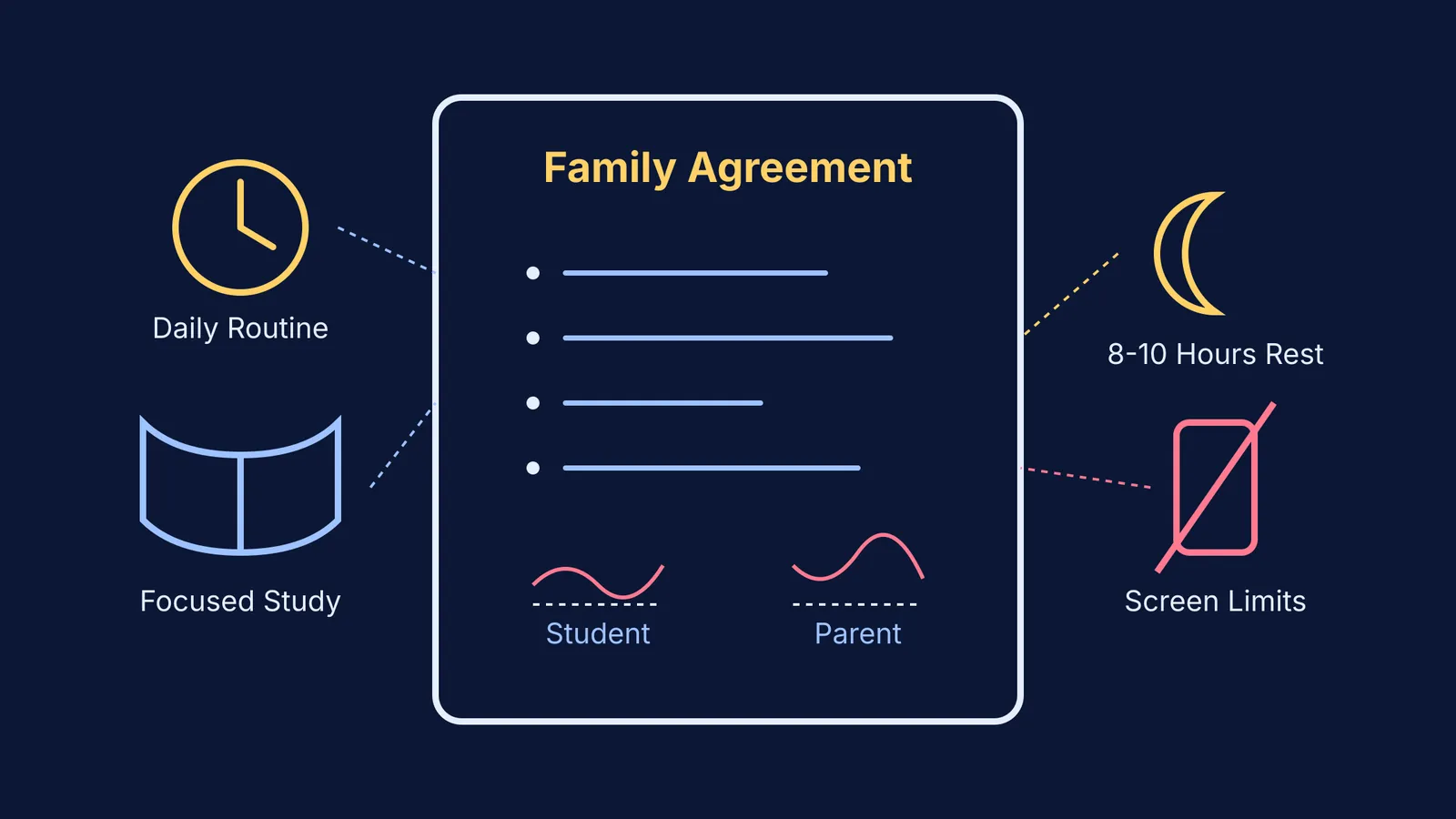
A successful agreement addresses both effort and rest. It focuses on the "input" (the time spent focused) rather than the "output" (the marks on a test).
First, set expectations for daily focused time and how to handle frustration. Remind your teenager that getting stuck is normal. If they are not sure where to begin their revision, Fermi's AI tutor can work out what they already know and build a plan for the session, providing a clear next step. When they hit a difficult question, the Fermi Problem Library has worked problems with a step-by-step solver that explains the reasoning rather than just printing an answer.
Second, address screen time to prevent the "displacement effect", where scrolling replaces homework or sleep. Agreeing to keep the phone in another room during study blocks is highly effective, as research shows just having a phone on your desk hurts focus.
Finally, make rest non-negotiable. The American Academy of Pediatrics recommends that teenagers aged 13 to 18 get 8 to 10 hours of sleep per 24 hours (AAP News, 2016). They also advise avoiding screens for at least 1 hour before bedtime (DOI: 10.1542/peds.2016-2592) to prevent blue light from delaying sleep onset.
How do you write a family contract for screen time and study?
You should write your agreement together, ensuring both the teenager and the parents make commitments. Here is a short framework you can adapt:
The Teen's Commitments:
I will aim for focused study periods each day, taking short breaks to recharge.
During study blocks, I will leave my phone outside my home study space to avoid distractions.
I will turn off all screens well before bed to ensure I get ample sleep.
If I feel overwhelmed, I will tell my parents early rather than letting the stress build up.
The Parents' Commitments:
We will keep the house quiet during agreed study periods.
We will focus our feedback on your effort and consistency, not just your exam marks.
We will not interrupt your scheduled downtime or outings with questions about the syllabus.
How do you stick to the agreement?
Once the rules are set, review them weekly. Sit down briefly with your teenager to ask what is working and what feels too strict. A family agreement is a living document designed to support the student's physical and mental health, so it should evolve as the school year progresses.
If you find the schedule is too demanding, adjust the expectations together. By focusing on the process and sharing the responsibility, you create a calm environment where the student can do their best work without burning out before the crucial exams begin.


