On this page
A school's website tells you what it wants you to see. A one-hour visit on an ordinary working day shows you much more of what daily life there is like. Use the checklist below in the same order at every school, then compare your notes.
What should you look for in a primary school classroom?
Ask to sit in a Class 1 or Class 2 room for ten minutes, not just walk past it. Then watch for these things:
Whose voices you hear. Children should be answering, asking and talking to each other, not only repeating after the teacher.
What is on the walls. Children's own recent work, with different answers and spellings, is a better sign than identical charts bought from a shop.
How many adults there are for how many children. The Schedule of the Right of Children to Free and Compulsory Education Act, 2009 links a school's teachers for Classes I to V to the children admitted: two for up to 60, three for 61 to 90 and four for 91 to 120.
How mistakes are handled. Section 17 of the same Act says no child shall be subjected to physical punishment or mental harassment. Notice the teacher's tone when a child gets something wrong.
Whether there is something to touch. The RTE Schedule says play material and teaching-learning equipment shall be provided to each class as required. Look for blocks, counters, picture cards and objects children are allowed to use.
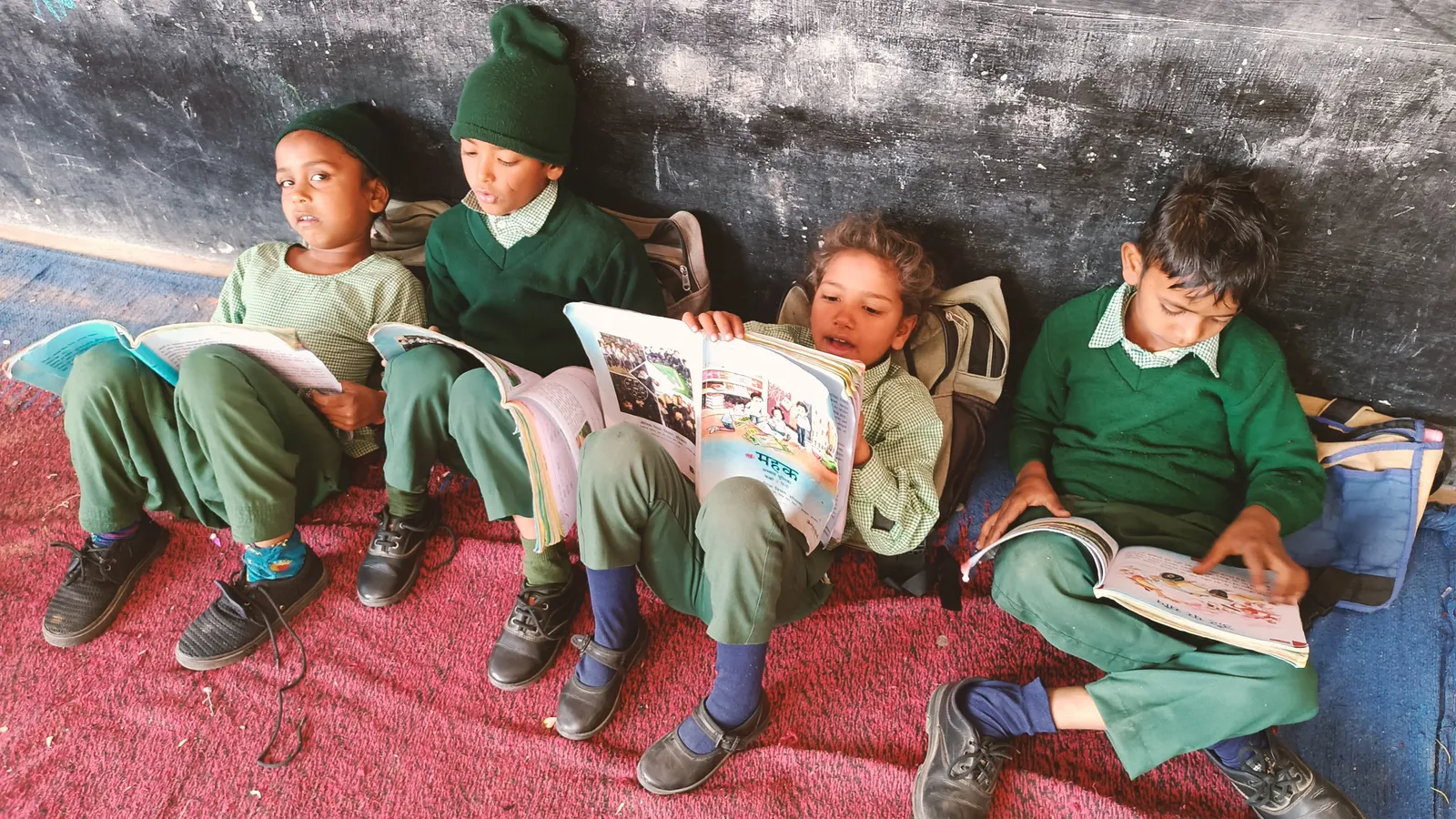
Does the school have a real reading corner?
Reading underpins most other learning in primary school, and many children are behind. In ASER 2024, only 23.4% of Class 3 children in rural government schools could read a Class 2 level text.
The RTE Schedule says there shall be a library in each school with newspapers, magazines and books on all subjects, including storybooks. ASER surveyors found books other than textbooks being used by students in 51.3% of the government schools with primary sections they visited in 2024, up from 36.9% in 2018 (ASER 2024).
A locked cupboard of books does not count. Check that books sit at a child's height, look handled, include your home language, and that children can take them home. Ask when, in the weekly timetable, children read for fun. Our guide to reading for pleasure explains why that time matters.
What homework policy should a primary school have?
The Ministry of Education's School Bag Policy 2020 recommends no homework up to Class II (The Tribune). For Classes III to V it suggests a maximum of two hours a week (Drishti IAS summary of the policy).
Ask to see one real week of homework from a Class 3 diary. Count the minutes and see whether the work is reading, talking and small tasks, or copying. For more on what helps at each age, see how much homework helps.
Why does teacher turnover matter?
A study of more than 850,000 New York City fourth- and fifth-grade student observations over eight years found that students in grade levels with higher teacher turnover scored lower in both English and maths (Ronfeldt, Loeb and Wyckoff, 2013). The authors also found a disruptive effect of turnover beyond any change in teacher quality.
You cannot see turnover on a visit, so ask about it directly (questions 3 and 4 below).
What questions should you ask the principal?
A good school will answer these without fuss.
“How many children will be in my child's class, and how many adults?”
“Can I see this term's timetable for Class 1? When do children read for fun?”
“How many class teachers in the primary section left during or after the last academic year?”
“Will my child keep the same class teacher for the whole year? Who teaches when a teacher is absent?”
“What is your homework policy for Classes 1 to 5, and is it written down?”
“How do you help a child who is behind in reading by the end of Class 1?”
“How do you handle discipline? What happens when a child misbehaves?”
“How often do you meet parents?” Section 24 of the RTE Act requires teachers to hold regular meetings with parents about attendance, learning and progress.
On admission, Section 13 of the same Act says no school shall collect a capitation fee or subject the child or parents to any screening procedure when admitting a child. The Act covers children aged 6 to 14. If a school asks for a donation or an interview, you can ask which rule it is following.
If you are also weighing boards, read our comparison of CBSE, ICSE and state boards. Later on, when maths and science ideas start to get harder, the Fermi Concept Library gives each concept its own lesson, so you and your child can go back to the one that didn't stick.