

On this page
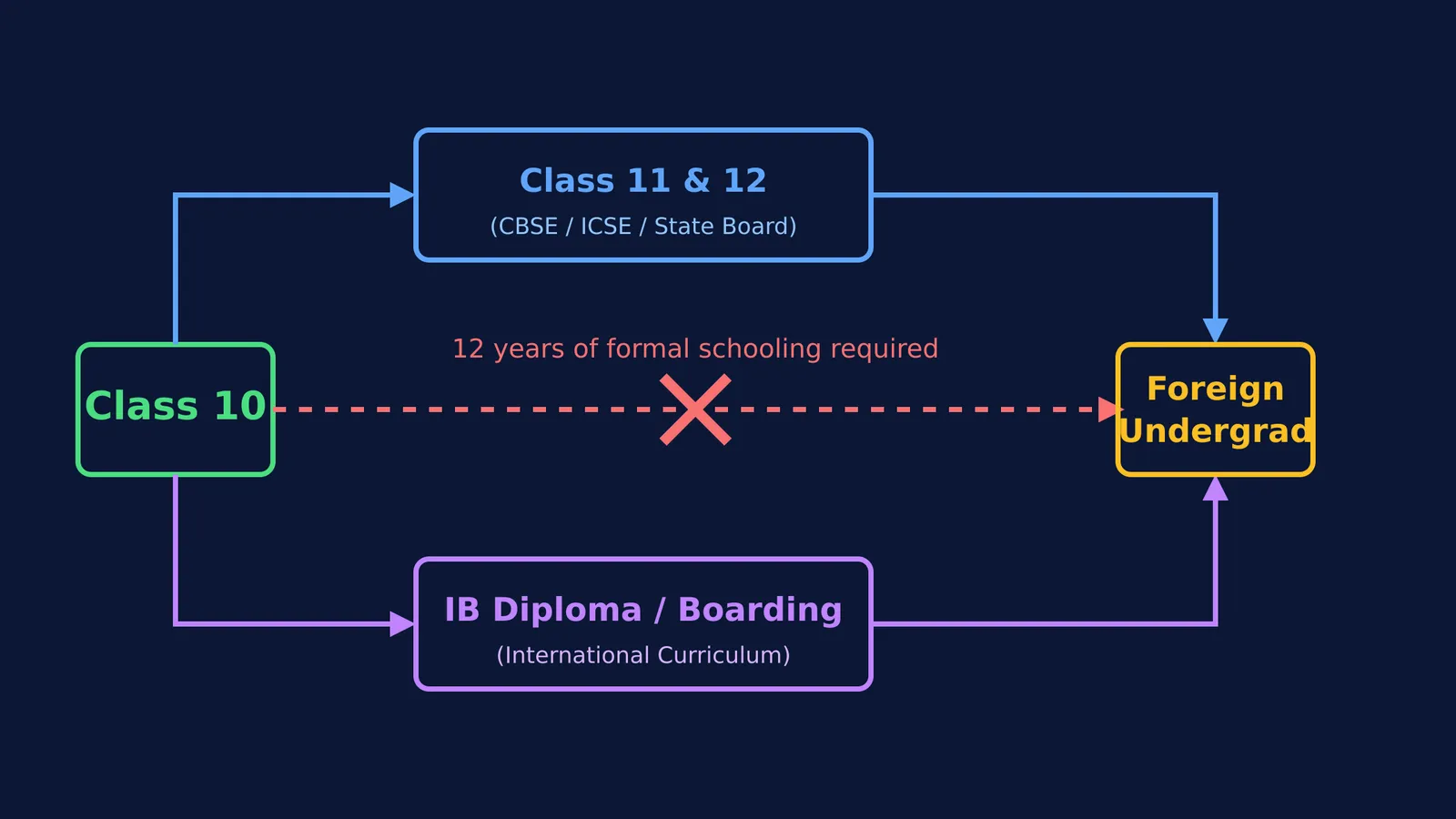
When a sixteen-year-old announces after Class 10 that they want to study abroad immediately, parents are often caught off guard. Four-year bachelor's degree programs in destination countries like the United States, Canada, and the United Kingdom require twelve years of formal schooling. A student holding only a Class 10 certificate cannot matriculate into standard undergraduate degrees. According to the Open Doors 2024 Report by the Institute of International Education, of 331,602 Indian students in American universities during the 2023/24 academic year, only 36,053 were undergraduates—under 11%—while nearly 60% pursued postgraduate study.
Teens asking to go abroad after Class 10 usually mean attending an overseas boarding school (such as United World Colleges) for Grades 11 and 12, or switching in India to the International Baccalaureate Diploma Programme (IBDP) to prepare for foreign undergraduate admissions. If you are weighing boarding schools versus staying local, review our guide on questions to weigh about boarding school.
How does the IB Diploma differ from CBSE or ICSE?
Switching to the IB Diploma is a major pedagogical change. Under the International Baccalaureate Organization curriculum directory, every candidate studies six subjects—normally three at Higher Level (HL) requiring 240 teaching hours and three at Standard Level (SL) requiring 150 hours—across languages, humanities, sciences, and mathematics. Students also complete the DP Core: a 4,000-word Extended Essay (EE), a Theory of Knowledge (TOK) course with a 1,600-word essay, and Creativity, Activity, Service (CAS).
Assessment also differs from national boards. Under IB Diploma Programme assessment regulations, each subject is scored 1 to 7, with up to 3 bonus points from the Core, producing a maximum of 45 points. Earning the diploma requires at least 24 points. Instead of relying solely on final board exams, the IB uses continuous Internal Assessments—including research reports, oral presentations, and practical projects—accounting for a significant portion of each subject grade. See how to choose between IGCSE and CBSE for how different systems distribute assessment pressure.
For analytical depth in Higher Level sciences, the Fermi Concept Library maps every concept in physics, chemistry, and mathematics with dedicated lessons to help bridge foundational gaps.
Four questions parents must ask before making the switch
Before paying admission fees, discuss these four diagnostic questions with your teenager:
Are they running toward a curriculum or away from coaching? Many teenagers seek an international board to escape JEE or NEET coaching. However, the IB Diploma is not an easier path; it replaces multiple-choice drilling with continuous research essays, lab write-ups, and oral presentations. If your teenager feels alienated by conventional tracks, explore when a child's career choice differs from your plan to open constructive dialogue.
Can they manage self-directed deadlines? In CBSE, teachers set short homework cycles and textbooks define exam scope. In the IB Diploma, students formulate research questions for their 4,000-word Extended Essay under IB Diploma Programme Core regulations and balance overlapping coursework deadlines across six subjects. When working through unfamiliar problem styles, Fermi's AI tutor works out what a student already knows, holds a line of reasoning across the session, and guides them step by step without simply handing over the final answer.
What is the fallback plan if foreign admissions fall through? Visa rules, currency movements, and admission caps change frequently. Families must confirm whether their subject choices preserve eligibility for domestic universities if plans shift.
Can your family support the full six-year financial commitment? The IB Diploma in India typically requires significantly higher tuition than national boards. An undergraduate degree abroad also adds major tuition and living expenses over three or four years, as documented in international education cost benchmarks tracked by the Institute of International Education. Families should budget for Grades 11 and 12 plus the undergraduate degree as an integrated financial commitment.
Does an IB Diploma count for Indian colleges and exams?
Parents frequently worry whether an international board closes doors in India. The Association of Indian Universities grants equivalence to the IB Diploma as equal to the Senior Secondary Certificate (10+2) of Indian boards. However, equivalence requires earning the full diploma with at least 24 points and passing three Higher Level and three Standard Level subjects. Course results certificates without the full diploma do not receive equivalence.
Students keeping Indian competitive exams open must select Grade 11 subjects carefully. For engineering via JEE Main, students require Mathematics (preferably Analysis and Approaches HL) and Physics. For medicine via NEET-UG, regulations mandate Physics, Chemistry, and Biology. Balancing IB coursework with Indian entrance prep requires exceptional discipline.
A step-by-step checklist for the Class 10 transition
If your family decides to make the switch, follow this practical timeline:
October to December (Class 10): Tour candidate international schools, review their Higher Level subject offerings, and inspect science labs and libraries.
January to March (Class 10): Check entry prerequisites for target undergraduate degrees (such as higher-level mathematics for economics or computing) to finalize subject combinations.
April to June (Summer break): Develop foundational academic writing, citation hygiene, and touch typing. Writing structured five-page essays requires deliberate practice before classes start.
July to September (Grade 11): Finalize Higher Level and Standard Level courses and map out major Internal Assessment submission windows.
If exam stress or academic transition anxieties cause acute distress, confidential support is available via India's national tele-mental health helpline Tele MANAS at 14416.


