On this page
Why do teenagers want to meet online friends?
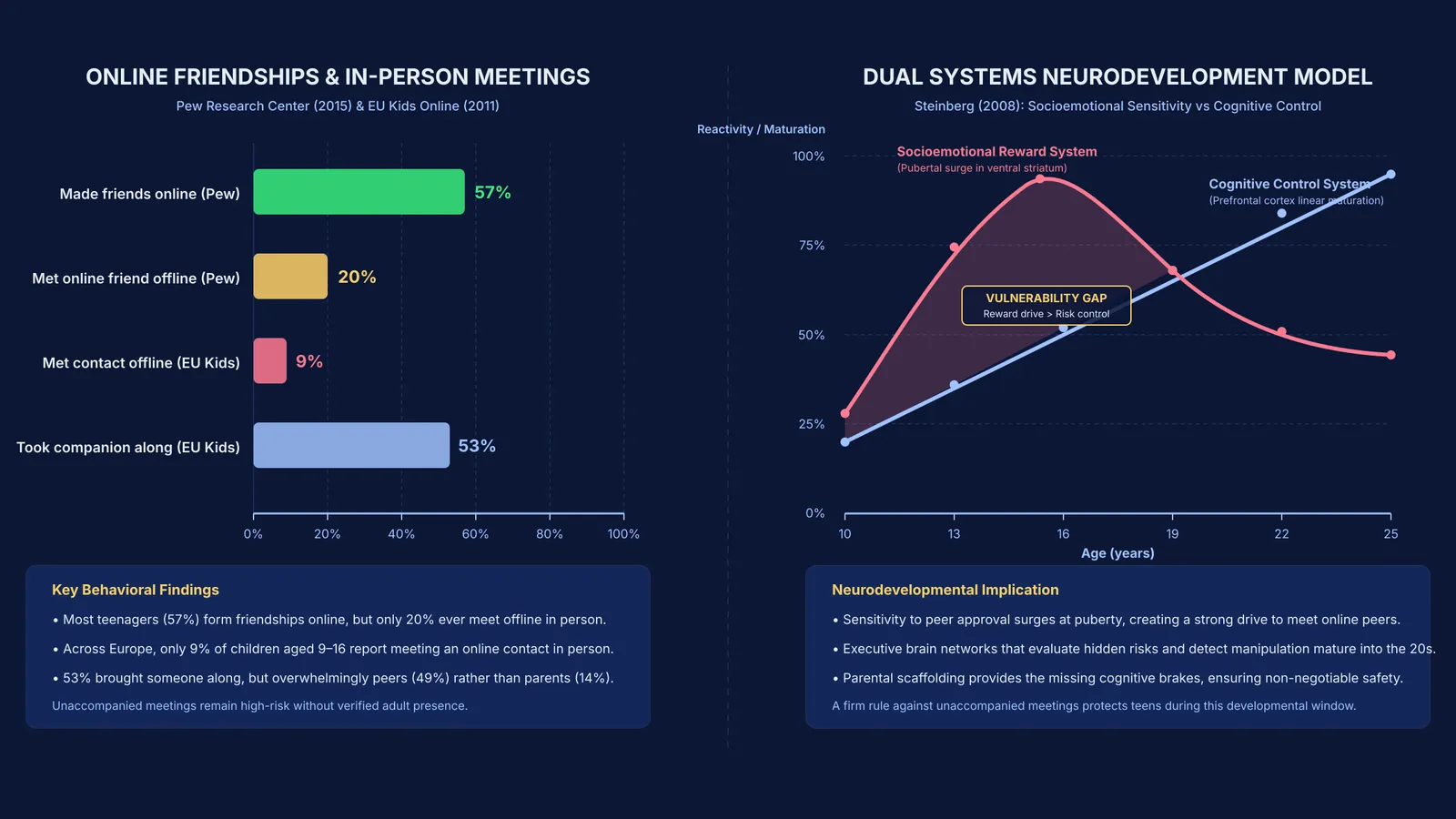
Adolescence brings an intense developmental drive for peer connection, and much of that social life now happens online. In a nationwide survey of teenagers aged 13 to 17 by the Pew Research Center, 57% of respondents reported making at least one friend online. Networked gaming accounted for 36% of these connections, while 64% originated on social media. For a teenager, shared enthusiasm for games, coding, or art makes an online peer feel like a kindred spirit.
Yet taking an online friendship into the physical world is rare. The same Pew Research Center study found that only 20% of teens who made a friend online had ever met that person face-to-face. Across 25,142 children aged 9 to 16, the EU Kids Online project found that only 9% had met an online contact offline, and 53% of those who did meet took someone with them.
This vulnerability stems from brain development. In a review in Developmental Review, psychologist Laurence Steinberg detailed the dual systems model: the socioemotional reward system in the ventral striatum matures rapidly at puberty, heightening sensitivity to social connection. Meanwhile, the cognitive control system in the prefrontal cortex—which assesses risk and detects deception—matures gradually into the mid-twenties. Teenagers experience strong emotional incentives to connect, but lack mature cognitive brakes to detect deception.
Why does your initial reaction matter so much?
When a child asks to meet an online acquaintance, a parent's instinct is often panic, anger, or an immediate ban. Research shows that explosive reactions backfire. In a study on family communication in Child Development, Judith Smetana and colleagues found that harsh parental reactions lead adolescents to conceal sensitive activities. When teenagers expect anger, they stop disclosing and take their plans underground.
Parental involvement requires keeping communication open while setting boundaries. In the Journal of Broadcasting & Electronic Media, Sonia Livingstone and Ellen Helsper found that restrictive rules reduce peer-to-peer risk, but must be paired with dialogue so youth do not bypass safeguards. Through autonomy-supportive parenting, parents listen with calm curiosity. If your child tells you about an online friend, they are seeking guidance; an angry outburst guarantees secrecy next time.
How should you ask questions without sounding interrogative?
Ask questions that show interest rather than suspicion. Start by acknowledging their feelings: "I am glad you told me, and I want to understand more about your friend." Then ask specific, neutral questions:
"What games or topics do you usually talk about together?"
"How long have you known each other, and on which platforms do you chat?"
"Have you ever spoken on a live video call, or only via text and voice?"
"Do you know any of their mutual school friends or family?"
"Has this person ever asked you to move to encrypted apps or keep secrets?"
Listen for inconsistencies without interrupting. If the person avoids video calls or refuses to name their school, treat these as objective warning signs. Encourage clear screen-time rules so unmonitored late-night chats do not foster isolated emotional attachments. When screen time shifts from social chatter toward structured study, Fermi's AI tutor can work out what you already know and build a plan for the session, so you sit down to a clear next step.
What is the firm family rule for meeting online contacts?
While your tone should stay calm, your boundary around physical meetings must be firm: no child meets an online contact alone. The National Commission for Protection of Child Rights advises that children must never share location details or meet online contacts without parental presence. Framing this as a universal family safety rule rather than distrust towards the child removes resentment.
For older teenagers where the friend appears to be a genuine peer, follow a strict verification protocol:
Hold a live video call from a family room with parents present.
Verify their identity through verifiable contacts, such as a mutual school friend or their parents.
If an in-person meeting is ever permitted, it must occur in daylight in a crowded public venue with a parent nearby.
Establish a fixed end time, with no trips to private vehicles or secondary locations.
If the contact refuses video calls, rejects meeting parents, or pressures your child to meet secretly, cancel the meeting immediately. Teach children privacy in digital apps so location sharing remains off.
When should you seek immediate external help?
If an adult has solicited an underage child, asked for intimate photos, or arranged a secret rendezvous, treat it as a legal emergency. Preserve all chat histories and profiles. In India, report cyber exploitation to the National Cyber Crime Reporting Portal or call the national cyber helpline at 1930.
For children needing urgent protection, call Childline at 1098. If your family is experiencing severe distress, emotional support is available through Tele-MANAS at 14416. Setting firm boundaries protects children while their prefrontal cognitive control continues to mature.