

On this page
When a teenager announces they want to pursue music professionally, parents often face a wave of anxiety. How will they balance hours of practice with their schoolwork? What if they sacrifice their grades for a career that seems impossibly risky?
The reality of balancing music and academics, as well as the shape of a modern music career, often looks very different from our fears.
Does serious practice hurt school grades?
You might assume that spending three hours a day on a violin leaves less energy for school. The data shows the opposite effect.
A 2020 population-level study of over 112,000 students in Canada found that those who participated in school music scored significantly higher on maths, science and English exams than their non-musical peers (Guhn et al., 2020). In fact, students highly engaged in instrumental music were approximately one academic year ahead. The researchers found this effect held true even after controlling for earlier academic achievement and socioeconomic background.
Learning an instrument requires intense, sustained discipline. The physical coordination, note-reading and ability to focus deeply for long stretches transfer directly to the study habits needed for difficult school subjects. (If you are concerned about extracurriculars generally, see our guide on whether sports and hobbies hurt marks.)
If your child is struggling to fit everything in, the challenge is usually scheduling. When they are short on time and stuck on their coursework, the Fermi Problem Library has worked problems with a step-by-step solver that explains the reasoning rather than printing an answer. If they do not know where to start studying after a long rehearsal, Fermi's AI tutor can work out what they already know and build a plan for the session.
The 10,000 hours of deliberate practice
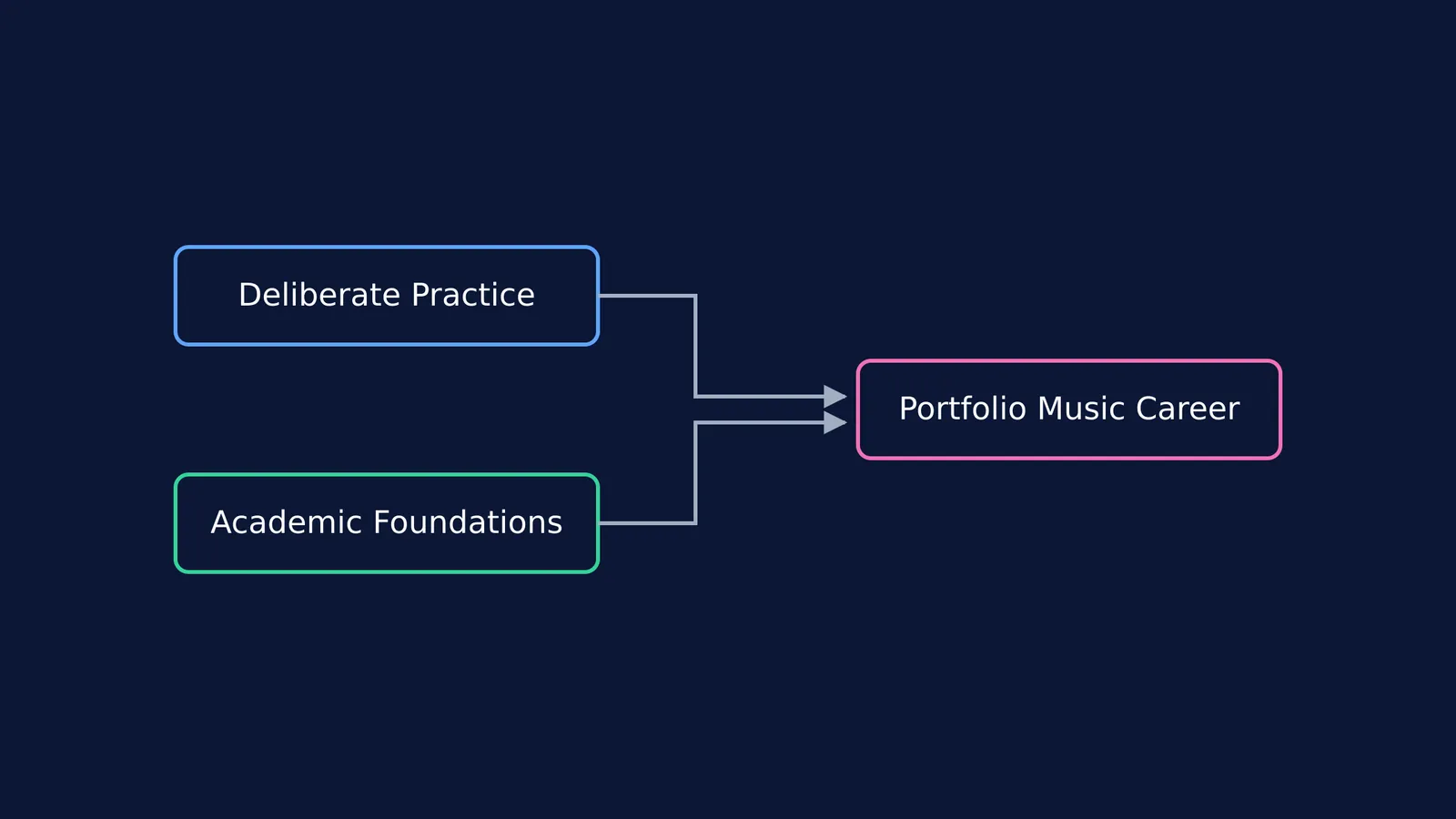
If your child is serious about a performance career, they will need to practice heavily. In a famous 1993 study, psychologist K. Anders Ericsson examined the practice habits of violinists at a music academy (Ericsson et al., 1993). He found that by age 20, the elite soloists had accumulated about 10,000 hours of deliberate practice.
Crucially, "deliberate practice" is not just playing through songs for fun. It means intensely focused work: tackling difficult passages, listening to feedback, and fixing specific mistakes. Ericsson noted that this level of mental effort is so taxing that even top performers can only sustain it for about four to five hours a day.
What does a music career actually look like?
If they do follow this path, what are the realistic financial prospects? The idea that a music career is a gamble between "global stardom" and "total failure" is largely a myth.
The Musicians' Census 2023, which surveyed thousands of working musicians in the UK, found that the average annual income from music was £20,700. To make a living, most musicians build a "portfolio career". The census reported that 53% of musicians sustain their careers by bringing in income from outside the industry, and 94% work freelance for at least part of their income.
A working musician might teach 15 hours a week, play weekend gigs, write music for small media projects, and do session work. Teaching is the bedrock of this model, providing a predictable anchor income that allows them to perform and write.
A plan for balancing school and music
If your child wants to commit to music, they need a structured week that protects both their craft and their academics. If you are unsure how involved to be, our guide on when to help with homework and when to step back offers practical boundaries.
Block the hard work first: Deliberate practice and hard subjects (like maths or physics) both require high executive function. Schedule these for their peak energy times, rather than late at night.
Separate play from practice: Help them differentiate between the hours they spend casually jamming with friends and the hours they spend doing the difficult, structured practice Ericsson described.
Encourage the portfolio mindset early: Support them in learning adjacent skills. Can they learn how to record and mix their own audio? Can they tutor a younger student in their instrument? These skills are what actually make a music career sustainable.
What if they change their mind?
It is incredibly common for a student to practice intensely through high school and then decide against a music conservatory. If they change course—which can be a delicate conversation, as discussed in our piece on when your child's career choice differs from yours—those thousands of hours are not wasted.
The grit required to master an instrument, the courage to perform under pressure, and the time-management skills they built will serve them in any field. If they eventually decide to study engineering, medicine, or law, they will step into that degree knowing exactly how to tackle something difficult.


