On this page
If your teen disappears into the bathroom with their phone and comes out much later, you are not alone, and it is rarely about the bathroom. In a busy home, a closed door is one of the few places where nobody asks for anything, and a phone makes that break stretch. The fix most families can live with is small: phones stay outside the bathroom, for everyone, adults included.
Why does my teen take the phone to the bathroom for so long?
Usually for one of three reasons:
Privacy. With shared rooms and relatives around, the bathroom is where they can text a friend without being overheard.
Escape. A break from a hard chapter that does not feel like giving up.
Habit. The phone goes wherever their hand goes, and a feed has no natural end.
The rule is the same for all three, but the conversation is different. If the bathroom is where your teen hides from a chapter they are stuck on, the long breaks are telling you about the study, not the phone. Fermi's AI tutor can work out what they already know and build a plan for the session, so they sit down to a clear next step.
Is using a phone on the toilet actually bad?
People who use one tend to sit there much longer. In a 2025 study in PLOS One, doctors in Boston surveyed 125 adults having a screening colonoscopy, and 66% said they used a smartphone on the toilet.
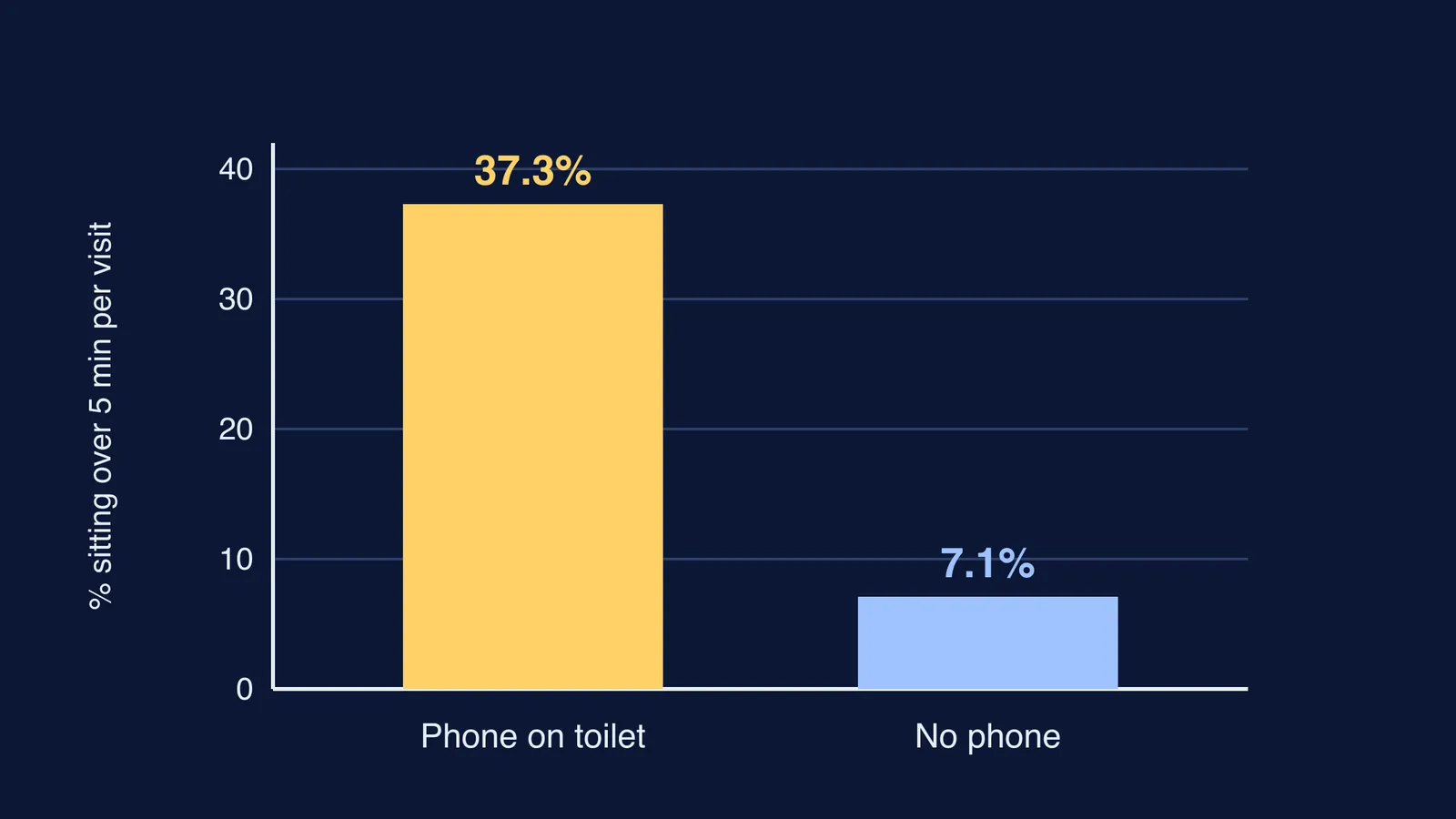
Among phone users, 37.3% sat for more than five minutes per visit, compared with 7.1% of people who did not take a phone in (PLOS One, 2025).
After adjusting for age, sex, weight, exercise, fibre and straining, using a phone on the toilet was linked to a 46% higher risk of haemorrhoids (PLOS One, 2025).
The people studied were adults aged 45 and over, and the authors note that their design cannot prove the phone caused anything. Treat it as a sensible reason, not a scare story. If your child has pain, bleeding or constipation, see a doctor.
How do I set a no-phone-in-bathroom rule?
Word it in one line. "Phones stay outside the bathroom. Everyone's."
Give the phone a place. A shelf or charging spot near the bathroom door.
Explain it once, at a calm moment. Not while knocking on a locked door.
Agree the edge cases together. Bath-time music can play from outside the door; calls can be taken in another room.
Review it at the end of the month. Ask what feels unfair, and adjust.
A script you can adapt:
"I've noticed the phone comes into the bathroom and the trips get long. I'm not checking up on you. Doctors have found that people who use phones on the toilet tend to sit there much longer, and long sitting has been linked to piles. So from Monday, phones go on the shelf outside, mine too. If you need a break or some privacy, tell me and we'll find you one."
If you already have a simple family phone agreement with your teen, add this as one line. If the first conversation turns into a fight, read what to do when your teen gets angry about the phone.
Why should parents follow the same rule?
Because teenagers notice the gap between what you say and what you do. The American Academy of Pediatrics' Family Media Plan guidance suggests screen-free zones, says the plan should include every member of the family, and calls parents "an important role model in practicing healthy digital habits".
A 2022 study of 2,360 Korean teenagers and their parents found that parents' smartphone addiction was directly and indirectly linked to their teenagers' smartphone addiction. It was a one-time survey, so it shows a link rather than a cause.
Agreeing a plan is not enough on its own. In a 2021 trial in JAMA Pediatrics, 1,520 parent and teen pairs were offered the AAP's online plan tool, and it did not measurably change how much teens engaged with media rules.
So put your own phone on the same shelf, and say it out loud the first few times: "Leaving mine here." We look at this more in how your own phone use shapes your child's study habits.
What if the bathroom is the only private place they have?
Offer privacy somewhere else, so the rule does not take away something they need: phone time in a room with the door half open, a walk to the shop, or a call on the balcony.
If long bathroom stays come with low mood, skipped meals, pulling away from family, or worry about who they are talking to, talk gently and get help from a school counsellor or doctor. Tele MANAS, the government's free mental health helpline, is open 24x7 on 14416 or 1-800-891-4416.
Start this week with a shelf by the door, and your own phone on it first.