On this page
Deciding when your child can walk or take public transport to school alone is a major milestone. While you might feel pressure to encourage independence—or fear you are letting them go too soon—safety guidelines offer a clear starting point.
Why is 10 the milestone age for walking to school?
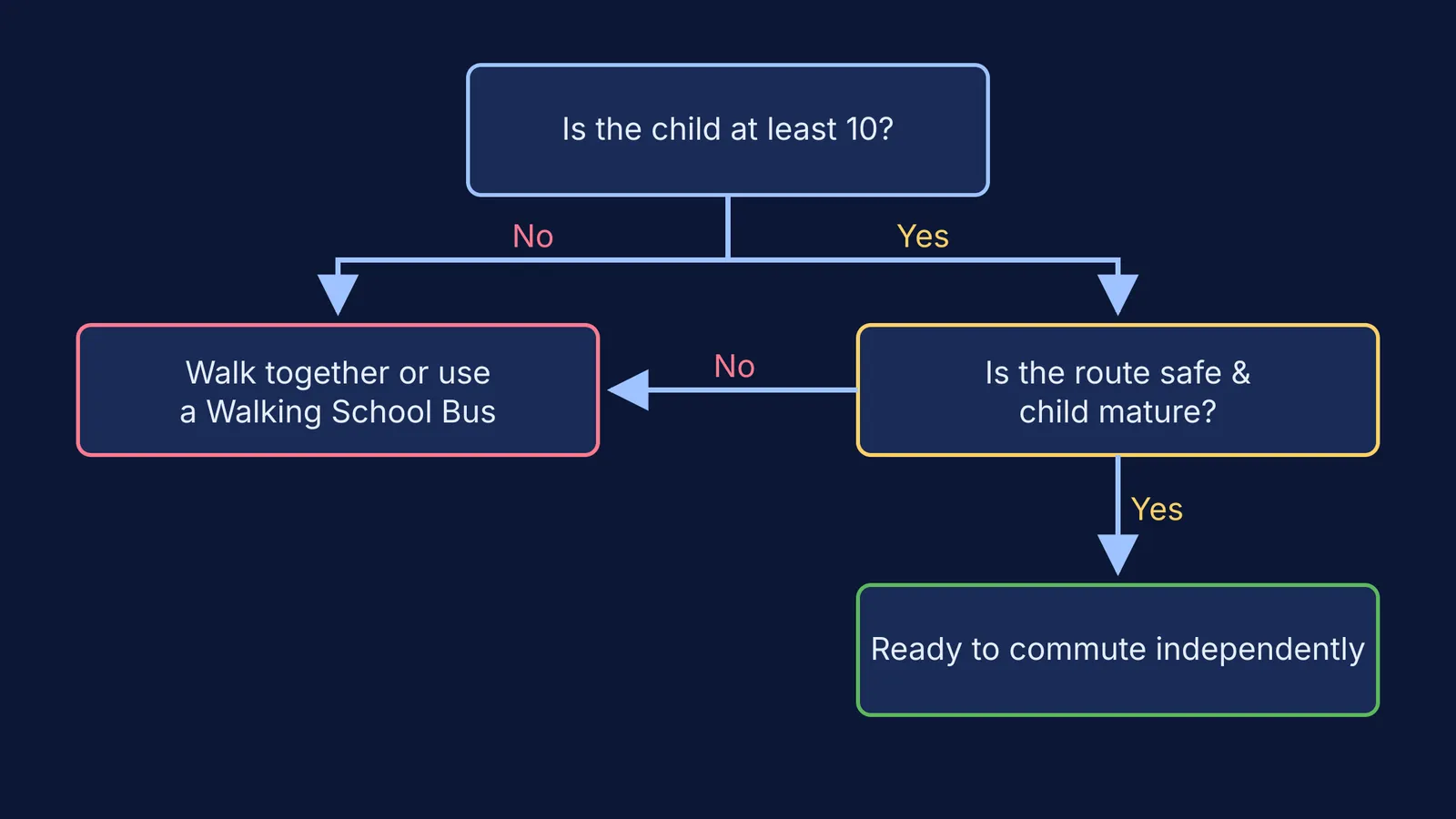
Safety organisations recommend that children should not cross streets alone until they are 10 years old (Safe Kids Worldwide). Before this age, children generally cannot accurately judge the speed and distance of oncoming cars.
Younger children also have less impulse control. They might remember the road rules perfectly at home but forget them the moment a friend calls out from across the street or a ball rolls into the road. By age 10, most children have developed the cognitive skills to navigate complex traffic situations and follow a route reliably.
How does distance and safety affect Indian children?
In India, independent mobility often depends on distance and the built environment. A study of 5,842 children in Hyderabad found that distance is the strongest predictor of how a child travels to school (BMC Public Health). Children living within 1 km were the most likely to walk or cycle.
However, the same study noted that safety remains a significant barrier. Parents must weigh the lack of pedestrian-friendly infrastructure and high traffic density against the benefits of active commuting. In this study, independent walking was often delayed until children reached 11 to 14 years old, as younger children relied on school buses, supervised vans, or adults.
Is your child ready for a solo commute?
Even if your child is 10 or older, they might not be ready for a solo commute. Assess their readiness with these three factors before making a decision:
Maturity and focus: Does your child follow rules consistently at home and school? Can they walk a route without getting distracted by their phone or surroundings?
Route safety: Walk the route yourself. Are there pavements, safe zebra crossings, and crossing guards? High-speed or congested areas might require you to delay independent walking.
Emergency knowledge: Does your child know what to do if they get lost, if a stranger approaches, or if they need help? They should know your phone number and how to identify a safe adult, such as a teacher or police officer.
How to practice the school route?
Independence is built step by step. Start by walking the route together multiple times. Let your child take the lead and make the decisions on when to cross, while you observe their habits. If they make a mistake, gently correct them and try again.
This approach to building confidence applies indoors as well. When children transition to studying independently, they need guided practice before they can manage entirely on their own. Fermi's AI tutor supports this by working out what the student knows and building a plan for the session, holding a line of reasoning so the student is never left stuck without a clear next step.
Once your child shows they can handle the commute safely, you can transition to trailing a few steps behind, and eventually letting them walk with a sibling or friend. You can also help children learn without adding pressure by keeping check-ins light and encouraging open conversations about their day. Over time, these small steps will build a study routine that lasts, whether it is for school safety or academic habits.