On this page
Why do teenagers share their live location?
Smartphones have turned physical presence into a digital status update. On apps like Snapchat, WhatsApp, and Apple Find My, live location sharing allows friends and family to see someone's movements in real time. For teenagers travelling between school, coaching classes, and home, sharing location often starts as a practical coordination tool. It eliminates repetitive check-in messages and lets parents know when an auto-rickshaw or bus commute finishes safely.
Yet social dynamics quickly expand this habit beyond logistics. In a 2026 study published in the Journal of Computer-Mediated Communication, researchers Julie Dereymaeker, Tom De Leyn, Elodie Devos, and Ralf De Wolf conducted 21 focus groups with 147 young people aged 13 to 16. They found that adolescents treat location sharing as an ongoing negotiation of boundaries. While young people value what the authors termed "connective safety"—mutual reassurance among trusted peers—they also expect tracking to remain non-continuous and limited to close friends. When platforms encourage constant broadcasting, peer pressure makes turning location off feel like an anti-social gesture or an admission of secrecy.
What are the risks of continuous location sharing?
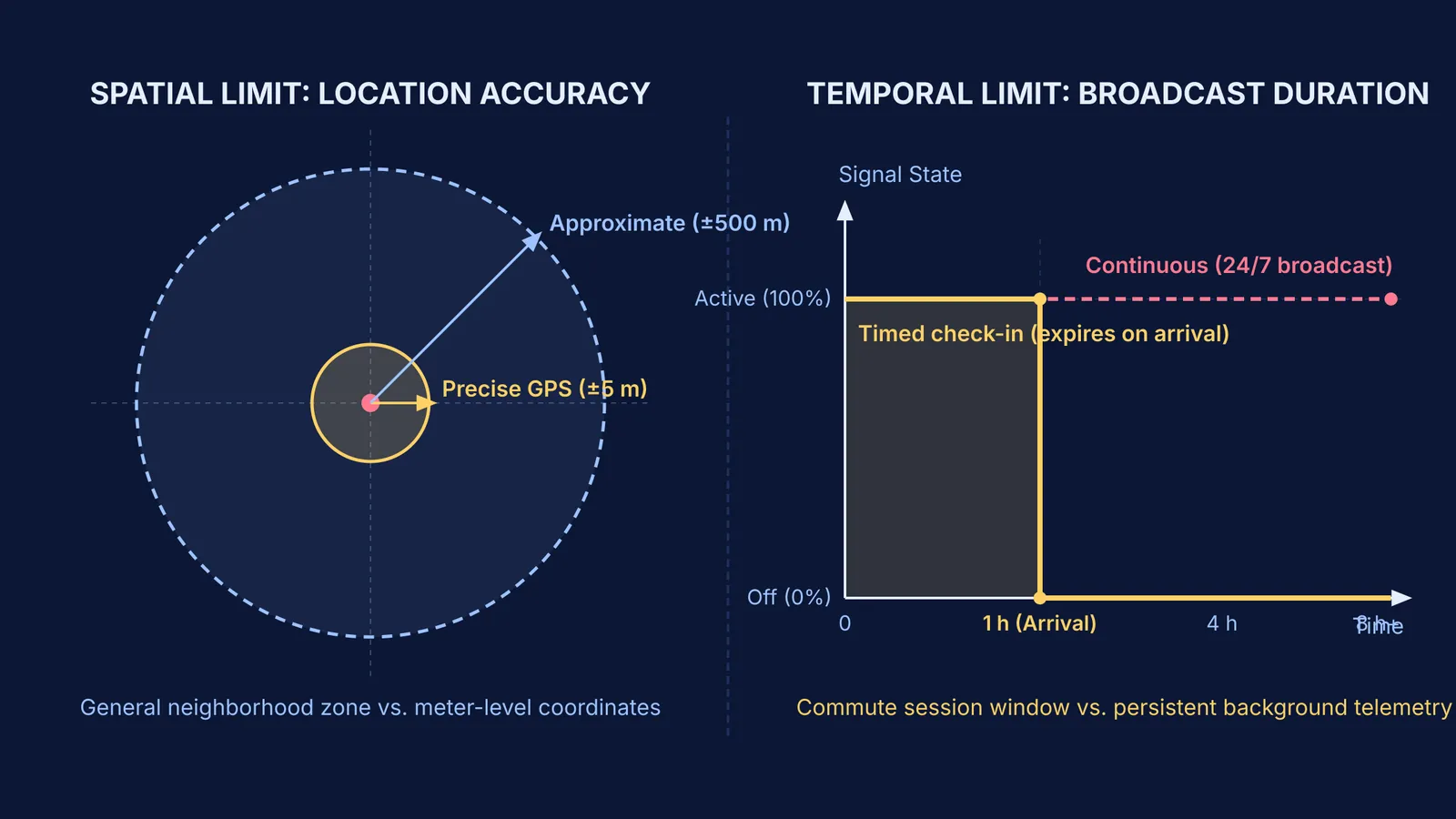
Broadcasting a live GPS signal around the clock creates serious privacy vulnerabilities. Unlike a static map pin showing a meeting point, continuous live tracking logs an adolescent's daily habits: the exact route walked to coaching, time spent at a friend's house, and quiet hours at home. If app visibility is left on "All Friends" or granted background access, that telemetry is accessible to casual acquaintances, distant classmates, and any third party that breaches an account.
Regulatory frameworks increasingly recognize these systemic risks. Under Section 9(3) of India's Digital Personal Data Protection Act, 2023, data fiduciaries face an absolute ban on tracking, behavioural monitoring, or targeted advertising directed at children under 18. Internationally, the UK Information Commissioner's Office enforces a strict geolocation standard under its Children's Code, requiring location tracking for young users to remain off by default and revert to private after each session.
Beyond external security, continuous monitoring can strain family trust. A 2023 investigation by Kaitlyn Burnell and colleagues published in the Journal of Family Psychology found that 51% of surveyed parents used digital location tracking to monitor their adolescents. While parents cited peace of mind, researchers noted that pervasive tracking functions as an electronic tether. Furthermore, a 2024 study of 706 students published in the Journal of Adolescence by Gregory E. Chase and colleagues revealed that 47% had been digitally tracked by a caregiver, and tracked students reported perceiving higher helicopter parenting alongside lower autonomy support. Aligning with autonomy-supportive parenting practices helps teenagers build internal accountability rather than feeling policed.
How should families audit app location settings?
The most effective way to address location sharing is to audit device settings side by side. According to the Children and parents: media use and attitudes report 2024 by Ofcom, 79% of parents of 16- to 17-year-olds have rules about what their children do online, and 49% set firm rules about what personal information their children can share online. Sit down together with the phone and review four specific layers:
Operating system permissions: Open phone settings and review which apps have location access set to "Always Allow". Switch social apps to "While Using the App" or "Never", and disable "Precise Location" for platforms that do not need meter-level accuracy.
Snapchat Snap Map: Enable "Ghost Mode" so your teenager's avatar disappears from the public map. If they choose to share with friends, select "Only These Friends" and prune the list to genuine peers.
Messaging apps: On WhatsApp and Telegram, teach teens to share live location only inside 1-on-1 chats with a 15-minute or 1-hour automatic expiration timer, rather than posting in large group chats.
Background family apps: Review tools like Life360 or Find My. Ensure both parent and teen understand who can view coordinates and agree on when place alerts trigger.
What rules balance teen safety with privacy?
Opening a conversation about location tracking can trigger defensiveness if it feels like surveillance. Frame the discussion around digital footprint management and physical safety rather than mistrust. A practical script might sound like: "I do not need to watch your movements during class or when you are relaxing with friends. Let us make sure strangers and random app contacts cannot track your route either. How about we keep live sharing active only while you are commuting?"
Setting clear boundaries also supports evening academic routines. Constant location pings and map notifications disrupt homework and deep work, reinforcing research on keeping phones off the study desk. When a student arrives home, closing social map apps marks a clean mental shift from public transit to quiet study. Establishing structured family screen time and homework rules protects attention during exam preparation. In an uninterrupted study environment, Fermi's AI tutor can work out what a student already knows and build a plan for the session, guiding them through difficult STEM problems without social distractions. If foundational questions arise in physics or mathematics, the Fermi Concept Library provides structured lessons that clarify where each concept fits into the broader syllabus.
By replacing passive, continuous tracking with conscious, timed check-ins, families preserve essential safety lines while respecting an adolescent's growing independence.