On this page
If your child finishes homework in fifteen minutes and is out of the door before you can look at it, they are not being lazy. When play begins the moment homework ends, every minute saved is a minute of play earned, and the easiest minutes to save are the ones spent checking.
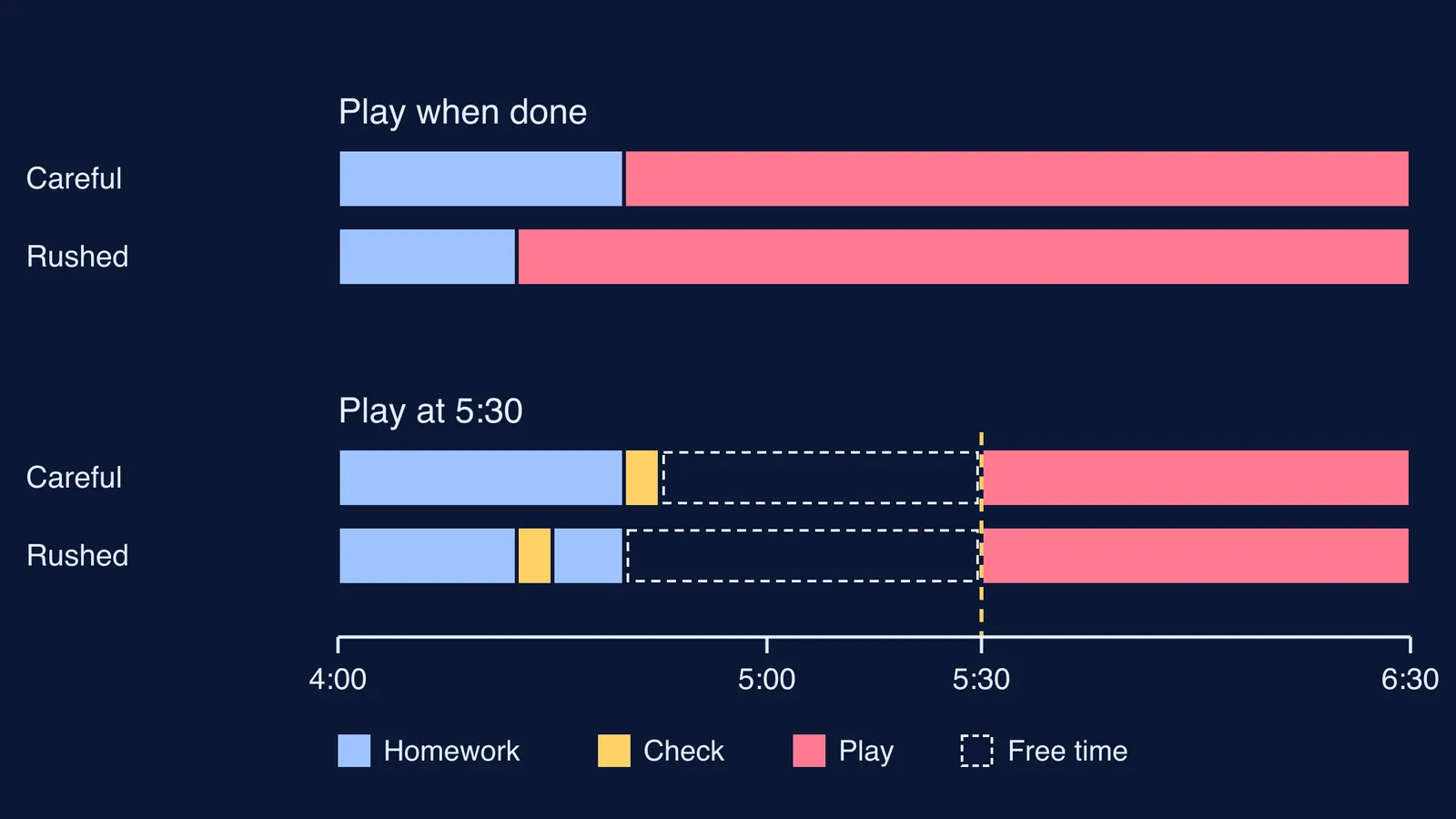
The fix has two parts: a short quality check the child does before play, and a play time fixed on the clock, so finishing early earns nothing extra.
Why does my child rush through homework to go and play?
Speed and accuracy pull against each other. A review in Frontiers in Neuroscience describes the speed-accuracy tradeoff as one of the most ubiquitous effects in behaviour, seen in everything from insects to primates (Heitz, 2014). Tell a child "finish, then play" and you have given them a reason to choose speed.
There is a motivation cost too. A meta-analysis of 128 studies found that rewards given for completing a task undermined intrinsic motivation, and that tangible rewards tended to be more harmful for children than for college students (Deci, Koestner and Ryan, 1999). Play is not a sticker, but when it becomes the prize for being done, homework turns into the thing standing between your child and the prize.
Play itself is not the problem. The WHO says children aged 5 to 17 need at least 60 minutes of moderate to vigorous-intensity aerobic activity every day (WHO India). The goal is to stop play depending on speed, not to shrink it.
Rushing can also be a signal. A child may scribble anything to escape work that is far too hard, or race through work that is far too easy. If your problem is the opposite, see our guide on what to do when homework takes too long.
How do you set a fixed play time so rushing gains nothing?
Pick a play time on the clock, say 5:30 pm, and keep it the same on school days.
Homework and the quality check come before it. Start early enough that careful work fits with room to spare.
If the child finishes early, the gap goes to something calm: a storybook, drawing, helping set the table. Not extra worksheets, because punishing speed with more work teaches dawdling instead.
If work is not finished by play time, play still starts on time, and the rest is finished afterwards, before dinner. Neither racing nor dragging changes when play begins.
Give it two weeks before you judge it. Children test new rules.
Whether play should come before or after homework depends on the child; our post on homework before or after play time weighs both orders.
What is a quick quality check before play?
The check should take about five minutes and be done by the child, not by you. Three questions:
Did I answer every question, including the back of the page?
Can I check two answers a different way? In maths, put the answer back into the sum or estimate it. In writing, read one paragraph aloud.
Could my teacher read this without guessing?
If the check finds a mistake, the child fixes that one item. For maths slips in particular, our piece on silly mistakes in maths has more checks sorted by type of error.
Here is a worked example. Take a Class 5 child with ten fraction sums and a short paragraph to write. Under "play when done", they finished in 25 minutes with three sums wrong and were outside by 4:25. Under the new plan, play is at 5:30. On day one they rush anyway and finish by 4:25. The five-minute check catches two sums where they added the denominators, and fixing them takes about ten minutes. Then they read until 5:30. Within days, rushing stops paying, and the work settles into a calmer 40 minutes.
What should I say to my child?
Keep it short, and say it before homework starts, not in the middle of an argument:
"From today, play is at 5:30, whether homework takes you 20 minutes or an hour."
"Before you go, you do the three-question check. I will only look at whether you did it."
"If you finish early, you can read or draw until 5:30."
When they catch their own mistake: "You found that yourself. That is the check doing its job."
With older children, rushing often hides a gap: they race past the questions they do not understand. The Fermi Concept Library has a lesson for every concept in physics, chemistry, biology, mathematics and computing, so a stuck student has somewhere to look instead of guessing.
Tonight, pick the play time and put the three questions on the fridge.