

On this page
Why do left-handed children struggle with handwriting?
Watching a left-handed child write can look exhausting. Their wrist curls inward into a hook, knuckles graze fresh ink, and hand cramps set in within minutes.
These difficulties are mechanical rather than neurological. In a landmark meta-analysis in Psychological Bulletin covering over 2.3 million individuals across 262 datasets, Dr. Marietta Papadatou-Pastou and colleagues determined that 10.6% of the world is left-handed, with males 23% more likely to be left-handed than females. Yet standard classrooms and scripts are engineered for the other 89.4%.
In left-to-right scripts like English and Hindi, right-handed writers pull the pen across paper, trailing behind wet ink. Left-handers must push the pen, creating friction against paper fibres and obscuring newly written words.
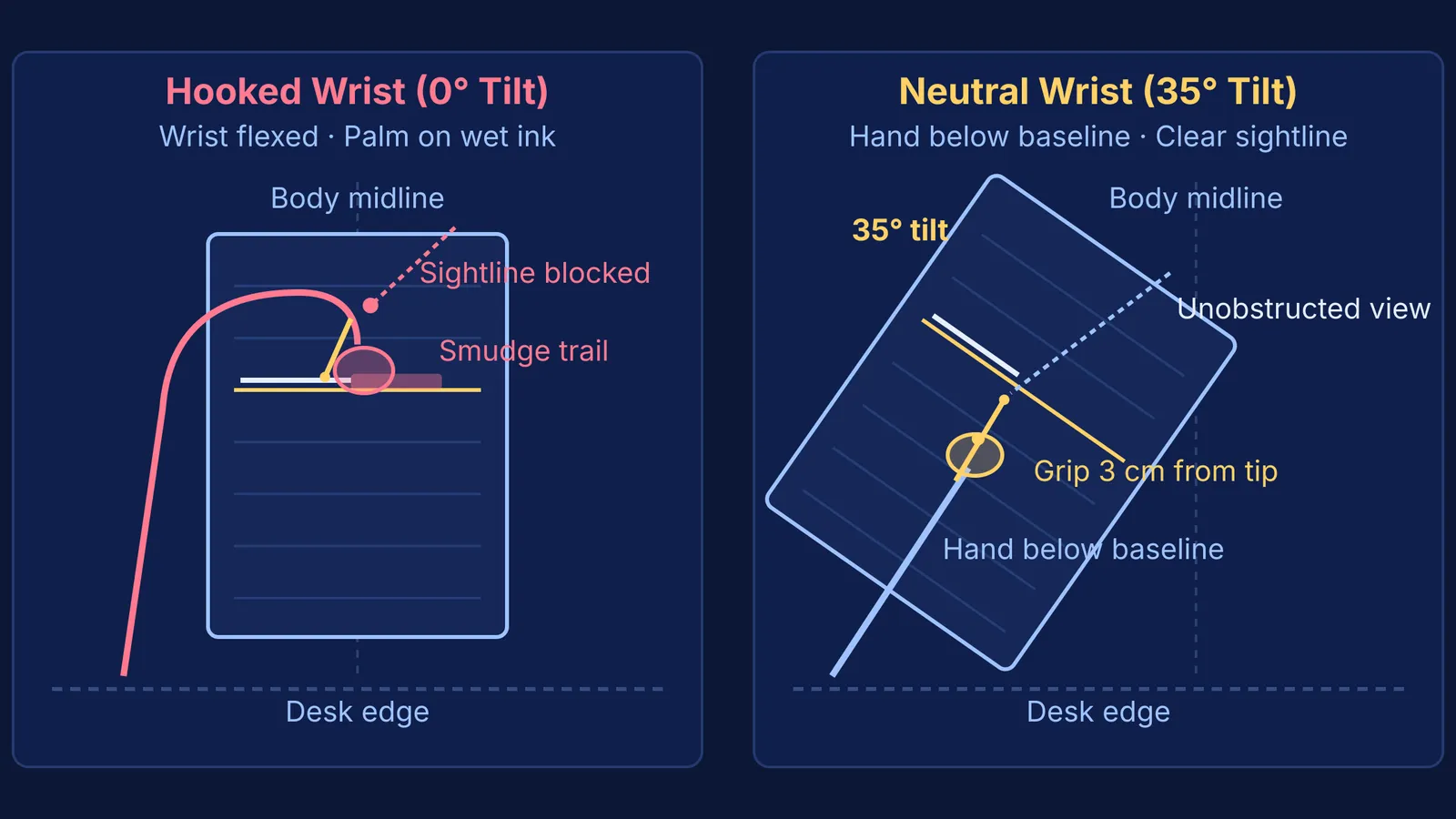
To see their work and avoid smudging, children curl their wrist above the writing line. In a study of 1,848 young men published in Neuropsychologia00047-1), Thomas Teasdale and David Owen found that 51% of left-handers adopted an inverted or hooked posture as an adaptive workaround. As Michael Peters and John McGrory established in Brain and Language90127-1), left-handers who adopt an inverted posture show no deficit in fundamental motor performance compared to non-inverted writers and right-handed peers.
How should a left-handed child position their paper and wrist?
Paper angle is the single most critical adjustment for left-handed writers. According to guidelines from the National Handwriting Association, children should tilt their paper clockwise by 30° to 45°, so the top right corner points down toward their torso.
Tilting the page delivers three immediate corrections:
It aligns the writing line with the forearm's natural arc, allowing the arm to pivot from the elbow rather than cramping the wrist.
It positions the hand below the baseline ("underwriting"), keeping the palm off wet ink.
It opens a direct sightline over the knuckles, eliminating the need to hook the wrist.
The page should sit 5 to 10 cm to the left of the child's body midline so the elbow does not pin against the ribs.
Grip height matters just as much. Right-handers comfortably hold a pencil 1.5 cm from the point, but left-handers need 2.5 to 3.8 cm of clearance so their fingers do not block their view of the tip.
Which pens, pencils, and seating setups work best?
Stationery and classroom seating adjustments eliminate everyday friction:
Pen selection: Avoid wet fountain pens and scratchy fine-point needles. Fast-drying gel pens or low-viscosity hybrid ballpoints prevent smudging as the hand moves.
Pencil hardness: Soft 2B graphite smudges easily under warm palms; standard HB pencils lay down clean, smudge-resistant lines.
Notebooks: Left-sided spiral bindings press painfully into left wrists. Opt for top-bound pads or stitch-bound notebooks.
Bench seating: On shared double desks common in Indian schools, seat the left-handed student on the far left to prevent elbow clashes with right-handed peers.
Lighting: Position study lamps on the right side so the writing hand does not cast a dark shadow over the active line. A properly arranged desk, as detailed in our home study space checklist, protects posture during long sessions.
Clear handwriting makes note review far more effective, a link confirmed by research on handwritten notes versus typing. When revising complex STEM concepts, students can consult the Fermi Concept Library, which organizes every concept across physics, chemistry, biology, and maths into clean, visual lessons. When working through complex numerical problems, Fermi's AI tutor can work out what a student already knows and build a plan for the session, letting them reason without scrambling on messy scratchpads.
What should parents and teachers say instead of forcing a change?
Pressure to switch hands remains common, yet neuroscience demonstrates it causes lasting friction.
In a brain-imaging study in The Journal of Neuroscience, Dr. Hartwig Siebner and colleagues found that adults forced in childhood to write with their right hand retained abnormal bilateral cortical activation decades later. Forcing a switch burdens the motor system with ongoing suppression. Parents can best support their child by helping them learn without pressure.
Use these practical scripts to advocate for your child:
To teachers: "My child writes left-handed. Tilting their paper 35° clockwise and seating them on the left side of the bench prevents elbow bumps and keeps their writing clear."
To relatives: "Handedness is hardwired in the brain. Forcing a right-hand switch creates motor stress. With proper paper tilt, left-handed writing is smooth and painless."
To your child: "Your handwriting is not messy; the paper was just at the wrong angle. Let us tilt the page and hold the pencil a little higher."


