On this page
Every parent loses their temper sometimes. Whether it is a dispute over household chores, finances, or differing approaches to discipline, tension inevitably surfaces in close quarters. For a child listening from another room or standing quietly in the doorway, the sound of raised voices can be alarming.
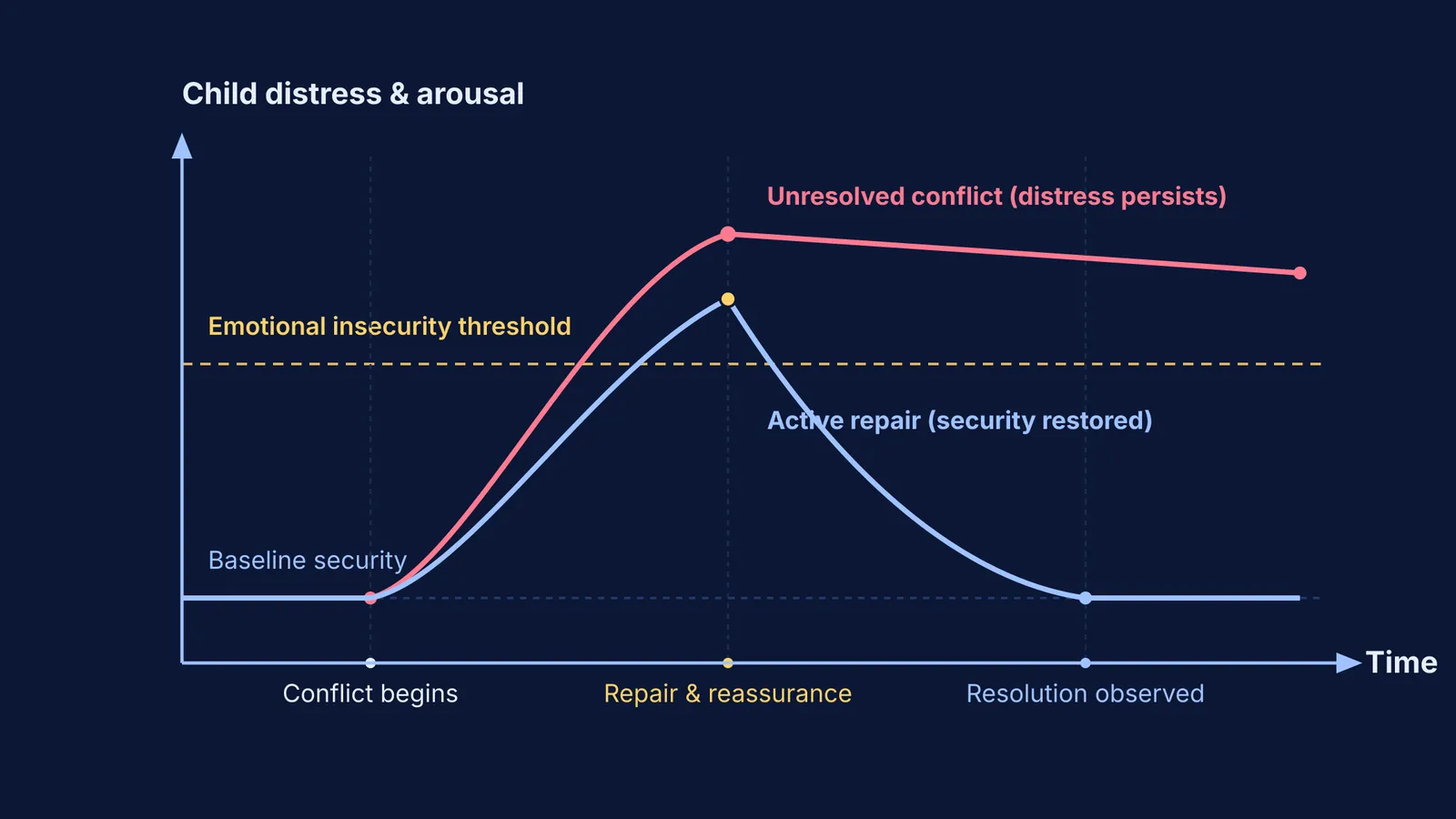
The good news from developmental psychology is that children do not need parents who never disagree. What shapes their emotional well-being is not the presence of disagreement, but the tone of the conflict and whether they witness a genuine repair.
Why does parental conflict affect children so deeply?
To understand how arguments register with young minds, researchers point to Emotional Security Theory. In a 2003 diary study in Child Development, E. Mark Cummings and colleagues tracked 116 families across 1,638 maternal and 1,281 paternal conflict reports to assess children aged 8 to 16. The team found that distressing conflict tactics, including verbal hostility, personal insults, defensiveness, and marital withdrawal, provoked pronounced fear and emotional insecurity in children. Conversely, constructive tactics such as calm discussion, mutual support, and affection preserved emotional stability.
Children are natural emotional barometers. When adults express hostility without resolving it, children perceive a direct threat to the safety of their home. A subsequent 2007 investigation in the Journal of Family Psychology analyzing 578 home conflict reports across 102 mothers and 163 children demonstrated that specific endings matter: compromise and sincere apologies significantly reduce sadness and fear, restoring a child's confidence in family stability.
Furthermore, children frequently misinterpret adult disputes. In their 1990 cognitive-contextual framework, John H. Grych and Frank D. Fincham showed that children routinely engage in self-blame during parental discord. If parents argue about tuition expenses or household strain, younger children and adolescents often assume their own behavior or school results caused the rift.
What should you say immediately after an argument?
When an argument flares up in front of your child, silence or pretending nothing happened makes anxiety worse. Children sense lingering tension even when voices stop. Implementing a four-step repair process helps re-establish safety.
Regulate your own nervous system. Take several deep breaths and step back before trying to explain the disagreement.
Reassure directly. State clearly that both parents are safe, the relationship is intact, and the dispute is not their fault.
Repair the rupture. Apologize for raising your voice or speaking harshly, and let them see that you and your partner respect each other.
Reconnect. Spend five minutes engaging in a normal, calm interaction, such as making a cup of tea or checking on homework.
Here is an effective script to use with younger children aged 6 to 11: "You heard Mummy and Papa arguing just now, and our voices were loud. We were disagreeing about an adult problem, but we are okay, and we love each other. Most importantly, this argument was not about you, and you did nothing wrong. It is our job to work it out, and we are doing that right now."
For teenagers aged 12 to 18, who often pick up on subtle undertones: "You noticed the tension between us earlier. We got frustrated and handled that conversation poorly, but it is an adult disagreement between the two of us. We are working on a solution together. You do not need to take sides or carry this worry, and our home is safe."
How can parents fight fair and resolve disputes constructively?
Conflict itself is not inherently destructive; it can model healthy negotiation when managed with clear boundaries. In physiological studies published in the Journal of Personality and Social Psychology, John Gottman and Robert Levenson found that during heated marital conflicts, heart rates regularly exceed 100 beats per minute. This state of diffuse physiological arousal, or flooding, severely impairs cognitive processing and eliminates the capacity for empathetic listening and calm problem-solving.
To keep disagreements constructive, adopt three practical rules:
Call a 20-minute time-out. Gottman observed that human physiology requires at least 20 minutes for heart rates and cortisol levels to return to baseline after flooding. Agree on a stop word and separate temporarily to cool down before resuming.
Ban contempt and withdrawal. Eye-rolling, name-calling, and stonewalling are especially frightening for observing children. Focus strictly on the specific issue rather than character flaws, keeping family discussions respectful.
Never triangulate. Do not ask a child to deliver messages to your spouse, choose a side, or act as an emotional confidant.
When household tension lingers, students preparing for crucial school and entrance exams often struggle to concentrate. Understanding how to help children learn without adding pressure and creating a quiet, dedicated study space buffers them from daily household friction. In addition, Fermi's AI tutor works out what a student already knows and builds a plan for the session, offering an independent, steady learning routine when surrounding environments feel unsettled.
When does conflict require outside support?
Disagreements become harmful when they turn into chronic hostility, intimidation, personal insults, or silent withdrawal that lasts for days. If family conflict feels overwhelming, or if a child shows persistent signs of distress such as withdrawal, changes in sleep, or academic drop-offs, professional guidance can help. Reviewing practical strategies for recognising signs of severe stress in teenagers is a helpful starting point.
In India, confidential support is accessible at any time. The Ministry of Health and Family Welfare provides free 24/7 tele-counseling through Tele MANAS at the toll-free number 14416. For institutional child protection and family rights, official resources are also available through the National Commission for Protection of Child Rights. Reaching out for professional mediation is a constructive step toward protecting your family's emotional foundation.
Repairing after a disagreement does not mean pretending you will never fight again. It demonstrates to your child that misunderstandings can be resolved with accountability, patience, and care.