

On this page
It is a common parenting fear: your child starts spending time with a new friend, and suddenly their attitude or study habits change. The immediate instinct is to step in and put a stop to the friendship before the negative peer influence becomes permanent.
However, research shows that how a parent responds to a "bad influence" determines whether a child simply hides the friendship or learns how to make better social decisions for themselves.
Why do parents worry about bad influences?
Peer influence peaks during early adolescence, when a child's need for social compatibility often overrides their internal judgment. If a friend routinely skips homework or engages in risky behaviour, parents rightly worry that their child will adopt the same habits to fit in. During these years, teenagers are hardwired to look to their friends for cues on how to behave, dress, and speak. When a friend introduces negative language or a dismissive attitude toward school, the child may simply be trying on a new persona to secure their place in the social hierarchy.
But stepping in directly can trigger psychological reactance—the urge to restore freedom when it feels threatened. This is why a direct confrontation about a friend often leads to slamming doors rather than a change in behaviour. The child feels their independence is under attack and may defend the friend aggressively just to prove a point.
What happens when you ban a friend?
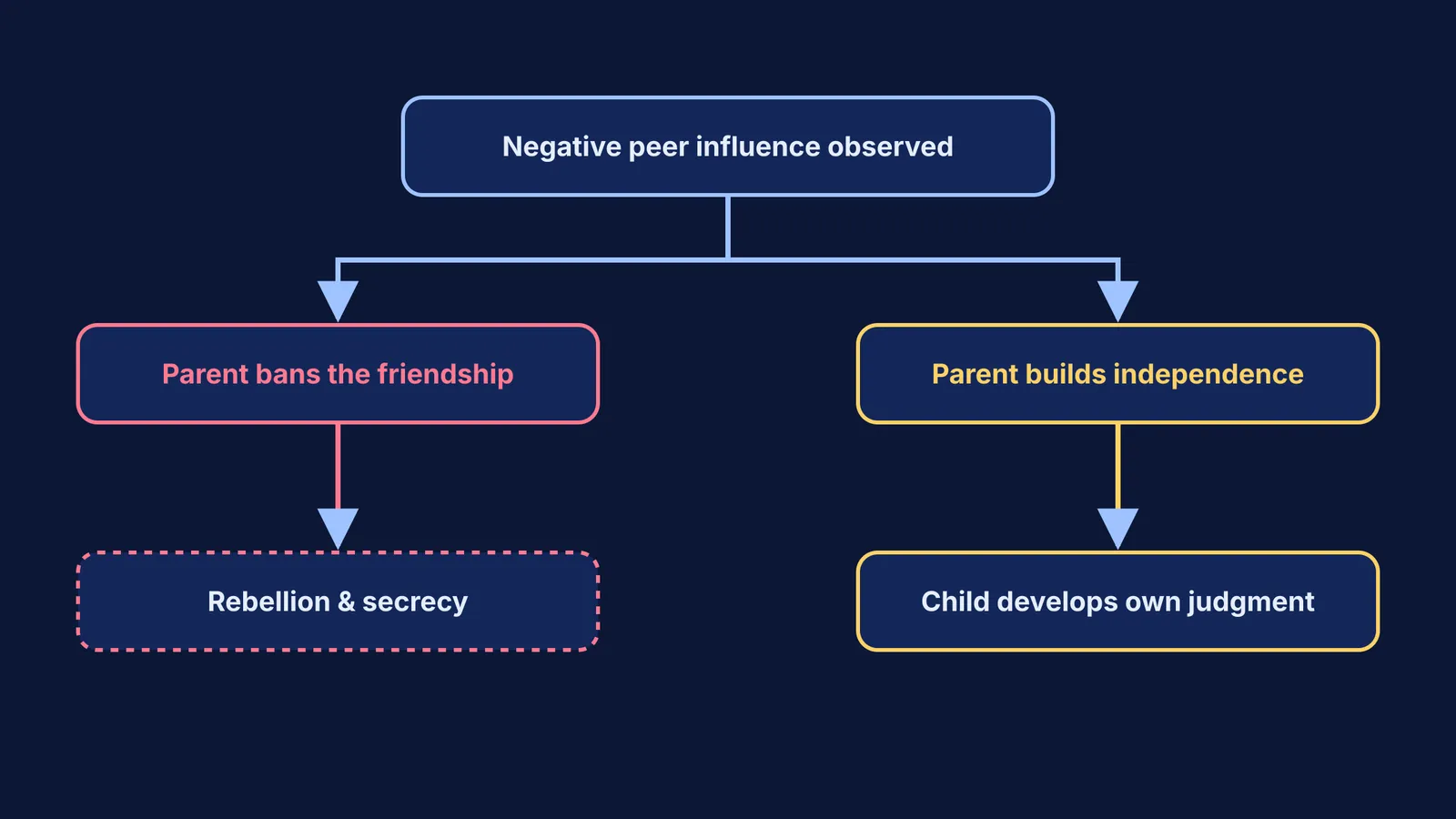
It is tempting to simply forbid the friendship. A 2026 study led by Brett Laursen at Florida Atlantic University tracked 394 students and found that mothers are remarkably effective at ending friendships they disapprove of. The study noted that mothers often act as "relationship hitmen" when they disapprove, making the friend feel unwelcome and weakening the bond until the friendship collapses.
But this heavy-handed approach comes with a cost. While the specific friend might be removed, the child is left socially isolated. The researchers warned that maternal interference in friendships is linked to subsequent emotional problems and potential rejection by the broader peer group. Prohibiting friendships can also backfire, driving the adolescent to spend more time with the friend in secret and increasing the likelihood of delinquent behaviour.
How to handle a bad influence friend?
Instead of issuing verdicts on specific friends, developmental psychologists recommend an approach that builds independence. A 2006 study led by Joseph Allen highlighted that adolescents who learn to assert their own point of view with their parents are less likely to succumb to negative peer pressure.
Get to know the friend Invite the friend to your home. Observing them in your own environment allows you to see the dynamic first-hand and gives you a chance to be a positive, welcoming presence. It is much harder for a child to dismiss your concerns if they see you have made a genuine effort to know their friend.
Focus on specific behaviours Instead of attacking the friend's character, address the changes in your child's behaviour. If their grades are dropping, discuss the routine itself rather than blaming the friend directly. A teenager will quickly tune out criticism of their peers, but they will find it much harder to argue against objective facts, such as a missed curfew or a failed assignment.
If a disrupted routine means your child is falling behind and does not know where to start, Fermi's AI tutor works out what they already know and builds a plan for the session. Giving them a structured way to catch up restores their confidence and makes them less reliant on peer validation. Academic confidence often translates into social resilience, giving them the breathing room they need to step away from a demanding friendship.
A script for discussing peer influence
Rather than telling a teenager what to do, try asking questions that prompt them to evaluate the friendship themselves. If you are studying together, asking the right questions—similar to helping your child with maths word problems—encourages them to think critically rather than just taking orders. You want them to articulate the problem out loud, which requires patience and a willingness to listen without immediately offering a solution.
Instead of saying: "I don't want you hanging out with Rahul." Try: "I noticed you skipped your homework to play video games with Rahul. What is your plan to catch up?"
Instead of saying: "He is a bad influence." Try: "How do you feel about yourself when you are with that group?"
Instead of saying: "You are banned from seeing him." Try: "You can hang out with him here at our house, but I am not comfortable with you going to the mall unsupervised right now."
Ultimately, a warm, supportive home environment is the most effective buffer against negative peer pressure. When children feel secure in their family relationships, they are less desperate to seek approval from the wrong crowd.


