

On this page
The morning school run is often the most chaotic part of the day. When a child forgets which day requires the sports uniform or a specific science project, it can lead to tears, frustration, and a frantic scramble to the door. For parents, it feels like a daily battle against forgetfulness.
Why does my child forget which day is sports uniform?
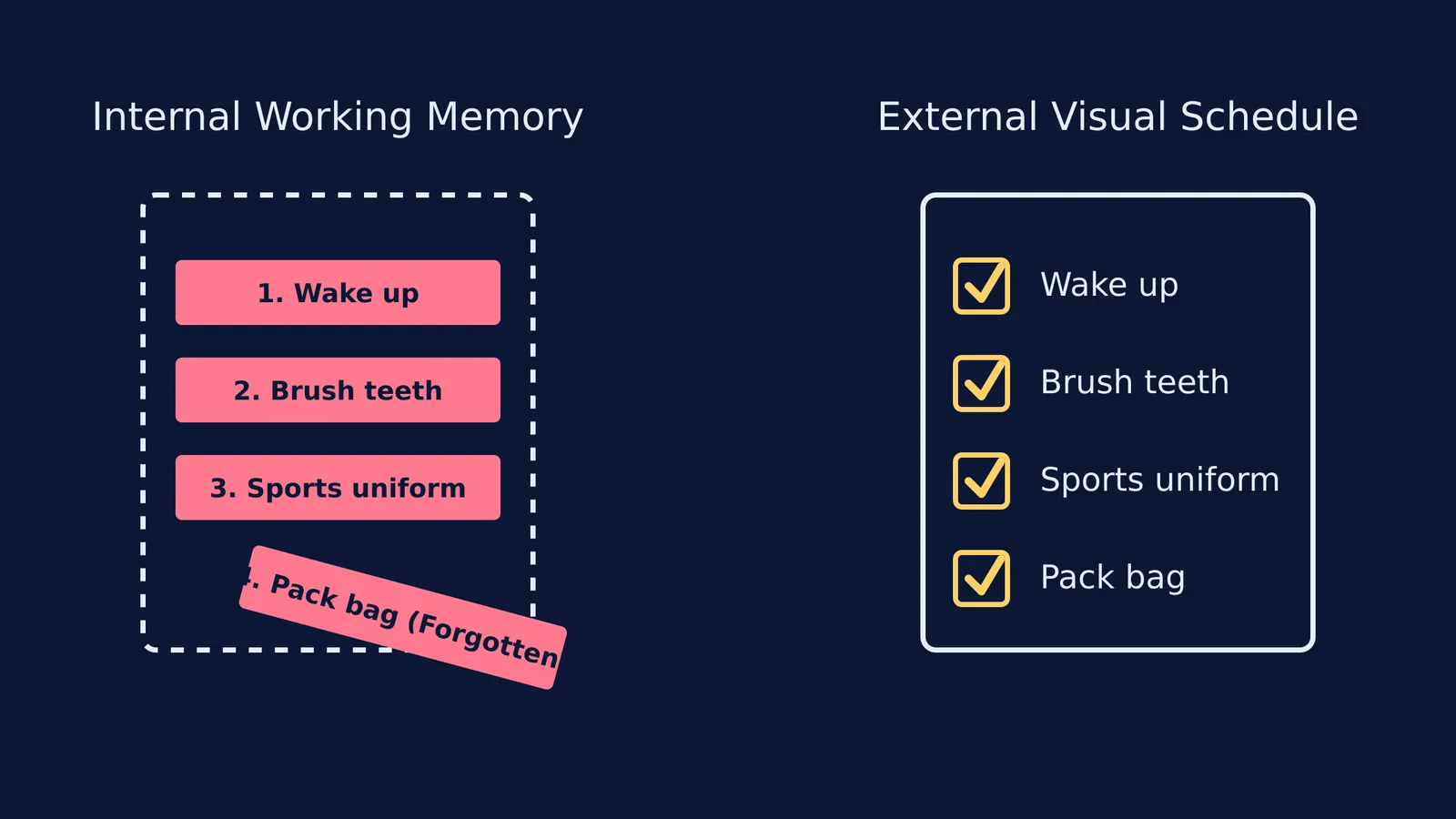
The brain's ability to hold multi-step instructions—such as "brush your teeth, put on your sports uniform, and pack your bag"—relies entirely on working memory, a core component of executive function. Working memory acts as the brain's temporary workspace. However, for a young child, the capacity of this workspace is remarkably small. If you give them three tasks, the third task often pushes the first one out of their awareness. By the time they have finished brushing their teeth, the instruction about the sports uniform has completely evaporated.
A 2026 meta-analysis in the Journal of Experimental Child Psychology reviewed 12 studies to understand how structured environments affect this development. The researchers found that the structure of formal schooling acts as a global training program, improving children's executive functions with a small but robust effect size (g = 0.24) [[1]](https://doi.org/10.1016/j.jecp.2025.106371). School environments provide this structure through predictable, highly visible routines. At home, parents can replicate this environment by offering "external executive function" so their child does not have to hold the entire sequence in their head.
How do visual schedules act as external working memory?
Instead of repeating yourself every five minutes, you can externalize the sequence of the morning routine. A visual schedule pinned to the bedroom door or bathroom mirror removes the cognitive load of deciding what comes next, replacing a fleeting verbal command with a permanent environmental cue.
Keep it visual: Use simple icons—a toothbrush, a red uniform for PE day, a backpack—rather than long, intimidating text lists.
Make it interactive: Let your child check off items or move a physical slider as they complete each step. This physical action provides a sense of closure and builds momentum.
Redirect, do not nag: When your child inevitably gets distracted, ask, "What does the schedule say?" rather than barking the next instruction. This shifts the dynamic from a parent giving orders to the child checking the schedule themselves.
Can packing the night before reduce morning stress?
A structured evening routine is perhaps the most effective way to eliminate morning stress. By moving the preparation to the night before, you shift the decision-making away from the groggy, time-pressured morning and into a calmer part of the day.
Create a "launchpad" near the front door. This is a designated physical space where everything needed for the next day is gathered before bedtime. Pack the backpack with all homework and forms, and lay out the complete uniform—including shoes and socks. This buffer protects your child from the panic of searching for a missing sports shoe five minutes before the bus arrives. A clean workspace and a fully packed bag also mean they start the next afternoon's study session without the friction of a messy room.
How can you hand responsibility to the child?
If a chaotic morning leaves your child too drained to focus later in the day, a clear evening plan acts as a powerful reset. By managing their cognitive load early, they have more energy for challenging academic tasks later.
When they sit down to physics or maths and do not know where to start, Fermi's AI tutor steps in by working out what they already know and building a plan for the session. This targeted support mirrors the structure of a good visual schedule, removing the anxiety of the unknown. Furthermore, for students who get stuck on multi-step tasks, breaking problems down is a highly trainable skill. The Fermi Problem Library offers worked problems with a step-by-step solver that explains the reasoning rather than printing an answer.
Training your child to follow a schedule gives them the tools to tackle their own learning with confidence and independence. How parents can help children learn without adding pressure explores this balance further. For more ways to support your child, read about Alan Baddeley's working memory model, explained for students or explore Exam season at home: routines that help the whole family.


