On this page
A fail in Class 9 feels big. It is also early: with more than a year before the Class 10 board exams, there is time to find the gap and fix it.
What should you say first when your child fails a subject?
Wait until the first upset has passed for both of you, then talk somewhere private, without siblings or phones.
Your child may notice how you react to failure more than what you believe about ability. In a 2016 study in Psychological Science, Kyla Haimovitz and Carol Dweck found that children could accurately perceive their parents' views of failure but not their views of intelligence. Parents who saw failure as debilitating tended to focus on their children's performance and ability rather than their learning, and those children tended to see intelligence as fixed.
A first conversation that keeps the focus on learning might sound like this:
“I've seen the result. I'm not angry, and we're going to sort this out together.”
“Walk me through the paper. Which questions felt hard, and which ones did you know but still lose marks on?”
“Let's meet your teacher together and make a plan.”
Leave out comparisons with siblings or cousins, and don't decide on tuition, punishments or phone bans in this first talk. There is more in our guide to talking about failure at home.
If your child seems persistently low, stops sleeping or eating normally, or talks about feeling hopeless, speak to the school counsellor or a doctor. Tele MANAS, the national mental-health helpline, offers free counselling on 14416.
How do you find out what went wrong?
Ask the school for the marked answer sheet, then sort every lost mark into one of four piles:
Didn't know it: a concept your child never understood.
Wrong method: knew the topic but set the question up wrongly.
Slips: arithmetic, copying or sign errors.
Didn't attempt: ran out of time or left it blank.
Then look beyond the paper. In the CBSE Class 9 mathematics curriculum for 2026-27, the year-end paper carries 80 marks and internal assessment carries 20: 10 for pen-and-paper tests and multiple assessment, 5 for the portfolio and 5 for lab practicals. Missed tests or an empty portfolio can pull a borderline result down. The same document gives geometry 25 of the 80 paper marks, the largest single unit, so a gap there costs far more than one in coordinate geometry, worth 4.
Take the sorted paper to the teacher. Ask which topics the class builds on next, and whether any internal assessment can be made up. Our list of questions to ask at a parent-teacher meeting helps you prepare, and how to read a report card explains the grades and remarks.
What does a term plan to rebuild the subject look like?
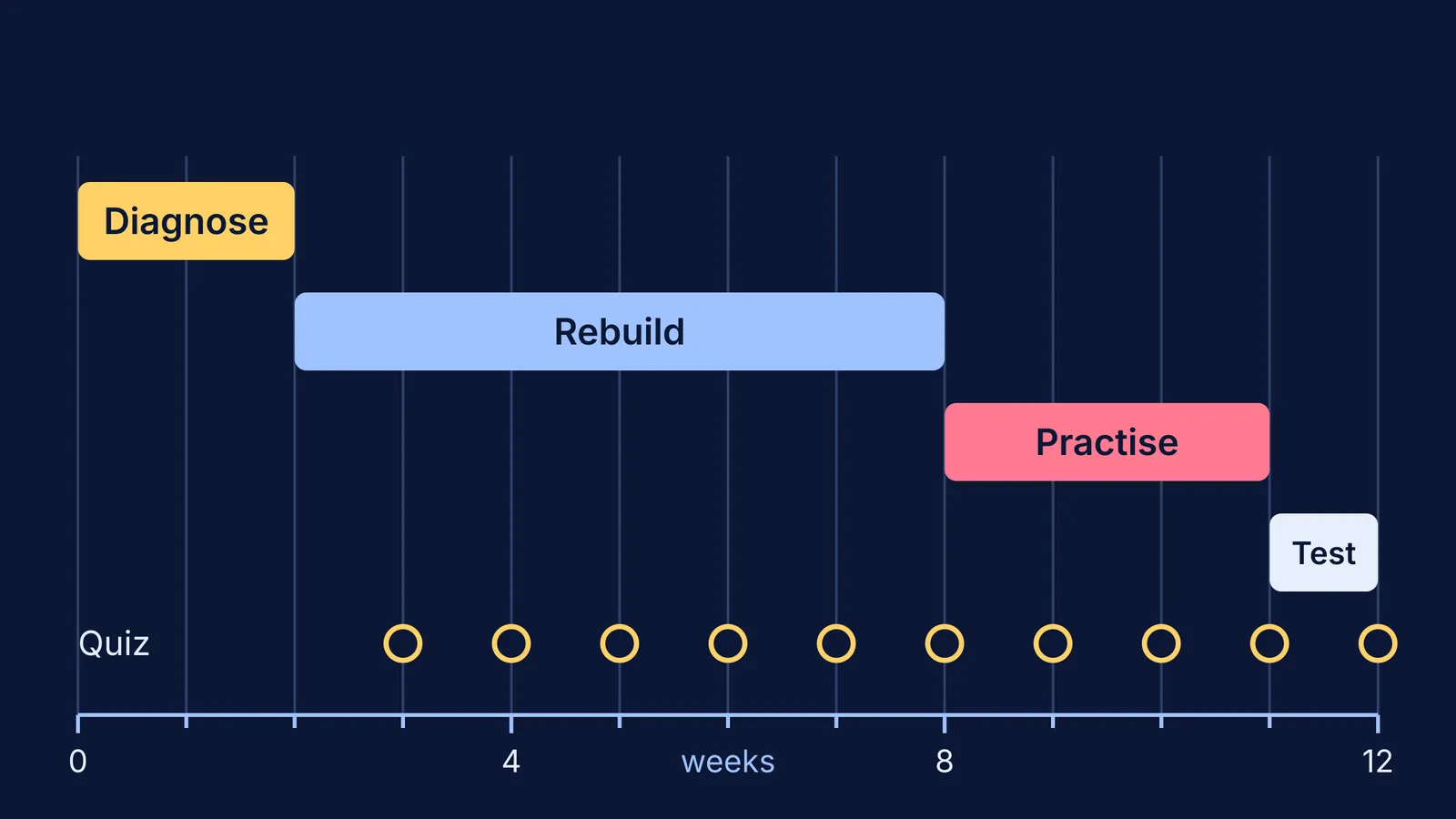
Pick one subject and give it about 12 weeks, 30 to 40 minutes on five days a week:
Weeks 1-2, diagnose: sort the paper, meet the teacher, finish any pending portfolio or lab work.
Weeks 3-8, rebuild: one topic a week from the “didn't know it” pile, earliest topic first. In maths, lines and angles come before congruent triangles.
Weeks 9-11, practise: mixed, timed questions from the NCERT textbook and exemplar, marked by your child against the solutions.
Week 12, test: one full paper under exam conditions, sorted into the same four piles.
From week 3, end each week with a ten-minute quiz from memory on that week's topic plus an older one. This is retrieval practice. In Roediger and Karpicke's 2006 experiments, students who took recall tests remembered more of prose passages two days and one week later than students who reread them, even though rereading made them feel more confident.
What does the plan look like for one student?
Take a made-up student, Meera, who scored 24 of 80 on her Class 9 maths half-yearly paper. Sorting the 56 lost marks showed 24 on geometry questions left blank, 16 on linear equations set up wrongly, 8 on slips and 8 on questions she ran out of time for. Her teacher also mentioned two missing portfolio pieces.
So Meera finishes the portfolio in weeks 1-2. Weeks 3-6 rebuild geometry from lines and angles upwards, and weeks 7-8 cover linear equations with every step written out. A 30-second check after each answer targets the slips.
How much should you help at home?
Less teaching, more structure. A meta-analysis of 50 studies on middle-school students by Nancy Hill and Diana Tyson found parental involvement was positively linked to achievement, with the exception of help with homework. Involvement that reflected what the authors call academic socialisation had the strongest positive link.
In practice: protect the study slot, ask what the weekly quiz showed, keep the teacher updated, and talk about why the subject matters for what your child wants to do later.
Between lessons, when your child is stuck on a method, the Fermi Problem Library has worked problems with a step-by-step solver that explains the reasoning rather than printing an answer.
Your first step: ask for the answer sheet this week.